Protect every contract milestone — surety bonds as the trusted guarantee India's infrastructure build-out demands
From ₹111 lakh crore NIP projects to SME subcontracts — Ministry of Finance-approved bond insurance that replaces bank guarantees without freezing your working capital.
India is building at a pace unseen since Independence. The National Infrastructure Pipeline (NIP) targets ₹111 lakh crore in capital expenditure through 2025, covering highways, railways, airports, ports, power plants and smart cities. Every one of those projects runs on contractual guarantees — and for decades, those guarantees came exclusively in the form of bank guarantees, tying up enormous chunks of a contractor's working capital. In August 2022, the Ministry of Finance changed that forever when it allowed public sector undertakings to accept insurance surety bonds as a valid substitute. For Indian contractors, developers and project owners, understanding surety bonds is no longer optional — it is a competitive necessity.
What Is a Surety Bond?
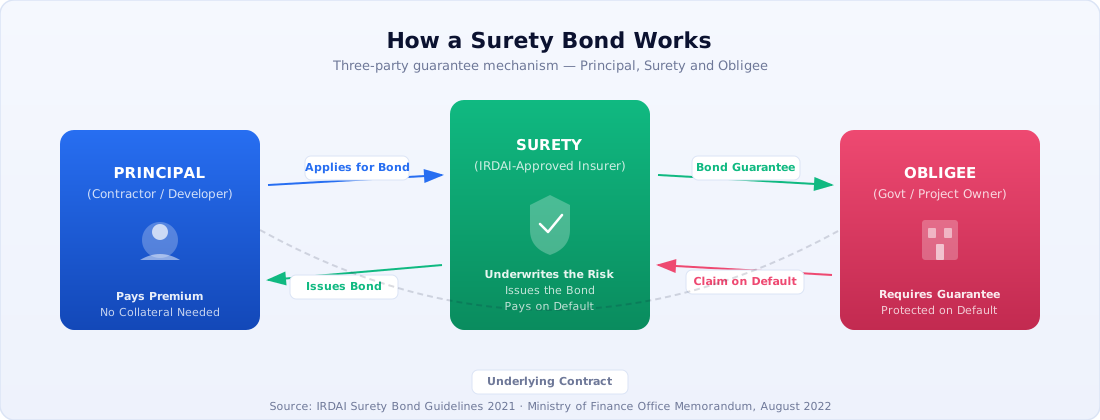
A surety bond is a legally binding, three-party guarantee contract. The three parties are the Principal (the contractor or business obliged to perform), the Obligee (the project owner, government body or client who requires the guarantee), and the Surety (the insurer who backs the Principal's promise to the Obligee). If the Principal fails to meet its contractual obligation — misses a milestone, abandons a project, or cannot repay an advance — the Surety steps in and compensates the Obligee up to the bond's stated limit.
Unlike a bank guarantee, a surety bond is an insurance product regulated by IRDAI under the Insurance Act 1938. The Principal pays a premium (typically 1–3% of the bond value per annum) rather than blocking cash collateral in a fixed deposit. The Surety's liability is finite and defined in the bond document. This makes surety bonds dramatically more capital-efficient than traditional bank guarantees.
How a Surety Bond Works: Step by Step
The surety bond lifecycle has five clear stages. First, the Principal (say, a highway construction company) bids for a government tender. The Obligee (NHAI or a state PWD) requires a bid bond as a condition of bidding — this replaces the earnest money deposit. If the Principal wins, the bid bond converts (or is replaced) by a performance bond, guaranteeing that the project will be completed to specification. Once mobilisation funds are released, an advance payment bond guarantees repayment. After project completion, a maintenance bond covers defect liability. Throughout this sequence, the Surety (insurer) underwrites each stage, assessing the Principal's financial strength, technical track record, and project risk before issuing the bond.
If the Principal defaults at any stage, the Obligee lodges a claim with the Surety. The Surety investigates — unlike a bank guarantee which is typically unconditional ("pay on demand"), a surety bond claim is conditional on demonstrable default — and either arranges completion of the contract (by financing a replacement contractor) or pays the Obligee up to the bond face value.
Types of Surety Bonds in India
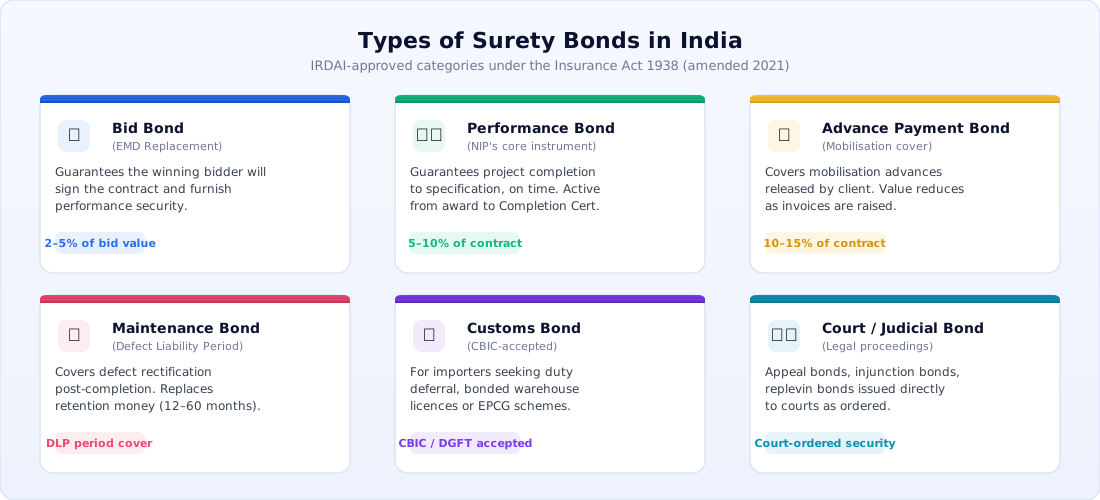
IRDAI's 2021 guidelines recognise six main categories of surety bond. Each serves a distinct contractual moment and carries its own risk profile:
Bid Bond (Tender Bond): Replaces the EMD (Earnest Money Deposit) at the bidding stage. Guarantees that the winning bidder will sign the contract and furnish the required performance security. Typical value: 2–5% of contract price.
Performance Bond: The backbone of the surety market. Guarantees that the Principal will complete the project as specified, on time, and within budget. Issued at contract award; remains live until Completion Certificate. Typical value: 5–10% of contract price.
Advance Payment Bond: Covers mobilisation advances paid by the Obligee to the Principal. As the Principal utilises the advance and raises invoices, the bond value reduces proportionally. Eliminates the Obligee's risk of advance misuse.
Maintenance/Warranty Bond: Active during the Defect Liability Period (DLP) — typically 12–60 months post-completion. Guarantees the Principal will rectify defects at their own cost. Common in road, building and MEP contracts.
Customs Bond: Required by CBIC (Central Board of Indirect Taxes & Customs) for importers seeking duty deferral or bonded warehouse licences. A pure financial guarantee that IRDAI-approved surety bonds can now fulfil.
Court/Judicial Bond: Issued in lieu of cash deposits required by courts — appeal bonds, replevin bonds, injunction bonds. Growing segment as courts in India become more receptive to insurance-backed securities.
The India Landscape: Who Is Driving the Market?
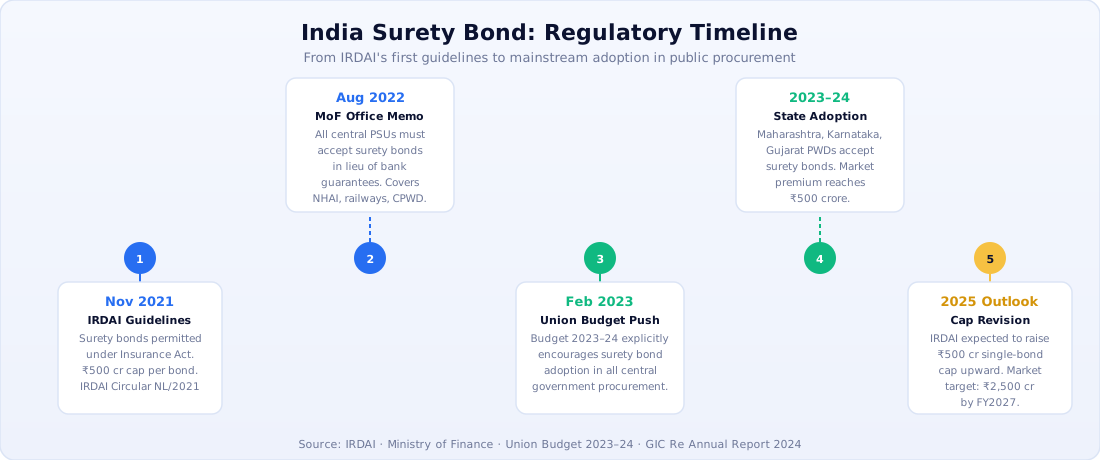
India's surety bond market was effectively dormant until 2021. Two events unlocked it simultaneously. In November 2021, IRDAI issued comprehensive surety bond guidelines permitting general insurers to underwrite these products. Nine months later, in August 2022, the Ministry of Finance issued an Office Memorandum directing all central government ministries and PSUs — NHAI, NHIDCL, AAI, CPWDs, railways, defence — to accept insurance surety bonds in lieu of bank guarantees for all government contracts. The Union Budget 2023 further validated this by explicitly encouraging surety bond usage in public procurement.
On the insurer side, approved surety bond providers in India include New India Assurance, ICICI Lombard, Bajaj Allianz General Insurance, SBI General Insurance, HDFC Ergo, National Insurance Company and United India Insurance. Specialist reinsurance capacity is provided by GIC Re and international reinsurers including Swiss Re, Munich Re and Hannover Re. TropoGo partners with leading IRDAI-approved surety underwriters to offer comprehensive bond placement for contractors, developers and trading entities of all sizes.
Key Benefits of Surety Bonds
Working Capital Liberation: Replacing a ₹5 crore bank guarantee (which requires ₹5 crore in margin money or FD) with a surety bond costing ₹5–15 lakh premium frees up crores for project execution.
Off-Balance-Sheet Treatment: Surety bonds do not appear as contingent liabilities in the same way bank guarantees do — improving financial ratios and credit headroom.
No Collateral Required: Banks demand 100% cash collateral or prime property mortgage. Surety underwriting is based on financial strength, track record and project risk — no blocking of assets.
Regulatory Acceptance: MoF 2022 directive makes surety bonds admissible across all central government, railway and defence contracts. State governments (Maharashtra, Karnataka, Gujarat) are following suit.
Conditional Claims Protection: Unlike "pay-on-demand" bank guarantees, surety bonds require the Obligee to demonstrate actual default — protecting contractors from frivolous encashment.
Scalable for SMEs: Smaller contractors who cannot access large bank guarantee limits due to collateral constraints can now compete for larger tenders via surety bond facilities.
Challenges and Limitations
Underwriting Rigour: Sureties conduct thorough due diligence — audited financials (3 years), project completion track record, net worth certificate, banker references. Weak financials may result in refusal or sub-limits.
State-Level Acceptance: While central government has mandated acceptance, many state PWDs and urban local bodies still insist on bank guarantees. Legal clarity at state level is still evolving.
Premium Sensitivity: For very short-duration, low-risk contracts, the net saving over bank guarantee margin costs may be marginal. A cost-benefit analysis is essential.
Awareness Gap: Many procurement officers are unfamiliar with surety bond documentation and claims processes, sometimes causing delays in tender submission.
Market Depth: India's surety market is young — aggregate premium was under ₹500 crore in FY2024. For very large single bonds (₹500 crore+), capacity may require multiple co-surety arrangements.
Regulatory Framework: India's Surety Bond Policy Timeline
India's regulatory journey on surety bonds has been swift but deliberate. IRDAI's November 2021 guidelines set the product parameters: maximum bond value of ₹500 crore per bond, maximum exposure of 10% of gross written premium for the insurer, mandatory reinsurance support, and a clear claims procedure. The Ministry of Finance's August 2022 directive operationalised these products in public procurement. NITI Aayog's 2022 report on infrastructure financing explicitly recommended expanding surety bond usage. The 2023–24 Union Budget's infrastructure push further signalled policy continuity. By FY2025, IRDAI is expected to revise the ₹500 crore single-bond cap upward as market depth improves.
Need a Surety Bond for Your Next Contract?
TropoGo places performance, bid, advance payment and customs bonds with IRDAI-approved sureties — fast turnaround, competitive premiums, expert documentation support.
Why Surety Bond Insurance Is the Foundation, Not an Add-On
A surety bond is not a simple commodity — it is a complex underwritten guarantee where the insurer stands fully behind the Principal's contractual performance. TropoGo's surety bond offering covers the full spectrum of bond types required across India's construction, infrastructure, trading and judicial segments:
Performance Bond: Guarantee of project completion to specification — the workhorse of India's NIP build-out, covering road, rail, port and energy EPC contracts.
Bid Bond (EMD Replacement): Instant tender eligibility without locking up earnest money. Accepted by NHAI, railways, defence PSUs, and most central government bodies under the MoF 2022 directive.
Advance Payment Bond: Protects the Obligee's mobilisation advance against misuse or contractor default — critical for projects with 10–15% front-loaded funding.
Maintenance & Defect Liability Bond: Post-completion coverage through the DLP period. Replaces retention money withheld by clients, releasing your cash earlier.
Customs & Import Bond: CBIC-compliant surety bonds for importers operating under bonded warehouse licences, EPCG schemes, or deferred duty arrangements.
Court / Judicial Bond: Appeal, injunction and replevin bonds for businesses in commercial litigation — issued directly to courts as ordered.
Outlook: India's Surety Market in 2025 and Beyond
The Reserve Bank of India's tightening of bank guarantee issuance norms — requiring higher liquidity coverage ratios — is expected to make bank guarantees progressively more expensive through 2025–26. This structural shift will make surety bonds the natural default for infrastructure contracts. Industry analysts project the Indian surety premium market will cross ₹2,500 crore by FY2027, driven by the NIP's second phase, the Gati Shakti master plan, and state-level policy alignment. For contractors who get ahead of this curve now — building a surety relationship, establishing financial track records, and incorporating bond costs into project bids — the competitive advantage will be substantial.
As surety becomes mainstream, the quality of the surety provider matters enormously. TropoGo works exclusively with IRDAI-licensed general insurers backed by A-rated reinsurers, ensuring your bond will be accepted without dispute and honoured without delay if the worst happens.
Frequently Asked Questions
Is an insurance surety bond accepted in place of a bank guarantee by Indian government bodies?
Yes. The Ministry of Finance's Office Memorandum dated 3 August 2022 directed all central government ministries, departments and PSUs — including NHAI, railways, defence establishments and CPWDs — to accept IRDAI-approved insurance surety bonds as a valid substitute for bank guarantees. State governments including Maharashtra, Karnataka and Gujarat have issued similar orders. However, some state PWDs and urban local bodies have not yet updated their tender documents — always confirm acceptance in the specific tender terms before substituting.
What is the cost of a surety bond compared to a bank guarantee?
A bank guarantee typically requires 100% cash collateral (blocked in an FD at around 6–7% per annum) plus 0.25–0.75% per annum commission. A surety bond requires no collateral and costs 1–3% per annum premium depending on bond type, contract duration, and the Principal's financial profile. For a ₹5 crore performance bond over two years, a bank guarantee costs roughly ₹12–15 lakh in opportunity cost plus commission; a surety bond costs ₹10–30 lakh premium with zero capital lockup. The break-even depends on working capital deployment efficiency.
What does a surety company look for when underwriting a bond?
Sureties assess the "Three Cs" — Character (track record, litigation history, reputation), Capacity (technical ability, equipment, manpower), and Capital (net worth, current ratio, debt-equity ratio, cash flows). Minimum typical requirements: three years of audited financials, positive net worth at least equal to 50% of the bond value, prior project completions of comparable scale, and no pending adverse court judgements. Sureties may also request a project-specific business plan and banker reference letters for large bonds.
How is a surety bond claim different from a bank guarantee encashment?
A bank guarantee is typically "unconditional and irrevocable" — the bank pays the moment the Obligee presents a compliant written demand, without verifying whether actual default occurred. A surety bond claim is conditional on demonstrable breach of the Principal's underlying obligation. The Surety investigates the claim (usually within 30 days under IRDAI norms), may arrange contract completion instead of cash payout, and can defend against fraudulent or premature encashment. This "conditionality" is a genuine protection for contractors — though it also means the Surety has legitimate grounds to dispute invalid claims.
Can an MSME or small contractor get a surety bond in India?
Yes, and this is one of the key policy objectives of the MoF 2022 directive. MSMEs that cannot provide large collateral for bank guarantees can access surety bonds on the strength of their financial statements, project track record, and technical capabilities. Many surety underwriters have developed MSME-specific products with streamlined underwriting for bond values under ₹50 lakh. Some state government procurement programmes additionally allow surety bonds at reduced EMD percentages for MSME-classified bidders under public procurement preference policies.
How do I get surety bond insurance for my next tender or contract?
TropoGo makes surety bond placement straightforward — you share your audited financials, the tender document, and your project track record; we assess eligibility, recommend the right IRDAI-approved surety insurer, and manage the entire issuance process, typically within 5–10 working days for standard bonds. For large or complex bonds, we structure co-surety arrangements to meet capacity requirements. Visit our Surety Bond Insurance page to start your application or speak with a specialist today.
India's infrastructure ambitions are too large for working capital to be tied up in outdated bank guarantee structures. Surety bond insurance — IRDAI-approved, Ministry of Finance-accepted, and now available through specialist brokers like TropoGo — gives contractors, developers and trading companies the financial flexibility to bid bigger, build better, and grow faster. Whether you need a bid bond for your next NHAI tender, a performance bond for an EPC contract, or a customs bond for your import licence, TropoGo's specialist team will match you with the right surety at the right premium.