What is Travel Insurance and Why You Should Never Travel Without It
2 May 2026 | 6 min read
Travel Insurance India
One hospital bill abroad can cost more than your entire trip. Understand what travel insurance covers — and why no Indian traveller should leave without it.
Picture this: you're in Bangkok for a family holiday, and on day two your child develops acute appendicitis. The nearest hospital is private, bilingual — and expensive. A single surgery, two-night ICU stay and ambulance transfer adds up to ₹28 lakh. Without travel insurance, that bill lands directly on your credit card. With it, your insurer's 24/7 helpline takes the call, authorises cashless treatment, and you focus entirely on your family's recovery.
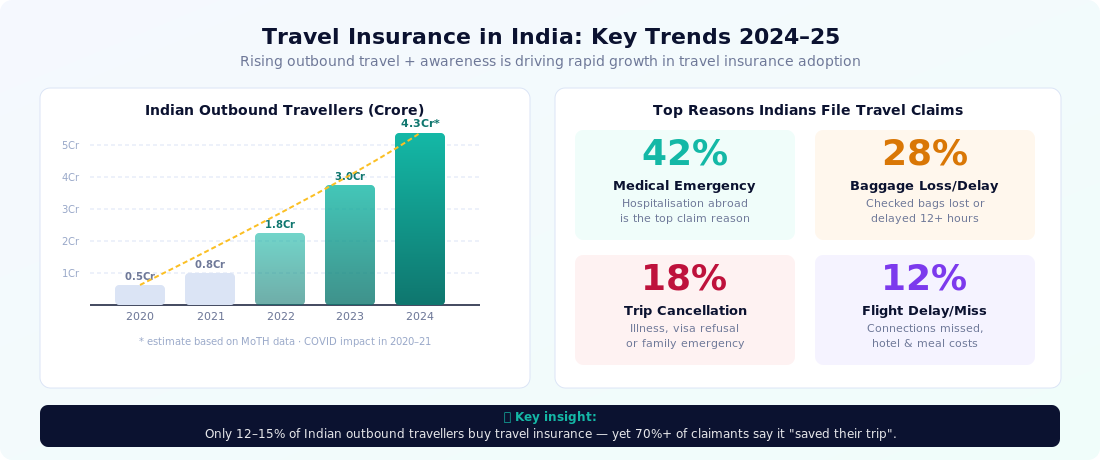
India's outbound travel market crossed 4.3 crore departures in 2024, yet fewer than 15% of those travellers carry valid travel insurance, according to industry estimates. That gap between travel enthusiasm and financial protection is precisely where disasters happen — and where a ₹600-per-day policy makes all the difference.
What is Travel Insurance?
Travel insurance is a short-term policy that protects you against a defined set of financial losses that can occur before, during, or immediately after a trip. Unlike life or health insurance — which are annual contracts — travel insurance is purchased per trip (or as an annual multi-trip plan) and activates from the moment you leave your home address to the moment you return.
In India, travel insurance is sold by general insurers regulated by IRDAI. It is not legally mandatory for domestic travel, but many countries — particularly the Schengen Area, Canada, and the UAE — require proof of travel insurance as a visa condition. Even where not compulsory, it is strongly advisable: your domestic health insurance policy typically provides zero coverage overseas.
What Does Travel Insurance Cover?
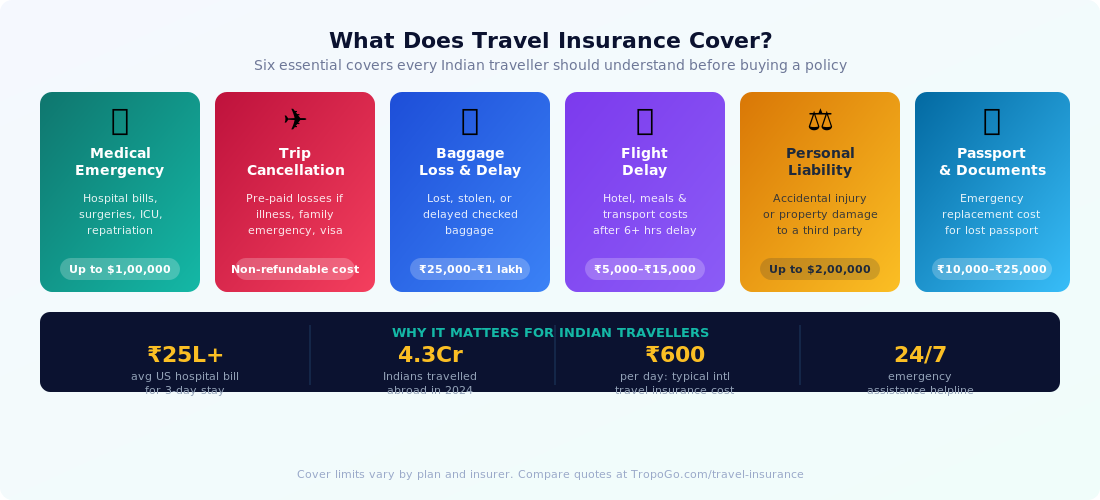
A comprehensive travel insurance plan bundles multiple covers into a single policy. The six most important are medical emergency cover (hospital treatment abroad), trip cancellation (pre-paid losses if the trip cannot proceed due to illness, visa refusal, or family emergency), baggage loss and delay, flight delay, personal accident, and personal liability. Most plans also include passport loss cover and hijack/terror distress allowance.
Why Indian Travellers Are Underinsured
The underinsurance paradox is real: most Indian travellers are meticulous about hotel bookings, forex cards and international SIMs — but overlook insurance. The reasons are structural. India's domestic health insurance culture is still maturing; many people assume their corporate group health policy covers overseas travel (it almost never does beyond accidental hospitalisation, and only rarely even that). There's also a "nothing bad will happen to me" optimism that statistics firmly contradict.
Between 2023 and 2025, Indian insurers settled thousands of overseas medical claims averaging ₹8–₹15 lakh per event. Flight delay claims spiked 40% after the post-COVID aviation capacity crunch. Baggage claims tied to international routes — particularly via transit hubs like Dubai and Doha — are filed at a rate that surprises most first-time travellers.
Types of Travel Insurance Plans Available in India
Indian insurers offer several plan categories suited to different travel patterns:
Single-trip International: The most common — covers one outbound trip for the specified duration. Ideal for annual holidays or business travel to specific destinations.
Annual Multi-trip: One policy covers unlimited international trips within 12 months, each trip up to a maximum duration (typically 45 or 90 days). Best value for frequent flyers making 3+ international trips a year.
Student Travel Insurance: Designed for Indians studying abroad. Extends for one or two academic years, includes mental health support, sponsor protection (in case the fee-paying parent dies), and study interruption cover.
Senior Citizen Travel Insurance: Specialised plans for travellers over 60, with enhanced medical cover (since age raises claim probability), pre-existing disease sub-limits, and medical escort cover.
Family Travel Insurance: Covers the entire family on a single policy — typically 2 adults + up to 4 children — at a discount vs individual plans.
Domestic Travel Insurance: Covers trips within India — primarily for flight delay, baggage, and accidental hospitalisation. Less comprehensive than international plans but useful for frequent domestic flyers.
Schengen Visa and Travel Insurance: What You Must Know
If you are applying for a Schengen visa (covering 26 European countries), you must provide proof of travel medical insurance with a minimum cover of €30,000 (approximately ₹27 lakh) valid for the entire trip duration and all Schengen countries. The policy must cover emergency medical treatment, hospitalisation, and repatriation. Indian insurers including New India Assurance, HDFC Ergo, Tata AIG, Bajaj Allianz, and Niva Bupa (formerly Max Bupa) offer Schengen-compliant plans that can be purchased online with an instant policy document.
Similarly, the UAE requires travel insurance for visa-on-arrival visitors, and Canada's immigration authorities consider travel insurance as a supporting document for visitor visa applications. Even for visa-free destinations like Thailand and Sri Lanka, the hosting government's emergency health infrastructure is not designed to absorb uninsured foreign patients — you will be billed at full private rates.
How to File a Travel Insurance Claim
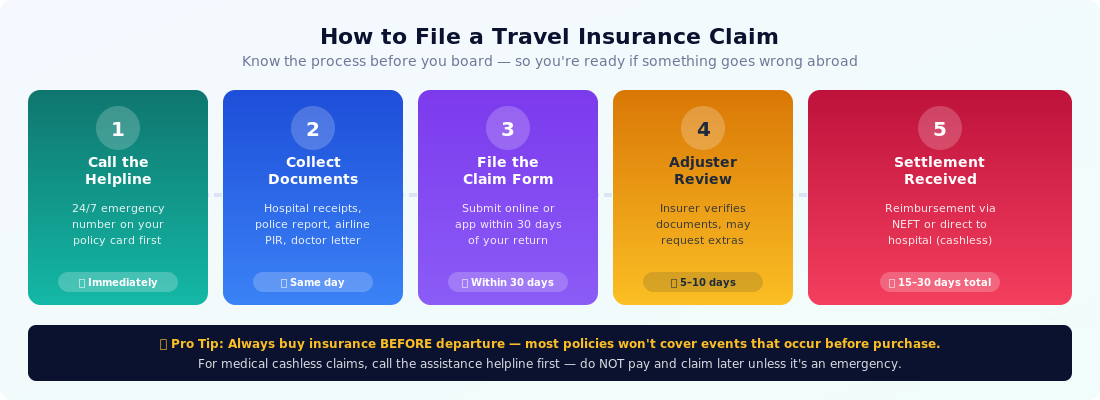
The claims process is straightforward when you know the steps in advance. The most critical rule: call your insurer's international assistance helpline before you pay anything major. Paying first and claiming later is only for unavoidable emergencies — most policies require pre-authorisation for planned hospital admissions.
Document everything. For medical claims: hospital discharge summary, all invoices, doctor's certificate. For baggage: airline's Property Irregularity Report (PIR), purchase receipts for claimed items. For trip cancellation: airline/hotel cancellation confirmation, doctor's certificate or visa rejection letter. For flight delay: airline's delay confirmation letter (get this at the airport).
How Much Does Travel Insurance Cost?
Travel insurance for Indian outbound travellers is genuinely affordable. A solo trip to Europe for 15 days typically costs ₹800–₹1,500 in premium, depending on the plan and medical cover limit. A family of four on the same trip might pay ₹2,500–₹4,000 for comprehensive cover including zero-depreciation medical with pre-existing disease sub-limit. Annual multi-trip plans for a frequent business traveller start at ₹6,000–₹8,000 for up to 12 months of unlimited trips.
The premium is a tiny fraction of what an uninsured medical emergency costs. A 3-day hospital stay in the USA for appendicitis averages $12,000–$15,000 (≈ ₹10–₹12.5 lakh). Emergency dental treatment in Australia runs AUD 800–₹2,000. A single hospitalisation event abroad can easily cost 50–100× the annual travel insurance premium.
Why Travel Insurance is the Smartest ₹600 You'll Spend on Any Trip
The case for travel insurance isn't just financial — it's psychological. Knowing you have 24/7 emergency assistance, cashless hospitalisation in 150+ countries, and a direct line to evacuation specialists changes how you experience travel. You explore more freely, take reasonable risks, and aren't paralysed by "what if" anxieties that diminish the joy of the journey.
TropoGo's travel insurance plans are underwritten by IRDAI-regulated insurers and tailored for Indian travellers. The key covers include:
Emergency Medical Cover: Cashless hospitalisation and outpatient treatment in 150+ countries, with cover limits from $50,000 to $5,00,000 depending on destination and plan tier.
Medical Evacuation & Repatriation: Air ambulance and ground transport to the nearest appropriate medical facility, or repatriation to India if clinically advised.
Trip Cancellation & Interruption: Reimbursement of non-refundable pre-paid costs if the trip is cancelled or cut short due to illness, death in family, natural disaster, or visa rejection.
Baggage & Personal Belongings: Compensation for lost, stolen, or permanently damaged checked baggage, with separate limits for delay (to buy essentials while waiting).
Flight Delay & Missed Connection: Fixed daily allowance for accommodation and meals when flights are delayed beyond 6–12 hours, plus cost of rebooking missed connections.
Pre-Existing Disease Cover (with sub-limit): Available as an optional add-on — critical for senior travellers and those with managed chronic conditions like diabetes or hypertension.
Frequently Asked Questions
Is travel insurance mandatory for international travel from India?
It depends on the destination. Travel insurance is mandatory for Schengen visa applications (minimum €30,000 medical cover) and required by certain countries including the UAE and Cuba. For most other destinations, it is not legally required but strongly recommended — your domestic health insurance typically does not cover medical emergencies overseas.
Does travel insurance cover pre-existing diseases?
Standard travel insurance policies exclude pre-existing conditions. However, many insurers offer a pre-existing disease (PED) add-on for an additional premium, which provides a sub-limit for acute emergency treatment of declared conditions. Senior citizen travel plans often include a higher PED sub-limit. Always declare existing conditions honestly — concealment voids the claim.
What is the difference between single-trip and annual multi-trip travel insurance?
Single-trip insurance covers one specific journey from departure to return. Annual multi-trip insurance covers unlimited international trips within 12 months, subject to a maximum per-trip duration (usually 45 or 90 days). If you travel internationally more than 2–3 times a year, annual multi-trip is almost always better value — it can cost as little as 2× a single-trip premium while offering 12 months of cover.
Can I buy travel insurance after I have already departed?
Most insurers require you to purchase travel insurance before your departure date. Buying after you have already left India is either not permitted or triggers a waiting period (typically 24–48 hours) before cover activates. Always buy your policy at least 24 hours before travel — and ideally at the time of booking — to ensure trip cancellation cover is valid.
Does travel insurance cover COVID-19 or pandemic-related cancellations?
Post-2020, most Indian travel insurers now include COVID-19 medical cover for hospitalisation acquired during the trip. Trip cancellation due to COVID-related border closures or government travel advisories is more nuanced — check the specific policy wording. Some premium plans include "cancel for any reason" (CFAR) cover that removes most exclusions but comes at a higher premium.
How do I choose the best travel insurance plan for my trip?
Match the plan to your destination and risk profile. For the USA or Canada, choose high medical cover (minimum $1,00,000) because healthcare costs are extreme. For Europe, a Schengen-compliant plan with €30,000+ cover is mandatory. Frequent travellers should consider an annual multi-trip plan. Travellers over 60 should opt for senior-specific plans with PED cover. TropoGo's travel insurance comparison page lets you filter by destination, duration, and age to find the right fit.
Ready to Travel? Cover Yourself First.
TropoGo's travel insurance plans are designed for Indian travellers — from Schengen-compliant medical cover to student and senior citizen plans. Compare policies, get instant documents, and travel with confidence.
Travel insurance is not an optional expense — it is the final, non-negotiable item on your pre-departure checklist. Add it the same day you book your flights, store the emergency helpline number separately from your phone, and carry a printed copy of your policy. The cost is negligible. The peace of mind is priceless.