India is home to more than 1.5 crore registered commercial vehicles — trucks, buses, taxis, auto-rickshaws, delivery vans and construction equipment — that together move the country's economy. These are not idle assets; they are on the road all day, every day, navigating potholed state highways, monsoon flooding and congested urban arterials. A single accident can write off a ₹40 lakh truck, expose a fleet operator to an unlimited third-party liability claim, and strand a cargo delivery worth multiples of the vehicle itself.
The Motor Vehicles Act 1988 — as amended in 2019 — makes third-party insurance compulsory for every commercial vehicle before it can be registered or driven on public roads. Non-compliance carries fines of up to ₹2,000 for the first offence and ₹4,000 thereafter, and the vehicle can be seized. Beyond legal compliance, a well-structured commercial vehicle policy protects the vehicle, the cargo, the driver and the company's balance sheet from losses that would otherwise fall entirely out of pocket.
This guide explains what commercial vehicle insurance covers, how premiums are calculated, what the Motor Vehicles Act requires, and how fleet operators can structure policies that actually deliver at claims time.
What counts as a commercial vehicle in India?
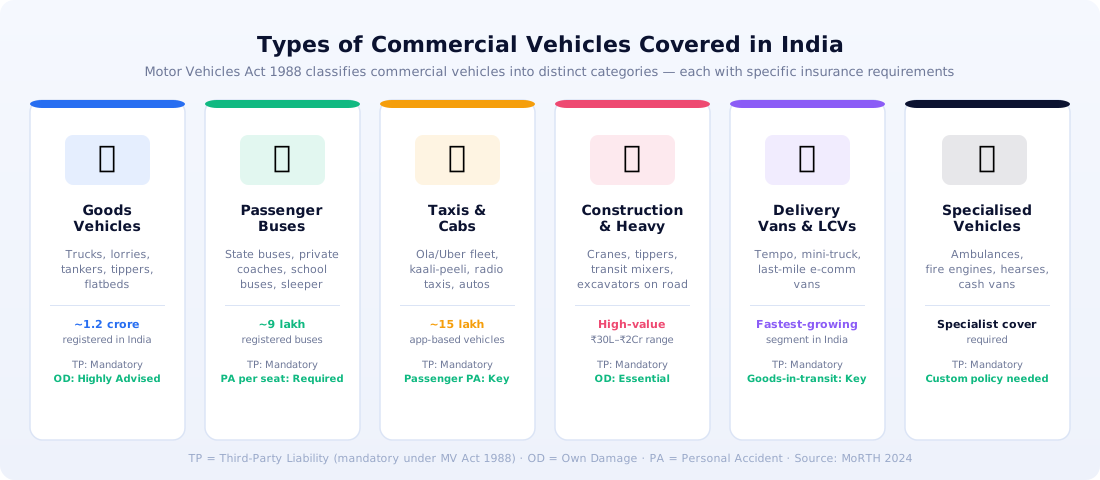
The Motor Vehicles Act and IRDAI guidelines classify a vehicle as "commercial" based on its registered purpose rather than its size. If the Registration Certificate (RC) lists the vehicle as used for transport of goods, passengers or hire, it is a commercial vehicle — and a commercial vehicle insurance policy is required. The six main categories each carry distinct cover requirements.
The distinction matters for premium calculation: IRDAI sets third-party rates separately for each category based on GVW (gross vehicle weight) brackets for goods vehicles and seating capacity for passenger vehicles. A 12-tonne tipper and a school bus face entirely different TP rate schedules even though both are classified as commercial vehicles.
What does commercial vehicle insurance actually cover?
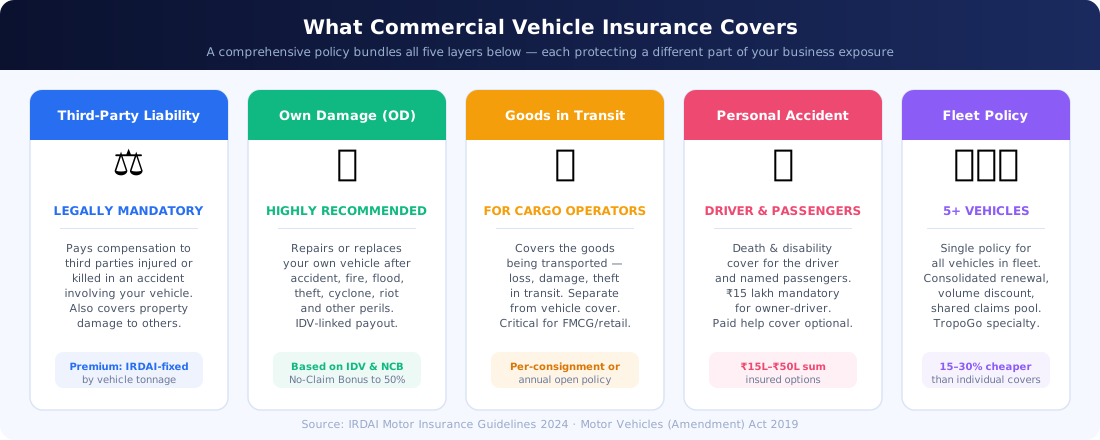
A comprehensive commercial vehicle policy combines several distinct covers into one structure. Most operators in India purchase a package policy — a combination of TP (third-party) and OD (own damage) in a single document — though TP-only policies are available for older vehicles where OD is not cost-effective.
India's commercial vehicle fleet loses an estimated ₹75,000 crore annually to road accidents, breakdowns and cargo loss.NCRB data shows goods vehicles account for 16% of total road fatalities — making comprehensive cover essential, not optional, for any business operating on Indian roads.
Third-party liability — the non-negotiable foundation
Third-party cover pays compensation to any person who is injured, killed or whose property is damaged by your commercial vehicle. Claims under third-party liability are heard by Motor Accident Claims Tribunals (MACTs) across India, and there is no cap on compensation for death or permanent disability — awards of ₹50 lakh to ₹2 crore are routine in major urban MACTs. An uninsured commercial vehicle operator who faces such a claim must satisfy it personally. A few high-value MACT awards have bankrupted small transport businesses that were operating vehicles without adequate TP cover.
Own damage cover — protecting the asset
Own damage cover reimburses repair or replacement costs when your vehicle is damaged by accident, fire, flood, cyclone, earthquake, theft, vandalism or riot. The payout is linked to the vehicle's Insured Declared Value (IDV) — broadly the current market value after applying IRDAI-prescribed depreciation schedules. A claim for total loss pays IDV minus the policy excess; a partial loss claim pays assessed repair costs minus depreciation on replaced parts, unless you have added a zero-depreciation add-on.
Goods-in-transit cover — protecting the cargo
Own damage covers the vehicle; goods-in-transit (GIT) cover protects the goods being carried. If a truck overturns and destroys ₹15 lakh of electronics consigned to a retailer, the OD claim covers the truck; the GIT claim covers the goods. GIT policies can be structured per consignment, per trip or as open annual policies for operators running regular routes with consistent cargo types. FMCG companies, pharmaceutical distributors, auto-parts suppliers and e-commerce logistics operators routinely require GIT cover from their contracted carriers as a condition of business.
How is the premium calculated?
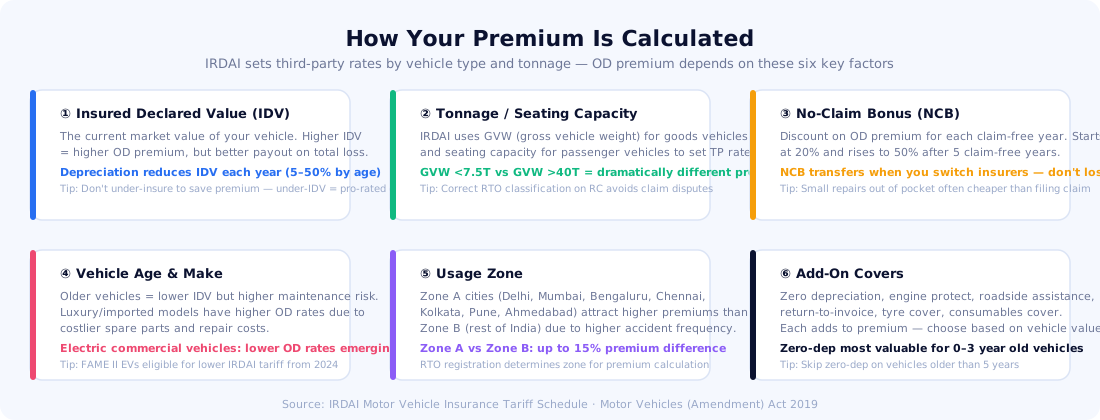
Third-party premiums are fixed by IRDAI annually and published in a tariff schedule — there is no negotiating them. Own damage premiums are market-rated and vary by insurer. Six factors drive the OD premium calculation.
The most powerful lever available to a responsible fleet operator is the No-Claim Bonus (NCB). An operator who runs claim-free for five consecutive years earns a 50% discount on the OD premium component. For a fleet of 20 trucks with a combined OD premium of ₹8 lakh per year, a 50% NCB saves ₹4 lakh annually — a figure that concentrates the mind on driver training, vehicle maintenance and selective claims filing.
The Motor Vehicles Act obligations every fleet operator must know
The Motor Vehicles (Amendment) Act 2019 significantly strengthened enforcement against uninsured commercial vehicle operation. Key legal obligations include:
Third-party cover is mandatory before registration — the RTO will not issue or renew a registration without proof of a valid insurance certificate.
Policy must be with an IRDAI-licensed insurer — policies issued by unlicensed entities or invalid policies constitute non-insurance and attract penalties equivalent to no insurance.
Driver must carry certificate at all times — traffic police can demand the insurance certificate and DL at any check post. E-certificates on the DigiLocker app are legally valid.
Claims cannot be repudiated for TP liability if minimum cover exists — even if the driver was unlicensed or the vehicle was overloaded, the insurer must pay the third-party claimant and recover from the policyholder.
Long-term TP cover for new vehicles — under 2018 Supreme Court directions, all new commercial vehicles must carry 3-year TP cover from the date of first registration, not a renewable annual policy.
Increased penalties post-2019 — driving without insurance now attracts a fine of ₹2,000 (first offence) or ₹4,000 (repeat offence) plus potential imprisonment up to 3 months. Vehicle may be impounded.
Fleet policies — the smart choice for businesses with 5+ vehicles
Any business operating five or more commercial vehicles should seriously evaluate a fleet insurance policy rather than individual vehicle policies. A fleet policy consolidates all vehicles under a single annual contract, simplifying renewals, reducing administration, and — critically — opening access to insurer pricing negotiations unavailable to single-vehicle purchasers. Fleet policies typically deliver 15–30% lower aggregate premiums compared with buying equivalent cover vehicle by vehicle, with additional benefits including a shared claims pool, a designated loss assessor and a single-window claims contact.
Indian logistics operators including Delhivery, Blue Dart, Mahindra Logistics and regional transporter networks routinely operate under fleet policies structured with deductibles, agreed-value clauses for specific vehicle categories, and embedded GIT cover — all under a single umbrella. TropoGo's commercial lines team structures fleet policies for operators from 5 vehicles upward across all commercial vehicle types.
Protect Your Fleet — Before the Next Accident Happens
TropoGo structures third-party, own damage, goods-in-transit and fleet covers for Indian commercial vehicle operators — from single trucks to multi-state fleets.
Why commercial vehicle insurance is a business-critical decision, not just a compliance checkbox
Most small transport operators in India purchase TP-only cover — the minimum required by law — to minimise premium spend. This is a rational short-term decision that creates catastrophic long-term exposure. When the vehicle that generates all the revenue is in a workshop for six weeks after a monsoon flood, TP-only cover pays nothing toward the repair bill. When cargo worth ₹20 lakh is stolen from a parked truck overnight, TP-only cover pays nothing. The business absorbs the full loss.
A properly structured commercial vehicle insurance policy protects five distinct value pools for any business on the road:
The vehicle asset — own damage cover ensures a breakdown or total loss doesn't leave you holding a loan EMI on a non-functional truck.
Third-party liability exposure — unlimited MACT awards are a real risk on Indian roads; TP cover is the only protection against a claim that could exceed the vehicle's value many times over.
The cargo in your care — goods-in-transit cover protects consignors, maintains carrier-client relationships and satisfies contract requirements from major shippers.
Your driver workforce — personal accident cover provides death and disability benefits for drivers who are the livelihood for their families, reducing your moral and legal exposure.
Business continuity — breakdown cover add-ons, roadside assistance and agreed-value clauses ensure that a single incident doesn't cascade into a months-long revenue loss.
What's next: electric commercial vehicles and telematics-linked pricing
India's commercial vehicle segment is undergoing its fastest technology transition since the diesel engine. Tata Motors' EV trucks, Olectra buses and a growing number of last-mile e-3-wheelers are entering fleets at scale, driven by FAME II subsidies and state EV policies. IRDAI has begun developing lower OD tariff guidance for electric commercial vehicles, recognising that lower drivetrain complexity reduces maintenance risk. Meanwhile, telematics-based insurance — where a device in the cab monitors speed, braking and driving hours to generate a risk score that feeds directly into premium calculation — is moving from pilot to mainstream for major fleet operators. Businesses that invest in telematics now are building the data asset that will unlock the lowest premiums in the next insurance cycle.
TropoGo works with IRDAI-approved insurers who are already piloting telematics-linked commercial vehicle policies — contact our commercial lines team to understand if your fleet qualifies for a telematics pilot programme.
Is commercial vehicle insurance different from private car insurance?
Yes, significantly. Commercial vehicle insurance is rated differently by IRDAI — TP premiums are fixed by vehicle type, GVW and seating capacity rather than engine cc. OD premiums reflect the higher annual mileage, more demanding operating conditions and greater liability exposure of commercial use. You cannot use a private car policy on a vehicle registered as a commercial vehicle — doing so voids the policy and constitutes non-insurance under the Motor Vehicles Act.
What is IDV and why does it matter for commercial vehicles?
IDV (Insured Declared Value) is the current market value of your vehicle, calculated after applying IRDAI-prescribed depreciation to the ex-showroom price. In a total-loss claim, the insurer pays IDV minus the policy excess. Under-insuring (declaring a low IDV to save premium) means you receive a proportionately lower settlement — often insufficient to replace the vehicle at current market prices. Always insure at a realistic IDV, especially for newer or high-value commercial vehicles.
Can I get a commercial vehicle policy for a very old truck?
Yes. IRDAI does not restrict insurance based on vehicle age alone. However, for vehicles older than 15 years, the IDV is very low, making OD cover of limited value. Most insurers will underwrite TP-only policies for old commercial vehicles without restriction. For OD cover on older vehicles, some insurers require a physical survey before issuing a policy. Contact TropoGo to check underwriting appetite for your specific vehicle age and type.
How does the No-Claim Bonus work for fleet policies?
For individual vehicle policies, NCB accrues per vehicle and stays with the vehicle owner (not the insurer) across renewals. For fleet policies, the NCB structure varies — some insurers offer a fleet-level NCB that applies across the entire policy based on the fleet's aggregate claims record. Others track NCB at individual vehicle level within the fleet umbrella. TropoGo structures fleet policies to maximise NCB retention — including recommending when a small claim is better paid out of pocket to protect the NCB earned over previous years.
What add-ons are most valuable for commercial vehicle operators?
The most valuable add-ons depend on vehicle type and usage. Zero-depreciation cover is most useful for 0–3 year old vehicles where parts replacement cost is high. Engine protection cover is critical in flood-prone areas (southern states, North Bengal, Assam) where water ingestion damage is not covered under standard OD. Roadside assistance is essential for trucks operating on inter-state routes far from authorised workshops. Goods-in-transit is mandatory for most commercial cargo operators. Return-to-invoice cover is useful for financed new vehicles.
How do I get commercial vehicle insurance from TropoGo?
Visit tropogo.com/other-insurance/commercial-vehicle-insurance and provide vehicle details — registration number, make, model, year, GVW or seating capacity, and current IDV. For fleet enquiries of 5+ vehicles, TropoGo's commercial lines team will provide a consolidated quote across all vehicles, including fleet discount, GIT bundling and telematics options where available. Policies are issued by IRDAI-licensed insurers.
Every commercial vehicle on an Indian road carries unlimited third-party liability exposure from the moment it moves. The question is not whether you need insurance — the law answers that — but whether your policy is structured to actually protect your business when the claim arrives.