What is Tractor Insurance and Why Every Farmer Needs It
13 May 2026 | 7 min read
Your Tractor Is Worth ₹9 Lakh. Is It Protected?
Own damage, fire, third-party liability, theft and natural calamity cover for Indian farmers, CHC operators and agri-entrepreneurs — built around IRDAI rules.
India has more tractors than any country on Earth. With over 9 lakh new tractors sold every year and an estimated 60 million tractors already working across India's fields, the tractor is not just a farm machine — it is the engine of rural livelihoods. From ploughing winter wheat fields in Punjab to levelling nursery beds in Andhra Pradesh, from pulling carts loaded with sugarcane in Maharashtra to transporting grain to the mandi in Uttar Pradesh, the tractor is the single most indispensable piece of capital equipment a farmer in India can own.
And yet, in a country where a mid-range 45 HP tractor costs ₹7–9 lakh and a heavy-duty 75 HP model can exceed ₹18 lakh, the vast majority of farm tractors operate without any comprehensive insurance at all.
A single accident — a rollover in a waterlogged field, a fire caused by a diesel fuel leak near a burning field bund, a collision on a state highway while pulling a loaded trailer — can destroy a machine that a family spent years saving for. For the 70 percent of tractor buyers who purchase on bank loans, the EMI continues even when the machine does not. Tractor insurance is the instrument that closes that gap.
This guide explains what tractor insurance is, what it covers, who regulates it in India, and how to get the right cover for your specific machine and farming operation.
What Is a Tractor in the Context of Insurance?
In insurance terms, a farm tractor occupies a unique dual category. When used on a public road — hauling produce to the mandi, towing a trailer, or moving between fields — it is treated as a motor vehicle under the Motor Vehicles Act 1988. When operating exclusively in a field or on private agricultural land, it is treated as agricultural equipment.
This dual-use nature creates a specific regulatory requirement. Under the Motor Vehicles Act, any tractor driven on a public road must carry at minimum a valid Third-Party (TP) liability insurance policy. This is legally mandatory and cannot be waived — operating without it is an offence that can result in a challan, vehicle impoundment, or worse, unlimited personal liability if your tractor injures or kills someone.
However, TP insurance covers only the damage your tractor may cause to others — not the damage to the tractor itself. For comprehensive protection — covering the tractor's own damage from accidents, fire, flood, theft, and natural disasters — a separate Own Damage (OD) or comprehensive policy is needed. Together, TP and OD form a complete tractor insurance package.
Types of Tractors Used in Indian Agriculture
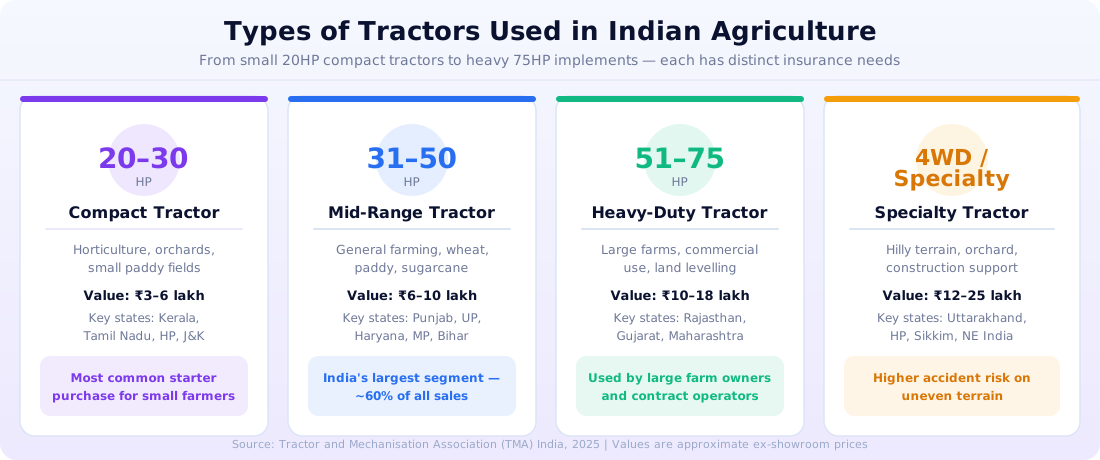
India's tractor fleet spans four distinct categories, each with different insurance needs and risk profiles. Compact tractors in the 20–30 HP range (₹3–6 lakh) dominate horticulture, orchards and small paddy cultivation in Kerala, Tamil Nadu, Himachal Pradesh and the northeast — they face higher rollover risk on terraced hillside plots. Mid-range tractors in the 31–50 HP range (₹6–10 lakh) account for roughly 60 percent of all tractor sales in India and are the workhorses of wheat, paddy, and sugarcane cultivation across Punjab, UP, Haryana, MP and Bihar. Heavy-duty tractors in the 51–75 HP range (₹10–18 lakh) power large farms and commercial operations in Rajasthan, Gujarat and Maharashtra. Specialty and 4WD tractors (₹12–25 lakh) are designed for hilly terrain, orchard rows and construction support — and carry significantly higher accident risk on uneven ground.
India's Tractor Market at a Glance
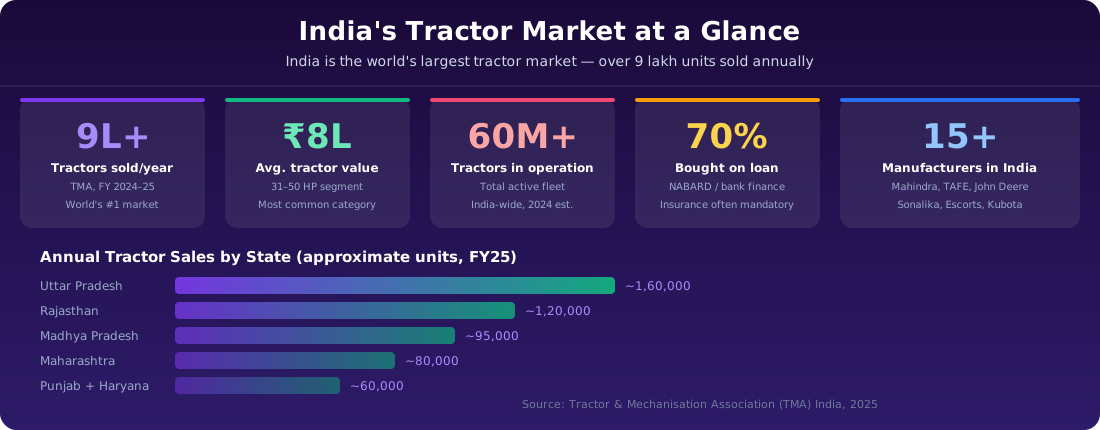
India is the world's largest tractor market by volume, with over 9 lakh units sold annually according to the Tractor & Mechanisation Association (TMA). Uttar Pradesh leads all states with approximately 1.6 lakh tractors sold in FY25, followed by Rajasthan (~1.2 lakh), Madhya Pradesh (~95,000), Maharashtra (~80,000) and the Punjab-Haryana belt (~60,000 combined). The average tractor in the dominant 31–50 HP segment is valued at approximately ₹8 lakh — meaning India's active fleet of 60 million+ tractors represents an asset base worth hundreds of billions of rupees, the vast majority of it uninsured.
Approximately 70 percent of tractor purchases in India are financed through NABARD-linked banks and agricultural NBFCs — making insurance a standard condition in a growing proportion of farm equipment loans. With more than 15 active manufacturers including Mahindra, TAFE, John Deere, Sonalika, Escorts and Kubota, choice is not the problem. Coverage is.
Why Tractors Face Serious Financial Risk
Rollover and overturning: India's fields are uneven, terraced, and seasonally waterlogged. Tractor rollovers — particularly in hilly states and during kharif paddy operations on sloping plots — are among the most common and most catastrophic tractor accidents, often injuring the operator while destroying the machine.
Fire from fuel leaks: Diesel fuel lines are exposed on older tractor models. A leak near a spark plug or a burning field bund — a common practice during post-harvest crop residue burning in Punjab and Haryana — can ignite a fire that writes off a ₹9 lakh tractor within minutes.
Monsoon flooding: Tractors operating in low-lying paddy regions in Bihar, Andhra Pradesh, Odisha and Assam face real risk of submersion during peak monsoon. Water ingress into the engine block can constitute a total loss on older machines with limited hydraulic sealing.
Road accidents: Tractors pulling loaded trailers or agricultural implements on state and national highways — often at dusk or after dark without adequate lighting — are a serious road safety hazard. A collision typically leaves the tractor as the most heavily damaged vehicle.
Theft and component stripping: Newer tractors with GPS-linked instrument clusters, advanced hydraulics and electronic fuel injection systems are increasingly targeted. Battery, tyres, hydraulic pump assemblies and electronic control units are stripped in poorly secured farm yards and left in remote fields overnight.
What Is Tractor Insurance?
Tractor insurance is a motor and agricultural equipment insurance product that protects your tractor against loss or damage arising from specified perils. In India it is regulated by the Insurance Regulatory and Development Authority of India (IRDAI) and structured around an Insured Declared Value (IDV) — the current market value of the tractor after IRDAI-prescribed standard depreciation.
A comprehensive tractor insurance policy typically combines the mandatory Third-Party (TP) liability cover with Own Damage (OD) cover for the tractor itself, and can be extended with rider add-ons covering natural calamities, personal accident for the owner-driver, and electrical accessories. Policies are annual and renewable — the IDV falls each year with the depreciation schedule, unless the machine has been significantly upgraded or refurbished.
The Regulatory Framework for Tractor Insurance in India
The Motor Vehicles Act 1988 makes third-party insurance mandatory for any tractor operated on a public road. State transport authorities and traffic police enforce this routinely — an uninsured tractor on any public road can be fined, impounded, and the owner held personally liable without limit for any injuries or fatalities caused.
IRDAI sets the premium rates for the mandatory Third-Party portion of tractor insurance through annual notifications and updates TP premium tables by vehicle category and HP class. The Own Damage portion is priced competitively by the insurer based on the tractor's IDV, age, HP category and the rider covers added. NABARD's agricultural machinery financing guidelines increasingly require borrowers to maintain at minimum a comprehensive cover — TP plus OD — as a condition of loan disbursal, aligning insurance uptake with formal credit access.
Protect Your Tractor — Before the Season Starts
TropoGo specialises in agricultural machinery insurance for individual farmers, CHC operators and Farmer Producer Organisations across India. Get a tailored tractor insurance quote in minutes.
A tractor is not just a machine — it is the productive centre of a farming household's economics. When that machine is damaged in an accident, destroyed by fire, or submerged in a monsoon flood, the financial shock extends far beyond the repair bill. Loan EMIs continue. Seasonal labour still needs to be hired. Crop windows — ploughing, sowing, irrigation — do not wait for a machine to come back from the workshop.
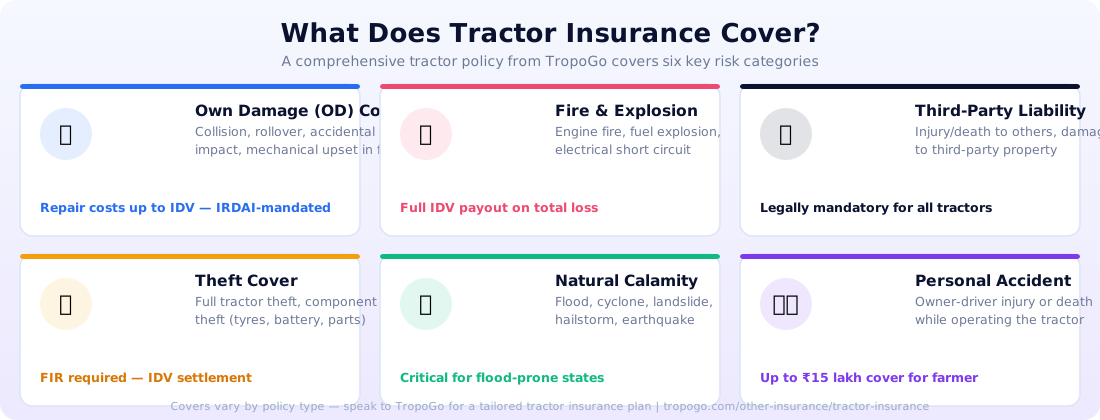
A comprehensive tractor insurance policy from TropoGo covers six distinct risk categories that reflect the real-world hazards Indian farmers face every season:
Own Damage (OD) Cover: Pays for repair or replacement of your tractor after a collision, rollover, accidental impact, or mechanical upset in the field. Covers up to the full IDV of the machine — IRDAI-mandated for all financed tractors under agricultural lending guidelines.
Fire & Explosion: Covers engine fires, fuel line explosions and electrical short-circuit fires. A single fire can write off a ₹9 lakh tractor in under fifteen minutes; this cover pays the full IDV on a total-loss claim.
Third-Party Liability: Legally mandatory under the Motor Vehicles Act for all tractors operated on public roads. Covers injury or death to third parties and damage to third-party property — with unlimited liability for bodily injury and death under the Act.
Theft Cover: Protects against full tractor theft or targeted component stripping — tyres, batteries, GPS units, hydraulic pump assemblies. An FIR filed with the local police station is required to initiate the claim; settlement is on IDV basis.
Natural Calamity: Covers damage from flood, cyclone, landslide, hailstorm and earthquake. This cover is particularly critical for farmers in Andhra Pradesh, Bihar, Odisha, Assam and West Bengal, where monsoon flooding routinely submerges low-lying paddy field tractors each kharif season.
Personal Accident: Covers the owner-driver for injury or death while operating the tractor. Many TropoGo tractor policies include up to ₹15 lakh cover for the farmer-operator — critical in a country where tractor rollovers and road accidents are a leading cause of agricultural injury and fatality.
What Does Tractor Insurance Cost?
Premiums vary by HP category, IDV, age of the tractor, and the covers selected. The mandatory Third-Party (TP) premium for a farm tractor falls in the range of ₹1,000–3,000 per year depending on the HP class — rates set annually by IRDAI. Adding Own Damage cover typically costs 1.5–3.0 percent of IDV per year. For a ₹8 lakh mid-range tractor with TP + OD + natural calamity and personal accident cover, the total annual premium works out to roughly ₹8,000–18,000 — approximately one to two percent of the machine's value, protecting an asset that generates the entire family's agricultural income.
CHC operators and Farmer Producer Organisations owning multiple tractors can negotiate fleet policies covering all machines under a single annual premium with volume discounts. Banks financing tractors through NABARD-linked agricultural credit schemes can bundle the insurance premium into the loan EMI structure, making it practical for first-time buyers to maintain consistent cover without managing a separate renewal each year.
The Outlook — Mechanisation, Risk and the Case for Universal Tractor Cover
India's farm mechanisation rate continues to climb, driven by rural wage inflation, active government support through the Sub-Mission on Agricultural Mechanisation (SMAM) scheme, and the explosive growth of Custom Hiring Centres and Farmer Producer Organisations as institutional equipment owners. As manufacturers move toward connected tractors with GPS tracking, telematics and precision farming implements — digital and electronic assets worth ₹1–2 lakh each — the total value exposed per machine rises with every model year.
Digital platforms like TropoGo make it possible to buy, renew and claim against a tractor insurance policy from a mobile phone in the field — no branch visit, no paperwork queue. As banks tighten lending conditions and IRDAI continues to expand agricultural insurance penetration, the question is no longer whether a farmer can afford tractor insurance. With TropoGo, the question is: can a farmer afford not to have it? India's 60 million tractors are the backbone of its food security. They deserve the same quality of insurance protection as any other commercial vehicle on the road.
If you own or operate harvesters as well, you may also want to read about harvester insurance for combine operators in India — a related but distinct product for India's combine harvester and CHC fleet.
Frequently Asked Questions — Tractor Insurance
Is tractor insurance mandatory in India?
Third-party (TP) insurance is legally mandatory for any tractor driven on a public road under the Motor Vehicles Act 1988. Operating a tractor on any public road without valid TP insurance is an offence that can result in a challan, vehicle impoundment, and unlimited personal liability for any accident caused. Own Damage (OD) cover — which protects the tractor itself from accidents, fire, flood and theft — is optional under the law but strongly recommended, and is increasingly required by banks as a condition of agricultural equipment loans.
What is IDV and how does it affect my tractor insurance claim?
IDV (Insured Declared Value) is the current market value of your tractor after IRDAI-prescribed standard depreciation. It is the maximum amount an insurer will pay if your tractor is stolen or declared a total loss. A ₹9 lakh tractor purchased this year might carry an IDV of ₹9 lakh in year one, falling to approximately ₹7–7.5 lakh by year three. Choosing the correct IDV at policy purchase is critical — under-insuring leads to proportionally reduced payouts at claim time.
Does tractor insurance cover the machine while it is being used to transport goods on the road?
Standard tractor insurance covers the tractor during agricultural use and transit between fields on public roads. However, if the tractor is used commercially to carry goods or passengers for hire — functioning effectively as a goods transport vehicle — a separate commercial vehicle endorsement may be needed to ensure full coverage. Confirm your specific use case with TropoGo at the time of policy purchase to avoid any coverage gap at claim time.
Can I get tractor insurance for a machine that is more than 10 years old?
Yes. Older tractors can be insured, though the IDV will be lower after depreciation and some insurers may require a pre-inspection survey. TropoGo works with agricultural machinery insurers who accommodate older machines — particularly relevant given that India's farm tractor fleet includes a large proportion of machines that are 8–15 years old and still in active daily service. Older machines may carry a higher premium as a proportion of their reduced IDV.
Does the natural calamity cover apply to flood damage while operating in paddy fields?
Yes. Natural calamity cover typically includes damage from flood, cyclone, landslide, hailstorm and earthquake — and applies whether the tractor is in a field, farm yard or on a road at the time. This cover is particularly important for farmers in Andhra Pradesh, Bihar, Odisha, Assam and West Bengal where monsoon flooding is a recurring seasonal risk for tractors operating in low-lying paddy plots. Note that natural calamity cover must be added as an explicit extension — it is not automatically included in a basic TP-only policy.
How do I get a tractor insurance quote from TropoGo?
Visit tropogo.com/other-insurance/tractor-insurance and provide your tractor's make, HP rating, year of manufacture, current estimated IDV and the states where you primarily operate. TropoGo's agricultural insurance team will build a policy covering third-party liability, own damage, natural calamity, and personal accident — ensuring your tractor and the livelihood it supports are fully protected before the next sowing or harvest season begins.
India's tractors are the backbone of its food production — and they deserve the same quality of insurance protection as any commercial vehicle or factory machine. Whether you own a single tractor, run a multi-machine CHC, or represent an FPO with dozens of member-farmers sharing equipment, a comprehensive tractor insurance policy is available from TropoGo today. Don't wait until the field season begins — get covered before the first furrow is turned.