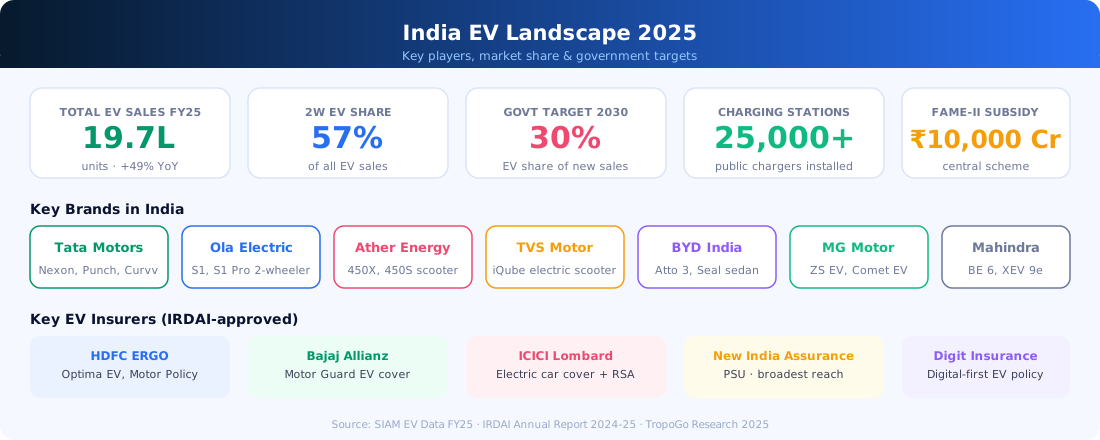
India is now the world's third-largest electric vehicle market by volume. In FY2025 alone, nearly 20 lakh EVs were sold — a 49% jump over the previous year. Tata Nexon EVs and Punch EVs account for most passenger car registrations; Ola Electric, Ather and TVS dominate two-wheelers. With the FAME-II subsidy, state-level incentives, and petrol prices above ₹100/litre in most metros, the financial case for going electric has rarely been stronger.
But the story most dealers don't tell you is this: replacing a lithium-ion battery pack on an EV costs ₹3–8 lakh — sometimes more than a year's worth of petrol savings. A standard motor insurance policy, designed for internal combustion engines, does not automatically cover this. EV owners need insurance built for EV-specific risks. This guide explains exactly what that means, what the right cover looks like, and why TropoGo is the right partner for it.
What is electric vehicle insurance?
Electric vehicle insurance is a motor insurance policy tailored to the unique risk profile of battery-powered vehicles. Like any motor policy regulated by IRDAI, it must include third-party liability cover (mandatory under the Motor Vehicles Act 1988). Beyond that, the intelligent additions specific to EVs are what make the difference between a claim that's fully settled and one that leaves you with a ₹5 lakh out-of-pocket expense.
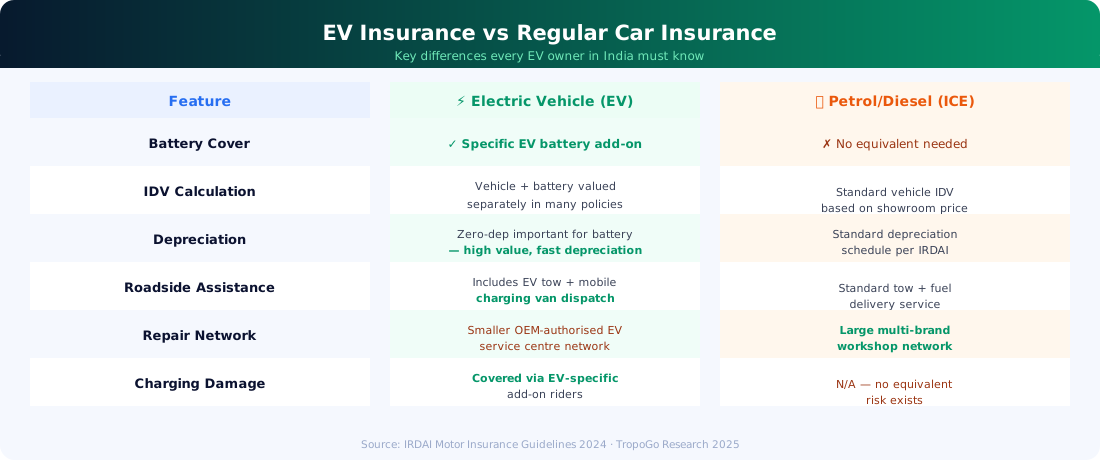
The core structural difference between EV and ICE (internal combustion engine) motor insurance is the battery. A standard ICE policy values the entire car at its Insured Declared Value (IDV) and covers it as a single unit. In an EV, the battery pack — worth ₹3–8 lakh and subject to its own depreciation schedule — may sit outside the standard IDV unless you add a specific battery cover rider. That gap is the single most important thing to close when buying EV insurance.
Battery pack replacement on a Tata Nexon EV: ₹5–7 lakh. Without insurance — you pay it all.Source: Tata Motors authorised service data · TropoGo Research 2025
How EV insurance differs from regular motor insurance
The core mandatory structure is the same — third-party liability and own-damage cover under IRDAI's Motor Insurance guidelines. But EV-specific risks create critical differences in what you should add to your base policy.
Battery cover — the non-negotiable add-on
Battery packs are not covered under standard motor own-damage policies unless you add a battery-specific rider. This add-on covers the battery against damage from accident, fire, or water ingress. Some policies also cover gradual degradation beyond a defined percentage — check the fine print. Without it, a collision that ruptures the battery module leaves you facing the single most expensive repair in EV ownership.
IDV and depreciation — two separate calculations
In a standard motor policy, the Insured Declared Value is calculated on the ex-showroom price of the car, with depreciation applied annually per IRDAI's schedule. For EVs, several insurers now calculate IDV in two components: the vehicle chassis + electronics, and the battery pack separately. The battery depreciates differently — lithium cells lose capacity faster in the first three years, so both IDV accuracy and zero-depreciation cover matter more for EVs than for ICE vehicles.
EV roadside assistance — mobile charging, not just a tow truck
Standard RSA policies send a mechanic with tools. EV RSA must also dispatch a mobile charging unit for range-anxiety breakdowns. Not all RSA riders bundled with EV policies cover mobile charging dispatch — confirm explicitly before signing.
India's EV landscape in 2025
The regulatory and commercial EV ecosystem in India has moved fast. Understanding the key players — from manufacturers to insurers — helps you choose both the right vehicle and the right cover.
Tata Motors is India's dominant EV passenger car maker with the Nexon EV, Punch EV and Curvv EV. Ola Electric leads the 2-wheeler segment ahead of Ather Energy and TVS iQube. Mahindra re-entered with the BE 6 and XEV 9e, while BYD and MG Motor are building premium EV market presence. The FAME-II programme has added 25,000+ public chargers nationally, with MeitY targeting 46,000+ by 2027.
Benefits of comprehensive EV insurance
Full battery protection. The costliest single component in any EV — a ₹3–8 lakh battery pack — is covered for accident, fire and in some plans, water-induced damage.
Zero depreciation on expensive parts. EV motors, inverters and power electronics are expensive to replace. Zero-dep cover eliminates the depreciation deduction at claim time, so you receive the full replacement cost.
EV-specific roadside assistance. Mobile charging dispatch for range-anxiety situations, flat-bed tow to an OEM-authorised EV workshop (not a generic mechanic), and 24/7 helpline.
Charging equipment damage cover. Home charger (EVSE) damage from power surge, fire or theft — available as an add-on rider with select insurers.
Third-party legal cover. Mandatory under the Motor Vehicles Act, but EV-specific policies now include clauses for EV-related incidents like charging cable trip hazards on third-party property.
No-Claim Bonus (NCB) retention. Like ICE motor policies, EVs earn 20–50% NCB for claim-free years, reducing renewal premiums progressively.
Challenges and things to watch out for
Limited OEM workshop network. Most EV insurers only pay for repairs at OEM-authorised centres. India's EV workshop network is a fraction of the size of multi-brand ICE workshops. Always confirm your city's network before buying.
Battery exclusions in the base policy. A standard own-damage policy — without the battery rider — explicitly excludes battery pack damage. This is the most common underinsurance mistake EV buyers make.
Higher premium vs ICE equivalent. EV insurance typically costs 10–20% more than a similar-priced ICE vehicle's cover, reflecting the higher battery replacement risk and smaller claims data pool for EVs.
Depreciation on battery IDV. Without zero-dep, your claim for battery damage in year 3 might settle at 50% of the replacement cost. Ensure you understand the depreciation schedule for the battery component specifically.
Charging infrastructure damage not always covered. Damage to third-party property caused by a faulty charging connector or cable is a grey area in most standard third-party covers. Verify with your insurer.
IRDAI regulatory framework for EV insurance in India
IRDAI regulates all motor insurance under the Insurance Act 1938 and Motor Vehicles Act 1988. For EVs, the key regulatory touchpoints are:
Third-party insurance is mandatory for any motor vehicle registered in India — EVs are no exception. Driving without TP cover attracts a fine of ₹2,000 for the first offence and ₹4,000 for repeat offences under the amended Motor Vehicles Act 2019.
IRDAI's 2022 EV product guidelines directed all motor insurers to offer EV-specific add-ons covering battery packs, external charging equipment and EV RSA as distinct product features rather than generic motor add-ons.
Bundled 5-year TP + 1-year OD policy — for new EVs, IRDAI mandates a 5-year third-party policy bundled with the first year's own-damage cover. From year 2 onwards, own-damage is renewed annually.
IDV for EVs — IRDAI allows insurers to separate battery IDV from vehicle IDV in policy documents. This creates transparency and allows accurate sum-insured for both components.
FAME-II compliance — vehicles availing FAME-II subsidy must maintain valid comprehensive insurance for the duration of the subsidy lock-in period (typically 3 years) as a condition of the scheme.
EV insurance built for India's electric revolution
Battery cover, zero depreciation, EV roadside assistance and charging damage protection — all in one IRDAI-approved policy stack from TropoGo.
Buying motor insurance for an EV from a generic motor aggregator is like buying health insurance from a stockbroker. The coverage gaps are invisible until claim time. TropoGo works with IRDAI-approved insurer partners who have built EV-specific product stacks — not generic motor policies with an EV label. Here is what we structure for you:
Own damage with separate battery IDV. Full replacement-value cover for the vehicle chassis and the battery pack, calculated as distinct IDV components — the correct structure for any EV policy.
Battery cover rider. Covers the battery pack against accident, fire, and water ingress. Some partner plans extend to mechanical failure due to thermal runaway — ask us to confirm on your specific vehicle.
Zero depreciation add-on. Eliminates depreciation deduction for all parts — including expensive EV-specific components (motor, inverter, BMS, power electronics) — giving you the full replacement cost at claim.
EV roadside assistance. 24/7 breakdown assistance including mobile charging van dispatch, flat-bed tow to OEM EV workshop, and key-lock service — built for EVs, not retrofitted from ICE RSA.
Charging equipment cover. Covers your home EVSE (charger unit) against fire, theft and power surge — an often-overlooked ₹30,000–60,000 asset that's excluded from standard home and motor policies.
Personal accident cover. Mandatory ₹15 lakh PA for owner-driver, with optional passenger PA for every seat — important if you operate your EV commercially or for app-based cab services.
Whether you drive a Tata Nexon EV, an Ola S1 Pro, an Ather 450X, a Mahindra BE 6 or a BYD Atto 3, the Electric Vehicle Insurance India page is where you start. We match your vehicle, your city and your usage pattern to the right policy — not a generic quote.
The outlook for EVs and EV insurance in India
India's government has set a target of 30% EV share in new vehicle sales by 2030. At current growth rates, total EVs on Indian roads will cross 5 crore by 2027. The IRDAI is actively working on standardising EV policy language and reducing the grey areas around battery cover and charging infrastructure. Insurers are building proprietary claims data on EVs for the first time, which will eventually reduce premiums as the risk pool matures. For now, the smart move is to get a well-structured EV-specific policy in place — and not discover its gaps the hard way.
FAQs about electric vehicle insurance in India
Is third-party insurance mandatory for electric vehicles in India?
Yes. Third-party insurance is mandatory for all motor vehicles in India under the Motor Vehicles Act 1988 — EVs are no exception. Driving without valid TP cover attracts a ₹2,000 fine (first offence) and ₹4,000 for repeat offences. For new EVs, IRDAI mandates a bundled 5-year TP policy with the first year of own-damage cover at purchase.
Does a normal car insurance policy cover an EV's battery?
Generally no. Standard own-damage motor policies do not automatically include the battery pack in coverage. You must add a specific battery cover rider. Without it, battery damage from an accident or fire is excluded — leaving you to pay ₹3–8 lakh out-of-pocket for replacement on most passenger EVs.
What is zero-depreciation insurance and why is it important for EVs?
Zero-depreciation (zero-dep) is an add-on that removes the depreciation deduction from claim settlements. Without zero-dep, the insurer pays only the depreciated value of a replaced part — so if your inverter or motor costs ₹2 lakh new, you may receive only ₹1.2 lakh after depreciation. Zero-dep is especially important for EVs because their key components (motor, inverter, BMS, battery) are expensive and depreciate fast.
How much does EV insurance cost compared to a petrol car?
EV insurance premiums are typically 10–20% higher than an equivalent ICE vehicle's cover, reflecting higher battery replacement costs and the smaller claims data pool available for EVs. However, the third-party premium for EVs is 15% lower than for ICE vehicles under IRDAI's rate schedule — a small incentive to encourage EV adoption. The net difference depends on the add-ons you choose.
What should I do if my EV breaks down on the road?
Call your insurer's EV roadside assistance helpline immediately. A good EV RSA policy will dispatch a mobile charging van if you've run out of charge, or a flat-bed truck (not a regular tow truck) to transport your vehicle to an OEM-authorised EV service centre. Do not allow a generic garage to work on an EV's high-voltage battery system — it can void your warranty and your insurance claim.
How do I get EV insurance through TropoGo?
Visit TropoGo's Electric Vehicle Insurance India page. We match your specific vehicle model, registration city and annual mileage to the right IRDAI-approved policy — including battery cover, zero-dep and EV RSA riders. For fleet EVs, commercial cab EVs or two-wheeler EV fleets, our desk structures group policies with tailored add-ons.
Your EV is your investment in India's clean-energy future. Protect it with insurance that actually understands what it covers — not a generic motor policy that leaves your ₹6 lakh battery pack in the fine-print exclusions.