Every year, millions of Indian families are pushed below the poverty line by a single medical emergency. The reason is not a lack of hospitals or doctors — it is the bill at the end of the ward stay. India spends 62% of its total health expenditure out-of-pocket, more than twice the global average of 27%. A single hospitalisation at a private hospital in a tier-1 city can cost ₹3–10 lakh. Without insurance, that bill lands entirely on the family.
Health insurance is the financial product designed to absorb that blow. This guide explains how it works, what the main plan types are, who the leading insurers are, what IRDAI's 2025 rule changes mean for you, and how to choose a policy that actually pays when it matters.
What is health insurance?
Health insurance is a contract between you (the policyholder) and an insurance company regulated by the IRDAI (Insurance Regulatory and Development Authority of India). In exchange for an annual premium, the insurer agrees to reimburse — or pay directly to the hospital — your qualifying medical expenses up to a pre-agreed sum insured.
The key mechanism is simple. You pay a predictable, manageable premium each year so that an unpredictable, potentially catastrophic medical bill does not wipe out your savings. In India, where most of the best hospitals are private and charge market rates, this protection is no longer optional — it is a financial necessity.
62% of Indian health spending is out-of-pocket — the highest among G20 economies.Source: National Health Accounts 2024 · IRDAI Annual Report 2024–25
Types of health insurance plans in India
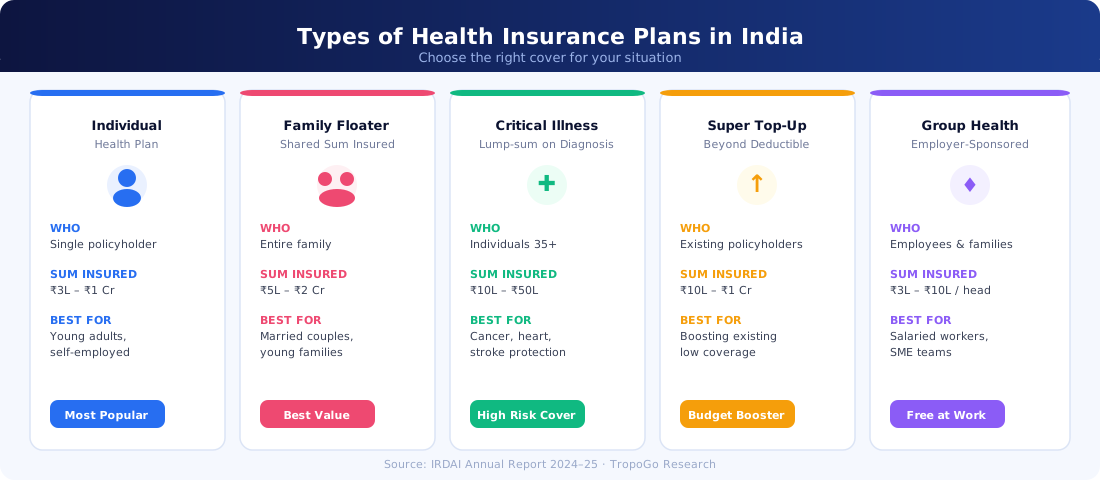
Not all health insurance policies are the same. Understanding the five main types helps you pick the right one — or the right combination — for your situation.
Individual health plan
The most straightforward — one policy, one person, one sum insured. If you are unmarried, self-employed, or want a higher cover than your employer provides, this is the starting point. Premiums depend on your age, pre-existing conditions and the sum insured you choose.
Family floater plan
A single policy with a shared sum insured that covers your entire family — typically spouse, children and parents. The shared pool is statistically cheaper than buying separate individual policies, because it is unlikely all members will be hospitalised in the same year. The risk is that a single large claim can exhaust the pool for everyone else. A sum insured of ₹15–25 lakh is the realistic floor for a metro family of four in 2025.
Critical illness cover
Pays a lump sum on diagnosis of a specified condition — cancer, heart attack, stroke, kidney failure, organ transplants and typically 20–36 other named illnesses. Unlike hospitalisation cover, it pays regardless of the actual medical bill, making it useful for income replacement during treatment and recovery. Best taken alongside a regular health policy, not instead of one.
Super top-up plan
Kicks in once your total hospitalisation bill in a year crosses a pre-set deductible — say, ₹5 lakh. Everything above that deductible, up to the policy limit, is covered. Premiums are low precisely because the insurer only pays above the deductible. If you have a ₹5 lakh employer policy or a basic individual plan and want to extend your protection to ₹25–50 lakh without a big premium jump, a super top-up is the most cost-efficient route.
Group health insurance
Employer-sponsored cover for employees and their dependants. No medical underwriting at entry, broad coverage from day one, and typically a lower premium than retail plans. The catch: it stops the moment you change jobs. Group health insurance should be treated as a bonus, not as your primary health safety net.
India's health insurance landscape in 2025
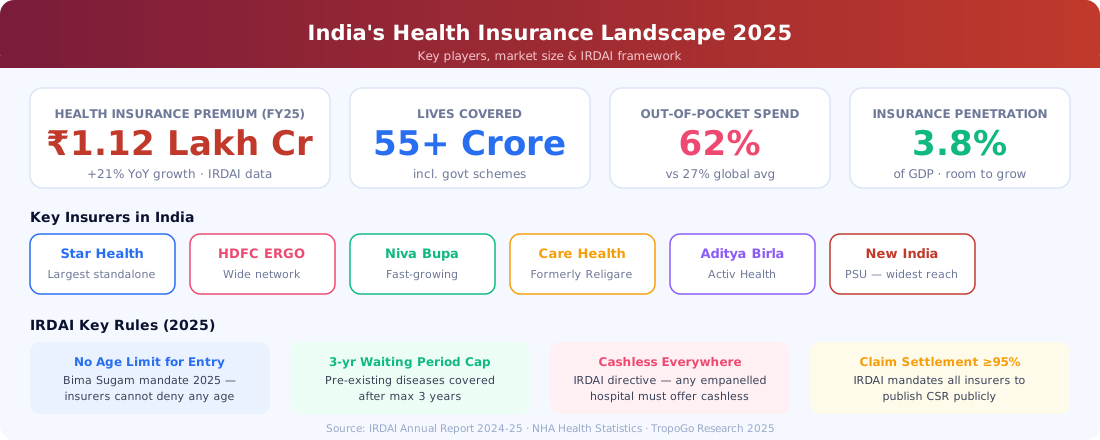
The Indian health insurance market has grown at over 20% per year for the past three years and crossed ₹1.12 lakh crore in premium in FY2025. Yet fewer than 41 crore Indians hold any form of private health insurance — leaving hundreds of millions exposed. Here is who the key players are and what IRDAI is doing to close that gap.
The dominant standalone health insurers are Star Health (the largest by premium), Niva Bupa (fastest growing), Care Health (formerly Religare), and Aditya Birla Activ Health. General insurers like HDFC ERGO, ICICI Lombard and the PSU quartet — New India Assurance, Oriental, National, United India — also write large health books. IRDAI's 2025 reform programme, branded Bima Sugam, is pushing all insurers to simplify products, make cashless claims universal and remove age caps on new policies.
Key benefits of health insurance
Hospitalisation cover. Room rent, surgeon fees, ICU charges, operation theatre, medicines and consumables — a good policy covers all of it up to the sum insured, with no out-of-pocket for network hospitals.
Pre- and post-hospitalisation expenses. Most standard plans cover diagnostic tests and specialist consultations for 30–60 days before admission and 60–90 days after discharge.
Day-care procedures. Cataract surgery, chemotherapy, dialysis and hundreds of other procedures that don't require an overnight stay are now covered as standard under all new IRDAI-compliant policies.
Ambulance cover. Ground and air ambulance charges up to ₹5,000–10,000 per hospitalisation.
Restore / recharge benefit. Leading insurers automatically reinstate your sum insured once it is exhausted within the year — critical for families using a floater where multiple members may claim.
No-Claim Bonus (NCB). Every claim-free year adds 5–50% to your sum insured without extra premium — a compound benefit that can double your cover over a decade.
Tax benefit. Premiums paid for self, spouse, children and parents are deductible under Section 80D of the Income Tax Act — up to ₹25,000 per year for self and family, and an additional ₹50,000 for senior citizen parents.
What health insurance does not cover
Every policy has exclusions. Understanding them before buying saves nasty surprises at claim time.
Pre-existing diseases (PED) are subject to a waiting period — now capped at 3 years under IRDAI's 2025 mandate, down from the previous 4-year industry standard.
The first 30-day waiting period for non-accident claims (except in employer group policies, which typically waive this).
Specific illness waiting periods — conditions like hernia, joint replacement, and cataracts often carry 1–2 year waiting periods even after the initial 30 days.
Cosmetic procedures, fertility treatment, self-inflicted injuries and experimental therapies are typically excluded.
OPD (outpatient) consultations and medicines are excluded from most standard plans — though add-on OPD riders are now widely available.
How cashless claims work in India
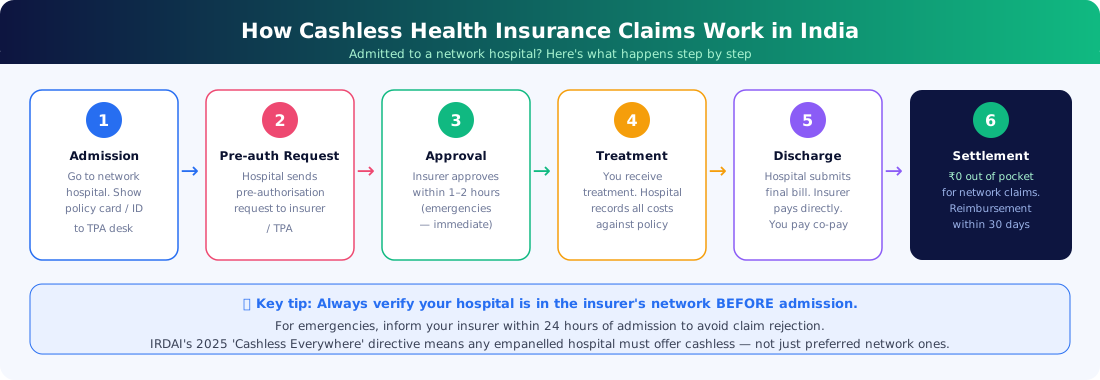
The cashless facility is what makes health insurance genuinely useful in an emergency. Instead of paying the hospital upfront and claiming reimbursement later, the insurer settles the bill directly with the hospital. For this to work, the hospital must be part of the insurer's network — and IRDAI's 2025 'Cashless Everywhere' directive now requires any hospital empanelled with any insurer to honour cashless claims for all.
IRDAI regulatory framework — what changed in 2025
IRDAI has been the most active regulator in India's insurance sector in 2024–25, with a clear mandate: increase coverage and reduce friction. The key changes that affect every health insurance buyer:
No age cap on fresh entry. Insurers can no longer decline a new policy solely on the basis of the applicant's age. Senior citizens above 65 who were previously turned away must now be offered cover.
PED waiting period capped at 3 years. Pre-existing diseases must be covered after a maximum 3-year waiting period across all plans.
Moratorium period reduced to 5 years. After 5 continuous years with no claim disputes, an insurer cannot reject a claim on the basis of non-disclosure of a pre-existing condition.
Cashless Everywhere. Any hospital that is empanelled with any insurer must provide cashless settlement — removing the network penalty for policyholders.
Mandatory claim settlement ratio disclosure. All insurers must publish their Incurred Claims Ratio (ICR) and Claims Settlement Ratio (CSR) publicly — making it easier to compare before buying.
Bima Sugam digital marketplace. A government-backed digital platform will allow policy comparison, purchase and claims from a single interface — being rolled out across 2025–26.
Find the right health insurance plan for your family
Individual, family floater and critical illness plans from IRDAI-approved insurers — compare premiums, sum insured and network hospitals in one place.
Health insurance is not a commodity. The same ₹15,000 annual premium can buy radically different cover depending on sub-limits, co-pay clauses, network size and the insurer's actual claims settlement record. TropoGo works with IRDAI-approved partners to structure health cover that performs when it matters — not just when you buy it. Here is what we help you access:
Individual and family floater plans with sum insured from ₹5 lakh to ₹2 crore, from leading standalone health insurers with claims settlement ratios above 95%.
Critical illness cover paying a lump sum on diagnosis of cancer, heart attack, stroke, organ failure and up to 36 other conditions — designed to replace income during treatment, not just pay the hospital.
Super top-up plans that extend your existing cover to ₹25–50 lakh at a fraction of the cost of a fresh high-sum policy.
OPD and wellness add-ons covering outpatient consultations, annual health check-ups, dental and vision — the everyday costs that eat into budgets even without hospitalisation.
Group health policies for SMEs and corporates — from 7-employee startups to large enterprises, with family cover, day-one PED waivers and no medical underwriting.
Senior citizen-focused plans with no upper age cap, pre-existing disease cover from year one (with IRDAI-compliant waiting period structures) and domiciliary cover for home treatment.
If you have outgrown your employer's group cover, just started a family, or are planning ahead for aging parents, the Health Insurance India page is the right starting point.
How to choose the right health insurance plan
Five questions narrow the field quickly. Answer these honestly before comparing premiums — the premium is the last thing to look at, not the first.
What is your city tier? Medical costs in Mumbai, Bengaluru and Delhi are 40–60% higher than in tier-2 cities. Metro residents need a minimum sum insured of ₹10 lakh for an individual and ₹20 lakh for a family of four.
Do you have pre-existing conditions? If yes, look for plans where the PED waiting period starts immediately rather than plans where it resets on porting — and check whether the insurer has a track record of honouring PED claims after the waiting period.
How good is your employer cover? If your company provides ₹5 lakh group cover, a ₹10 lakh super top-up at a ₹5 lakh deductible is far cheaper than buying a fresh ₹15 lakh individual policy.
Do you need critical illness cover separately? A standard hospitalisation plan pays the hospital. A critical illness plan pays you — covering lost income, home modification costs and anything else a hospitalisation bill doesn't capture. The two are complementary.
What is the insurer's Claims Settlement Ratio? Look for insurers with a CSR above 95% and an Incurred Claims Ratio (ICR) between 65–85% — a sign the insurer is paying legitimate claims but not under financial stress. IRDAI mandates this data to be publicly available.
The outlook for health insurance in India
India's health insurance market will cross ₹2 lakh crore in annual premium by 2028 at current growth rates. The structural driver is demographics: a rising middle class, increasing awareness of medical costs after the COVID-19 pandemic, IRDAI's regulatory push for simplification, and the Bima Sugam platform making comparison and purchase friction-free. The gap between those who need cover and those who have it is finally beginning to close — but the window to buy before your first major health event is always now, not later.
FAQs about health insurance in India
What is the minimum sum insured I should buy for health insurance in India?
Financial advisors recommend a minimum of ₹10 lakh for an individual and ₹20–25 lakh for a family floater in metro cities, given the rising cost of private hospitalisation. If budget is tight, a ₹5 lakh base plan combined with a ₹20 lakh super top-up (₹5 lakh deductible) is an affordable alternative that provides meaningful protection.
Can I get health insurance if I have a pre-existing condition like diabetes or hypertension?
Yes. Under IRDAI's 2025 rules, no insurer can deny cover solely on the basis of a pre-existing condition. The PED will typically be subject to a waiting period of up to 3 years, after which it is covered. Some plans offer PED cover from year one at a higher premium — check with your advisor whether the premium uplift is worth it based on your condition's likely treatment costs.
Is health insurance premium deductible under income tax?
Yes. Under Section 80D of the Income Tax Act, premiums paid for yourself, your spouse and children qualify for a deduction of up to ₹25,000 per year (₹50,000 if you are a senior citizen). An additional ₹25,000–₹50,000 deduction is available for premiums paid for parents — the upper limit applies if either parent is a senior citizen.
What is the difference between a family floater and individual health plans?
A family floater policy covers the entire family under a single shared sum insured. Any family member can use any part of it — but if one person makes a large claim, the pool available to others in the same year reduces. Individual plans give each person their own dedicated sum insured. Floaters are cheaper; individual plans are safer when the family includes a senior citizen with a higher claim likelihood.
How does the cashless claim process work in India?
At a network hospital, the hospital's TPA desk sends a pre-authorisation request to your insurer. Approval typically comes within 1–2 hours for planned procedures (immediately for emergencies). You are discharged without paying the insured amount — only non-covered items or co-pay amounts need to be settled at the counter. IRDAI's 2025 Cashless Everywhere directive extends this to any empanelled hospital, not just 'preferred' network hospitals.
How do I buy health insurance through TropoGo?
Visit TropoGo's Health Insurance India page to compare plans from IRDAI-approved insurers, check network hospital lists, and get a personalised premium quote. For group policies covering your team, our desk structures plans from 7 employees upwards — no minimum head count for basic cover.
Medical emergencies are unpredictable. Your financial exposure to them doesn't have to be. Get the right health insurance plan in place before you need it — because health insurance you buy after a diagnosis is worth far less than the one you buy today.