Marine cargo insurance is a policy that protects the physical goods you are shipping — by sea, air, road, or rail — against financial loss from accidental damage, theft, fire, natural disasters, or total loss during transit. Despite its name, "marine" cargo insurance in India covers far more than ocean shipments: it applies to any goods in transit from one location to another, whether across Indian roads or across the Pacific Ocean.
For Indian businesses engaged in import, export, or domestic trade, marine cargo insurance is the critical financial safety net between a successful delivery and a crippling write-off. India's foreign trade stood at over ₹18 lakh crore in FY 2024-25, with the country ranking among the world's top 10 trading nations. Every rupee of that trade faces transit risk — and marine cargo insurance is the instrument that manages it.
The ICC Clauses: Understanding What is Covered
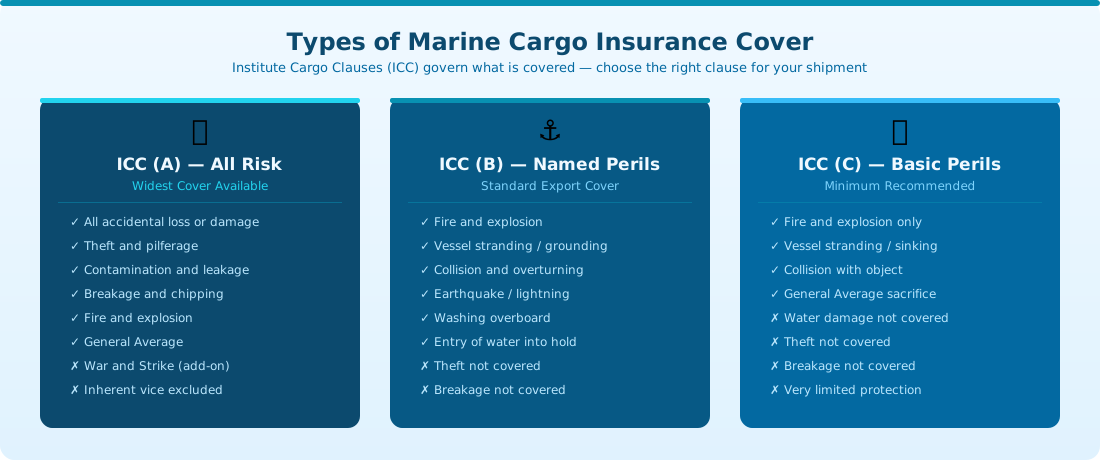
Marine cargo insurance policies in India follow internationally standardised Institute Cargo Clauses (ICC), developed by the London Institute of Underwriters. These clauses define precisely what perils are covered, and come in three tiers — A, B, and C.
ICC (A) — All Risk
The broadest cover available. ICC (A) covers all accidental loss or damage to the insured cargo during the voyage unless specifically excluded. This includes theft, pilferage, leakage, breakage, contamination, sweat damage, and damage caused by rough handling at ports. Exclusions under ICC (A) include deliberate damage by the insured, inherent vice of the goods (such as fruit rotting naturally), war (unless added via a War Clause), and strikes (unless added via a Strikes Clause). ICC (A) is recommended for high-value, fragile, or theft-prone cargo.
ICC (B) — Named Perils
ICC (B) provides cover against a specific list of named perils: fire and explosion, vessel stranding or grounding, sinking or capsizing, overturning or derailment of land conveyance, collision, earthquake, lightning, washing overboard, and entry of sea, lake or river water into the vessel or container. Critically, ICC (B) does not cover theft or pilferage, and does not cover breakage of fragile goods unless caused by a listed peril.
ICC (C) — Basic Perils
ICC (C) is the minimum standard cover and is appropriate only for robust cargo that is unlikely to be stolen or broken. It covers fire, explosion, vessel stranding, sinking, collision, and General Average sacrifice. It does not cover water damage, theft, or breakage. Indian importers and exporters should treat ICC (C) as the absolute floor — and in most cases should upgrade to ICC (B) or ICC (A) for meaningful protection.
India's Major Trade Corridors and Ports
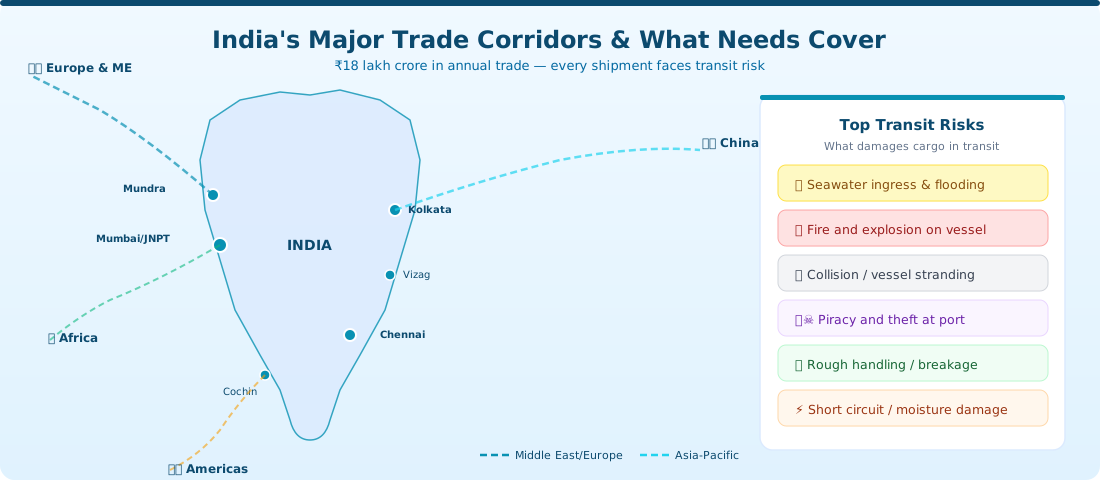
India has 12 major ports and 200+ minor ports handling over 1,400 million metric tonnes of cargo annually. The busiest gateways — JNPT (Mumbai), Mundra (Gujarat), Chennai, Kolkata/Haldia, and Visakhapatnam — together process the bulk of container traffic. Each port presents distinct cargo risks: JNPT's high container volumes create pilferage pressure; Kolkata's monsoon environment creates moisture and flooding risk; Chennai and Vizag face cyclone exposure during the northeast monsoon season.
India's three key trade corridors are the Western route (to the Middle East, Africa, and Europe via the Arabian Sea), the Eastern route (to Southeast Asia, China, Japan and South Korea via the Bay of Bengal), and the Southern route (to Australia and the Americas via the Indian Ocean). Each corridor carries distinct peril profiles — piracy risk is higher on some African routes, weather risk peaks in certain seasons, and port-side theft varies by country of destination. Marine cargo insurance must be structured to match these route-specific risks.
What Does Marine Cargo Insurance Actually Cover?
Physical loss or damage in transit: The core cover — pays for cargo damaged or lost during the voyage, whether by sea, air, road or rail under a multimodal policy.
General Average contribution: When a ship's master jettisons some cargo to save the vessel and remaining cargo, all cargo owners must contribute proportionally to the loss. Marine cargo insurance covers your share of this contribution — which can be significant on large vessels.
Salvage charges: Costs incurred by third parties who save your cargo from a peril of the sea. Your insurer covers these charges up to the insured value.
Sue and Labour charges: Reasonable costs you incur to prevent or minimise a covered loss — such as emergency repackaging at a transit port. ICC policies cover these costs in addition to the claim.
War and Strike risks: Available as add-ons via the Institute War Clauses and Institute Strike Clauses. Essential for shipments to conflict-adjacent regions or countries with significant labour unrest.
Open Cover vs. Voyage Policy: Which is Right for Your Business?
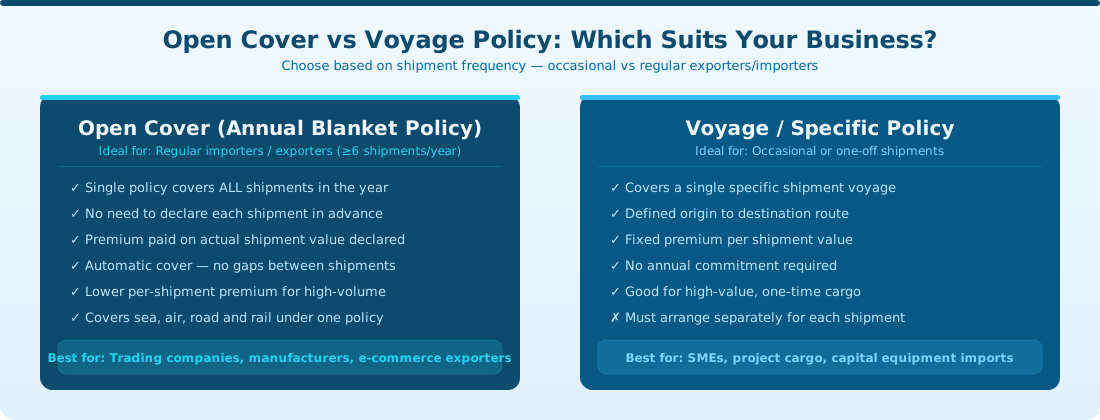
Indian businesses that ship goods regularly should consider an Open Cover policy, also called a floating policy or blanket policy. An open cover is an annual master policy that automatically covers every shipment declared under it, up to the agreed maximum value per shipment. Instead of arranging a new policy for each cargo movement, the exporter simply declares each shipment to the insurer and receives a certificate of insurance. This is administratively efficient, ensures no shipment is accidentally left uninsured, and typically attracts lower per-shipment premiums due to volume.
A Voyage Policy (or specific policy) covers a single shipment from a defined origin to a defined destination. It is appropriate for businesses that ship infrequently, for high-value one-off imports of capital equipment, or for project cargo. For regular exporters — particularly those shipping under Letters of Credit (LCs) where the bank requires evidence of cargo insurance — an open cover is almost always the better choice. Similar to how two-wheeler owners choose between TP and comprehensive cover based on their needs, marine cargo buyers must match policy structure to shipment frequency.
The Regulatory Framework: IRDAI and the Marine Insurance Act
Marine cargo insurance in India is governed by two primary instruments: the Marine Insurance Act, 1963 — which codifies the rights and obligations of insurers and policyholders in marine insurance contracts — and IRDAI regulations, which govern who can sell marine policies and how claims must be handled.
Under IRDAI's guidelines, marine cargo insurance can be issued by any general insurer licensed in India. Policies must be denominated in Indian Rupees, though the insured value may be referenced in the invoice currency (USD, EUR, etc.) with the exchange rate fixed at the time of the shipment. IRDAI mandates that insurers settle marine cargo claims within 30 days of receiving all claim documents — a shorter timeline than some other general insurance classes, reflecting the commercial urgency of trade finance.
A key Indian regulatory nuance: the buyer of goods (importer) typically insures the cargo when shipping on CIF (Cost, Insurance, Freight) Incoterms, while the seller (exporter) insures when shipping on FOB (Free On Board) terms. Many Indian exporters who sell FOB mistakenly assume the foreign buyer will arrange adequate insurance — in practice, this creates gaps that leave the exporter's reputation at risk when a claim arises. Arranging insurance regardless of Incoterms is best practice. Just as comprehensive car insurance goes beyond the mandatory third-party minimum, ICC (A) all-risk cover goes well beyond the ICC (C) minimum that banks often require.
Why Marine Cargo Insurance is Non-Negotiable for Indian Businesses
Whether you are a textile exporter shipping containers to the EU, a pharma company importing APIs from China, or an electronics distributor moving goods by road between Bangalore and Delhi, your cargo faces real transit risks at every stage. Marine cargo insurance provides six critical protections that no trade finance or supply chain strategy can replace:
Physical Loss Cover: Pays the insured value of goods lost in transit — whether stolen from a container, washed overboard, or destroyed in a warehouse fire at a transit port.
Damage Cover: Pays for the cost of damaged goods that arrive at destination unusable or requiring costly reconditioning — covering everything from seawater ingress to forklift puncture damage.
General Average: Covers your forced contribution to losses shared across all cargo owners when the vessel master sacrifices cargo to save the ship — a cost that can equal 5–30% of cargo value.
War and Piracy Risk: Available as add-on clauses for shipments through high-risk zones such as the Gulf of Aden, Red Sea, and Gulf of Guinea — currently active risk areas on major trade routes.
LC and Bank Compliance: Most Letters of Credit issued by Indian banks require the cargo to be insured under ICC (A) or (B) as a condition of payment. An open cover policy with regular insurance certificates satisfies this requirement seamlessly.
Working Capital Protection: A lost or damaged shipment without insurance can destroy a small exporter's cash flow instantly. Marine cargo insurance converts that catastrophic risk into a manageable, predictable premium cost.
TropoGo's specialist marine cargo insurance desk works with IRDAI-approved marine underwriters to structure ICC (A), (B), and (C) policies, open covers, voyage policies, war clauses, and multimodal inland transit cover for businesses of all sizes — from first-time exporters to established trading houses.
Marine cargo insurance protects the physical goods you ship — by sea, air, road or rail — against loss, damage and theft in transit. Any Indian business that imports, exports, or regularly ships goods domestically should carry marine cargo insurance. It is particularly critical for businesses operating under Letters of Credit, which typically require evidence of cargo insurance as a condition of payment.
What is the difference between ICC A, ICC B and ICC C cover?
ICC (A) is all-risk cover — it covers all accidental loss or damage unless specifically excluded. ICC (B) covers named perils including fire, vessel stranding, collision and earthquake, but not theft or breakage. ICC (C) is basic cover for fire, explosion and major maritime accidents only. For most Indian exporters and importers, ICC (A) is strongly recommended — particularly for containerised cargo where theft, moisture and handling damage are common risks.
What is an open cover in marine cargo insurance?
An open cover (also called a floating or blanket policy) is an annual master policy that automatically covers all shipments declared under it, up to a maximum per-shipment limit. Instead of buying a separate policy for each consignment, the policyholder simply declares each shipment and receives a certificate of insurance. Open covers are more cost-efficient for businesses with six or more shipments per year, and ensure no shipment is accidentally left uninsured.
Does marine cargo insurance cover domestic road transport in India?
Yes. Marine cargo insurance in India, under the Marine Insurance Act, 1963, covers goods in transit by any mode of transport — sea, air, road and rail. An inland transit policy (sometimes called a marine inland policy) covers domestic road and rail movements from the supplier's warehouse to the buyer's doorstep. This is distinct from an international marine policy but is issued and regulated under the same statutory framework.
How is marine cargo insurance premium calculated in India?
Marine cargo premium is typically expressed as a percentage of the cargo's CIF (Cost + Insurance + Freight) value, plus a standard 10% uplift. The rate depends on the commodity type, origin and destination, mode of transport, packaging, ICC clause chosen, and the policyholder's claims history. For open cover policies, rates are negotiated annually based on the total volume of shipments. Premium rates typically range from 0.05% to 0.5% of cargo value, making it one of the most cost-effective forms of business insurance.
Where can Indian businesses get specialist marine cargo insurance?
TropoGo offers specialist marine cargo insurance for Indian importers and exporters — covering ICC (A), (B), and (C) clauses, open cover and voyage policies, war and strike riders, and multimodal inland transit cover. With IRDAI-approved underwriters and dedicated claims support, TropoGo is built for India's trading businesses. Get your marine cargo insurance quote today.
Shipping Without Marine Cargo Insurance? Your Business is Carrying All the Risk.
A single container lost at sea or damaged at port can wipe out months of working capital. TropoGo's specialist marine cargo desk structures ICC (A) all-risk cover tailored to your trade corridors.