Every four minutes, someone in India dies from a preventable condition that could have been treated had they reached the right hospital in time. In a country of continental scale — where the nearest cardiac cath lab can be a six-hour mountain drive from a remote district — the helicopter ambulance is not a luxury. It is infrastructure. Air ambulances compress that six-hour drive into 45 minutes, keeping critically ill patients alive long enough to reach definitive care.
India's air ambulance sector has grown significantly over the past decade. With 200+ registered operators, a maturing DGCA regulatory framework, and expanding insurance support from IRDAI, the ecosystem is more accessible than ever — yet still poorly understood by the hospitals, corporates, and families who need it most. This guide explains what an air ambulance is, how the different types work, who the major Indian operators are, what regulations apply, and why specialist insurance is the operational backbone of every legitimate air ambulance service.
What is an air ambulance?
An air ambulance is an aircraft — typically a helicopter or fixed-wing plane — configured as a flying intensive care unit. Unlike a commercial air medical seat or a standard charter, a true air ambulance carries purpose-built medical equipment operated by trained aeromedical crew. The cabin is equipped to deliver hospital-grade care in the air: ventilators, defibrillators, infusion pumps, patient monitoring systems, and, in specialised variants, neonatal incubators or ECMO machines.
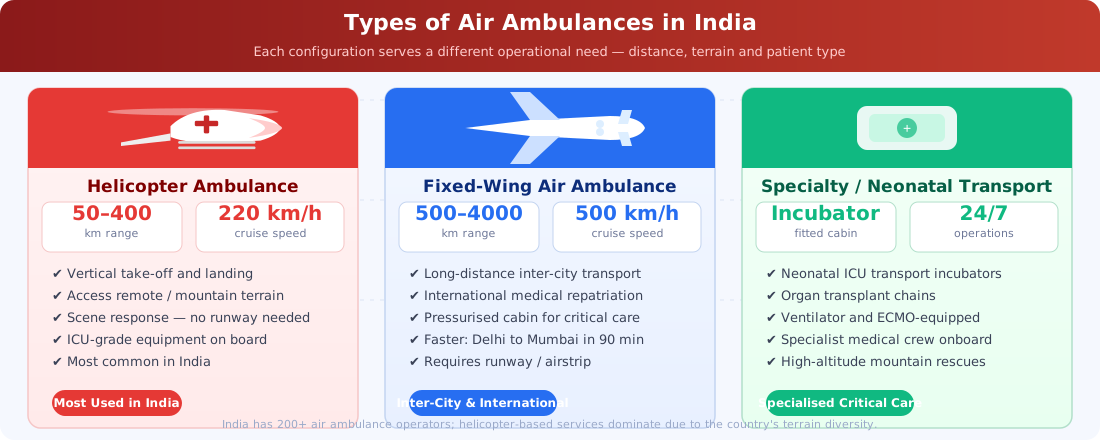
The term covers three distinct operational categories in India. Understanding which is needed for a given patient determines both cost and outcome.
Helicopter ambulance
The most common form in India. A helicopter ambulance takes off and lands vertically — no runway needed — making it the only viable option for mountain rescues in the Himalayas, scene response in congested Indian cities, or transfer from a hospital roof. Range is typically 50–400 km and cruise speed 200–220 km/h. Popular airframes in India include the Bell 407, Airbus H125 and H145, and the older Dauphin fleet operated by government agencies.
Fixed-wing air ambulance
For inter-city transfers of 500 km or more — Delhi to Chennai, Mumbai to Singapore — a pressurised fixed-wing aircraft is faster and better suited to transporting critically ill patients at altitude. Indian operators use turboprop aircraft like the King Air 350 or light jets like the Learjet 45 and Citation series, fitted with stretcher systems, medical gas supply and ICU-grade monitoring. Flight time from Delhi to Mumbai is 90 minutes; door-to-door from AIIMS Delhi to Apollo Chennai under 4 hours including ground legs.
Specialty and neonatal transport
A subset of both types above, configured for a specific patient population. Neonatal transport aircraft carry a certified transport incubator, servo-controlled environment and a dedicated neonatal nurse or intensivist. Organ transplant teams use specially fitted aircraft with cold-chain containers and a surgical team onboard. These variants require additional DGCA permissions and carry the most complex insurance requirements.
How does an air ambulance mission work?
From the moment a call is placed, a typical Indian air ambulance mission follows a tight choreography of dispatch, medical stabilisation, flight, and handover. Speed at each step is the difference between survival and mortality for time-critical conditions — cardiac arrest, stroke, polytrauma, and neonatal emergencies above all.
The "Golden Hour" — and why air matters in IndiaFor major trauma and STEMI (heart attack), clinical outcomes deteriorate sharply beyond 60 minutes from injury to definitive care. India's road ambulance network covers only ~60% of districts. Air ambulances bridge the gap in the remaining 40% — roughly 300 million people in remote and hilly terrain.
Typical mission sequence: (1) Emergency call routed to dispatch — operator nominates nearest available aircraft and crew. (2) Flight nurse or paramedic briefs referring hospital on what stabilisation to perform before departure. (3) Aircraft mobilises — average wheels-up time for established operators is 20–40 minutes. (4) En route, pilot files IFR or VFR flight plan with ATC; crew prepares equipment for patient type. (5) Patient loaded, stabilised, and monitored throughout flight. (6) Receiving hospital pre-alerted; direct handover to ICU or catheterisation lab on arrival.
Air ambulance operators in India — the landscape
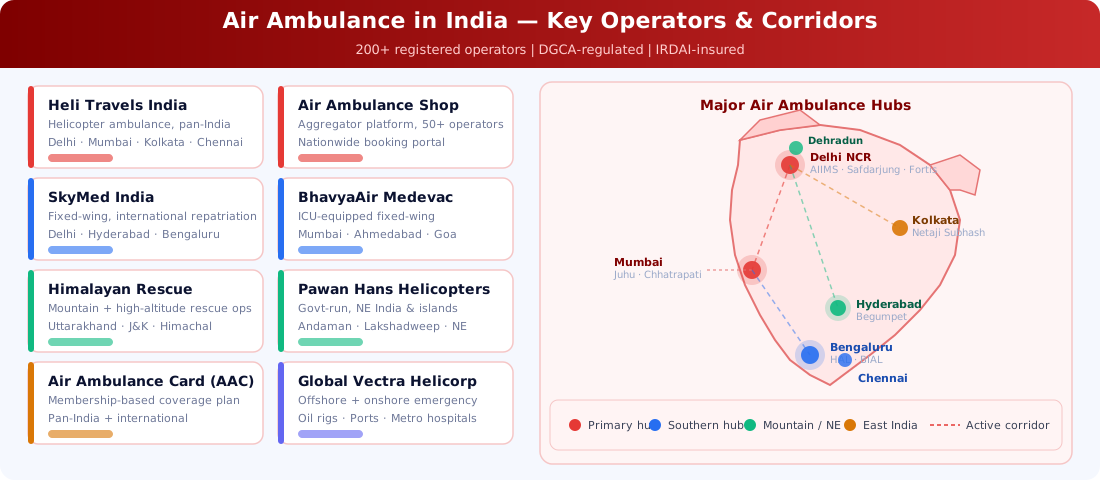
India has over 200 entities registered with the DGCA to provide air ambulance services, ranging from large national operators with 24/7 dispatch to state government health departments with a single contract helicopter. The map below shows the major hubs and operators.
Heli Travels India / Air Ambulance Aviation: Among the largest private operators, running helicopter and fixed-wing fleets from Delhi, Mumbai, Kolkata and Chennai with true 24/7 dispatch capability.
Pawan Hans Helicopters: Government-owned, operating in North-East India, Andaman & Nicobar Islands, Lakshadweep, and state government contracts in Maharashtra and Uttarakhand. Critical for island and tribal area coverage.
Global Vectra Helicorp: Offshore and onshore emergency services with a focus on oil & gas sector and industrial campuses.
SkyMed International / BhavyaAir: Specialist in international medical repatriation — bringing Indian nationals home from the Gulf, South-East Asia and East Africa on fixed-wing ICU-equipped aircraft.
Himalayan Rescue / state aviation wings: Uttarakhand, Himachal Pradesh, Jammu & Kashmir and Sikkim all maintain dedicated search-and-rescue and HEMS (Helicopter Emergency Medical Services) contracts for high-altitude operations.
Air Ambulance Card (AAC) and aggregators: Membership-based models that give corporates and individuals guaranteed response across multiple operators' fleets — increasingly popular with large employers in remote mining, infrastructure and energy sectors.
Benefits of air ambulance services
Speed where roads fail. Mountain terrain, monsoon-flooded roads and urban traffic gridlock can make a 200-km road journey take 8+ hours. A helicopter covers the same distance in 60–75 minutes.
ICU-standard care in flight. Modern air ambulances carry the same monitors, ventilators and infusion systems as a tertiary hospital ICU — the patient's condition can be actively managed rather than simply monitored.
Access to specialist centres. Remote hospitals can stabilise patients and transfer them to AIIMS Delhi, Tata Memorial Mumbai, Narayana Health Bengaluru or Apollo Hyderabad within hours rather than days.
Disaster and mass-casualty response. Following the 2013 Kedarnath floods and 2021 Chamoli disaster, air ambulances evacuated hundreds of critically injured patients from locations inaccessible by road.
Neonatal and maternal care. High-risk newborns and complicated pregnancies in tier-2 and tier-3 cities can reach a Level III NICU within hours of birth — directly improving survival rates for premature and sick neonates.
For a detailed side-by-side breakdown of when air transport outperforms a road ambulance — factoring terrain, response time, cost, and clinical capability — see our air ambulance vs ground ambulance comparison.
Challenges facing the sector
Cost and affordability. A helicopter ambulance mission in India costs ₹1.5–6 lakh depending on distance and aircraft type. Fixed-wing international repatriation can run ₹10–40 lakh. Without insurance, most families cannot access the service at the moment of crisis.
Helipad availability. Only a fraction of India's 25,000+ hospitals have helipads. The Ministry of Health's 2020 guidelines called for helipads at all district hospitals, but implementation remains uneven — particularly in eastern and central India.
Pilot and crew supply. India has fewer than 700 commercially licensed helicopter pilots. The aeromedical specialist — a nurse or paramedic trained to work in cramped, vibrating, high-altitude cabins — is even rarer.
ATC and airspace coordination. Air ambulances fly under the same IFR/VFR clearance system as commercial aviation. During busy periods at major airports, delays in clearance can erode the clinical time advantage.
Regulation fragmentation. An air ambulance mission crosses DGCA (aviation), IRDAI (insurance), Ministry of Health (medical standards), and state health departments. No single authority has end-to-end oversight, creating paperwork friction for operators.
India's regulatory framework for air ambulances
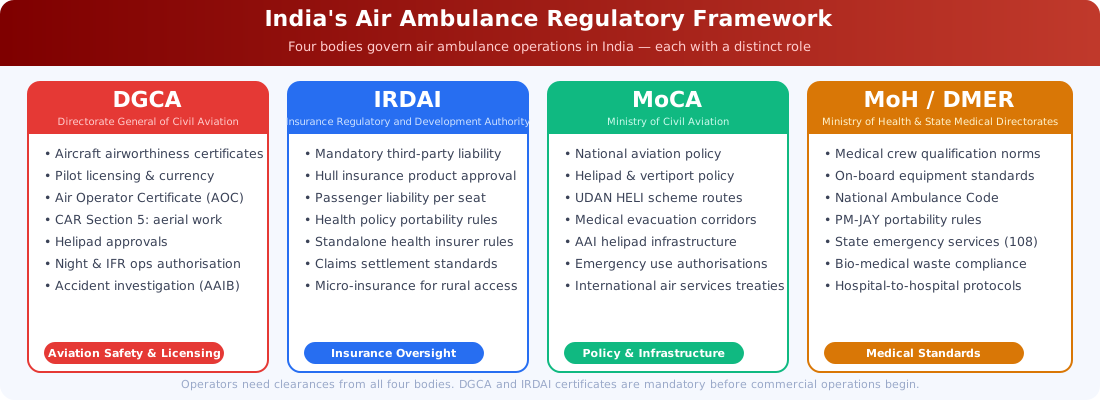
Four bodies govern the air ambulance space in India. Each plays a distinct role and operators must satisfy all four before they can call themselves compliant.
Key regulatory milestones:
The Civil Aviation Requirements (CAR) Section 5, Series B, Part III governs aerial work including air ambulance operations. Operators must hold a valid Air Operator Certificate (AOC) and apply for an aerial work permission specifically covering ambulance operations.
The National Ambulance Code (2013), issued by the Ministry of Health, sets minimum standards for medical equipment, crew qualifications, infection control and documentation — applicable equally to ground and air ambulances.
IRDAI's Aviation Hull and Liability guidelines set the minimum insured values for aircraft hull and third-party liability — a floor below which no commercial operator can legally fly passengers for hire.
The UDAN-HELI scheme under MoCA subsidises helicopter operations on remote and inaccessible routes, with a portion of the fleet made available for medical emergencies under state government contracts.
For the full compliance picture — AOC timelines, CAR Section 8 requirements, helipad approvals, and IRDAI's ₹50 crore insurance mandate — read our dedicated guide to India's Air Ambulance Regulations.
Air Ambulance Insurance, built for Indian operators
Hull, third-party liability, medical liability and crew cover from IRDAI-approved partners — structured for helicopter and fixed-wing operators, hospitals and medevac companies.
Why insurance is not optional for air ambulance operators
An air ambulance operator faces a uniquely concentrated risk profile: a high-value aircraft, a critically ill patient, challenging operating environments (mountains, night flights, monsoon weather) and a medical duty of care — all compressing into a single 45-minute flight. The consequences of an uninsured incident are existential for the operator and catastrophic for the patient's family. A properly structured insurance stack covers six layers:
Hull all-risk insurance — covering the aircraft, avionics, medical equipment installation and rotors against damage, loss or total hull loss. For a mid-size helicopter like the H145, hull value can exceed ₹50 crore.
Third-party liability (TPL) — mandatory under DGCA rules. Covers bodily injury and property damage to third parties on the ground or in the air caused by the aircraft.
Passenger liability — per-seat cover aligned with the Montreal Convention and DGCA Schedule II requirements for the patient and accompanying medical crew travelling as passengers.
Medical malpractice / professional indemnity for aeromedical crew — covers claims arising from in-flight medical decisions, drug administration errors or treatment outcomes during transport.
Crew personal accident — covering pilots and flight nurses/paramedics for death, permanent disability and temporary total disablement arising from an aviation accident or in-flight medical incident.
Loss of licence insurance — protecting pilots whose commercial licence is revoked following a medical condition, safeguarding income for the operator's key crew members.
TropoGo's specialist aviation desk structures all six layers into a single India-specific policy through IRDAI-approved partners. Whether you operate a single helicopter from a tier-2 city hospital or run a multi-aircraft national medevac fleet, the Air Ambulance Insurance India page is the right starting point.
How much does an air ambulance cost in India?
Costs vary significantly by aircraft type, distance, and the level of medical crew deployed. Rough benchmarks for 2026:
Helicopter ambulance (intra-city / short hop, <100 km): ₹1.5–2.5 lakh per mission.
Helicopter ambulance (inter-city, 100–400 km): ₹3–6 lakh per mission.
Fixed-wing (domestic, 500–2,000 km): ₹6–15 lakh per mission.
Fixed-wing (international repatriation): ₹15–40 lakh, depending on origin country, distance and medical configuration.
Neonatal transport (helicopter, specialised incubator): ₹2–4 lakh, often partially covered under state government NHM schemes in some states.
For corporates, NGOs and high-risk-industry employers, an Air Ambulance Membership Card (₹15,000–50,000/year per covered life, depending on scope) eliminates the scramble to find an operator at 2 a.m. and guarantees a known, contracted rate.
The outlook — where air ambulance is headed in India
Three structural tailwinds are set to expand the sector through 2030. First, the government's push to build helipads at all district hospitals (900+ target sites) will dramatically increase the number of viable landing zones across the country. Second, eVTOL air taxi infrastructure — vertiports in Mumbai, Delhi, Bengaluru — will double as air ambulance landing pads in medical emergencies, at lower operating cost than a traditional helicopter. Third, group health insurance and PM-JAY portability rules are gradually expanding to include air ambulance costs as a covered benefit, making the service accessible beyond the C-suite.
For operators, the immediate priority is building a fully compliant insurance stack before expanding fleet or routes. DGCA enforcement of AOC conditions and IRDAI's growing scrutiny of aviation liability products mean that under-insured operators face grounding, not just fines. Our forward-looking analysis on the future of air ambulance services in India examines these trends in depth.
FAQs — air ambulances in India
How do I arrange an air ambulance in India quickly?
Call a national aggregator like Air Ambulance Card, Heli Travels India or Air Ambulance Aviation — they operate 24/7 dispatch desks. Provide the patient's current location, destination hospital, and primary diagnosis. Expect a confirmed aircraft and crew within 30–60 minutes for metro-based missions; 60–90 minutes for remote locations.
Does health insurance in India cover air ambulance costs?
Some comprehensive group health and individual health policies include air ambulance as a sub-limit (typically ₹2–5 lakh). Standalone air ambulance membership cards offer guaranteed coverage without the sub-limit uncertainty. Always check the specific policy wording — many standard retail health policies exclude air ambulance entirely.
What medical equipment is carried on an Indian air ambulance?
A compliant air ambulance under the National Ambulance Code carries a transport ventilator, multi-parameter patient monitor (ECG, SpO2, NIBP, EtCO2), defibrillator/AED, infusion pumps, oxygen supply, emergency drug kit, and suction unit. Neonatal variants add a transport incubator with integrated monitoring.
Can an air ambulance land at any hospital?
Only hospitals with a DGCA-compliant helipad can receive a helicopter ambulance directly. India has approximately 800 operational hospital helipads — growing toward the government's target of one per district hospital. Fixed-wing aircraft always require a licensed airstrip or airport and then a ground ambulance for the final leg.
What DGCA approvals does an air ambulance operator need?
An operator must hold a valid Air Operator Certificate (AOC) with an aerial work — air ambulance endorsement, have DGCA-approved crew training records, maintain aircraft to CAR-M airworthiness standards, carry the minimum hull and liability insurance required under Schedule II, and register each mission via the DGCA's e-GCA portal.
What insurance does an air ambulance operator need in India?
A compliant operator needs hull all-risk, third-party liability, passenger liability per seat, aeromedical crew professional indemnity, crew personal accident, and ideally loss-of-licence cover. TropoGo's Air Ambulance Insurance desk structures all six covers into a single India-specific policy through IRDAI-approved partners.
If you operate, finance or manage an air ambulance service — or are a hospital or corporate looking to put guaranteed medevac cover in place — speak to TropoGo's specialist aviation insurance desk. We've placed cover for India's leading aerial operators and we know exactly what DGCA and IRDAI require.