Every minute matters in a medical emergency. Whether a road accident victim needs urgent trauma care, a premature infant must be transferred between NICUs, or a stroke patient needs a specialist neurologist city away, the transport decision can be the difference between life and death. In India, that decision has traditionally been binary: call the nearest road ambulance. But a rapidly growing air ambulance industry is changing the calculus — and with it, the insurance landscape.
This guide compares air and ground ambulance transport across the dimensions that emergency planners, hospital administrators, and insurance buyers care most about: speed, clinical capability, terrain reach, cost, and regulatory compliance. It also explains where specialist air ambulance insurance fits into every operator's risk framework.
What Is a Ground Ambulance?
A ground ambulance is a road vehicle — typically a customised van or minibus — equipped with Basic Life Support (BLS) or Advanced Life Support (ALS) equipment. In India, ground ambulances range from the government's free 108 Emergency Service (operational in 31 states) to private ALS ambulances run by networks like Ziqitza, Falck India, and StanPlus. Cost is low, availability is high, and for the vast majority of emergencies within a city or nearby district, they remain the right first choice.
Limitations emerge when distance grows, when traffic chokes city arteries, when terrain becomes mountainous or flood-prone, or when the patient's clinical condition requires continuous intensive care during transport — the kind that ground ALS units simply cannot replicate.
What Is an Air Ambulance?
An air ambulance is a medically equipped aircraft — either a helicopter or a fixed-wing plane — staffed by doctors, paramedics, and flight nurses, and outfitted with ICU-grade equipment: ventilators, cardiac monitors, defibrillators, blood pressure management systems, and in neonatal cases, transport incubators. In India, the market includes operators such as Air Rescue India, CEGA Air Ambulance, Comsovereign, BLS Air Ambulance, and Fortis Healthcare's aeromedical evacuation partnerships.
Helicopters dominate short-to-medium range missions (50–300 km) and excel at landing in confined urban spaces — hospital helipads, sports stadiums, highway medians. Fixed-wing aircraft take over for inter-city or international repatriation missions where distances exceed 300 km and a proper airstrip is accessible.
Head-to-Head: Air vs Ground
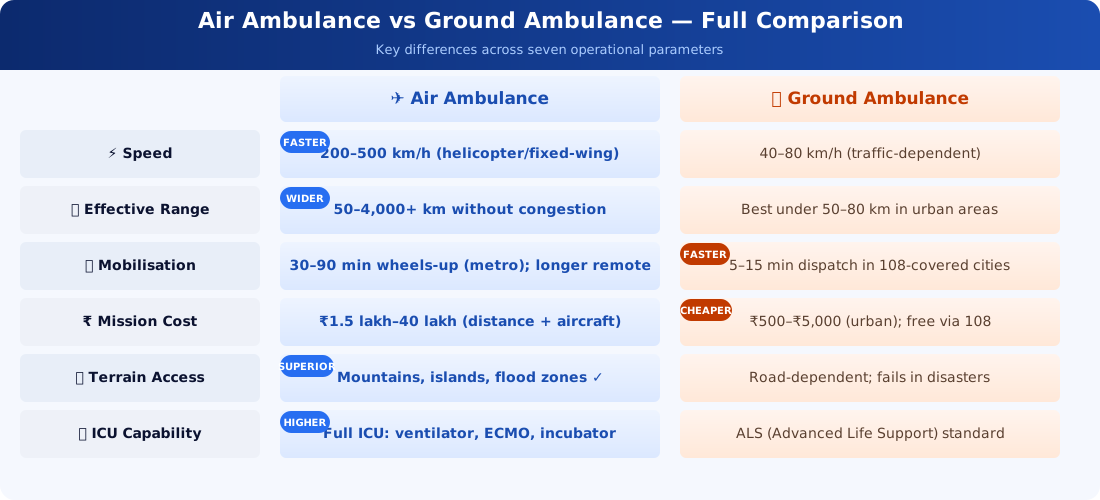
The right choice depends on six key factors. Here is how air and ground ambulances compare across each one:
Speed: A helicopter covering 200 km takes roughly 45–60 minutes. A road ambulance on the same route, navigating traffic and terrain, may take 3–5 hours — a critical gap for time-sensitive conditions like stroke, STEMI, or major trauma.
Range: Ground ambulances are practical up to 100–150 km; beyond that, patient fatigue, equipment battery limits, and staff rotation become issues. Helicopters handle 50–600 km comfortably; fixed-wing aircraft handle international repatriation up to 12,000+ km.
Response time: A well-positioned 108 ambulance reaches most urban locations in 10–20 minutes. Air ambulance response from dispatch to aircraft-ready is typically 45–90 minutes (due to crew assembly, flight planning, and ATC slot allocation).
Terrain: Floods, landslides, and mountain terrain make road access impossible for significant parts of Uttarakhand, Himachal Pradesh, Jammu & Kashmir, and Northeast India. Helicopter ambulances can reach villages with no road access at all.
Clinical capability: A modern ALS road ambulance can manage most stabilised emergencies. An air ambulance's flying ICU — pressurised, vibration-dampened, with specialist physicians on board — is needed for patients who require active intensive intervention throughout transport.
Cost: 108 ambulance service is free. Private road ALS runs ₹2,000–₹8,000 per trip. Helicopter air ambulances cost ₹1.5–₹4 lakh per mission; fixed-wing domestic missions range from ₹4–₹12 lakh; international repatriations can exceed ₹25 lakh.
When Should You Choose Air Transport?
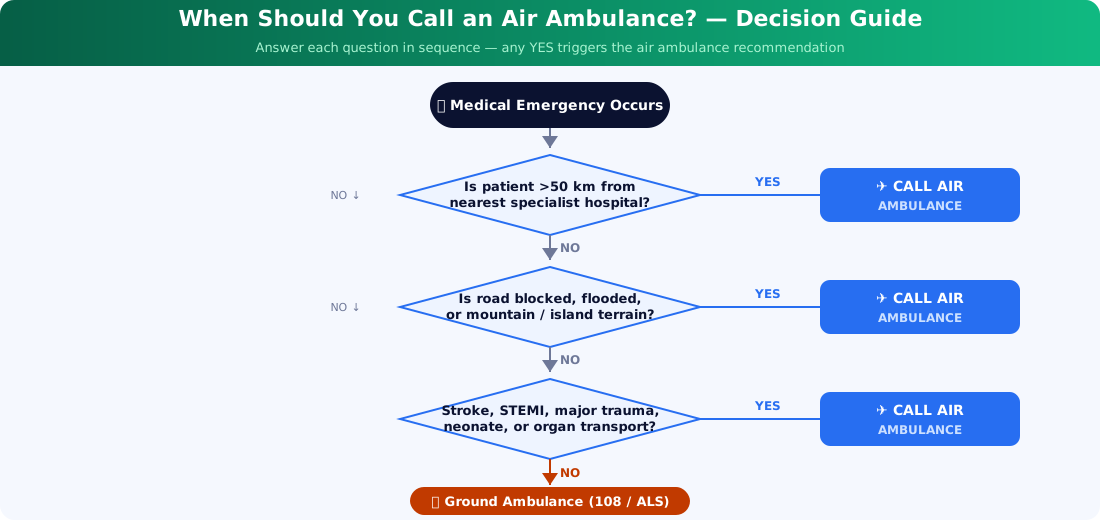
The decision is not about prestige — it is about clinical outcome. Emergency medicine guidelines and real-world Indian aeromedical data point to three decision triggers:
Distance over 50 km with a time-critical condition: Stroke, STEMI, major trauma, and spinal injury have outcome cliffs at the 3-hour and 6-hour mark. If ground transport cannot deliver the patient within those windows, air transport is warranted.
Road is blocked or inaccessible: Post-disaster scenarios — cyclone, flood, landslide — routinely cut off road access across Odisha, Kerala, Assam, and Uttarakhand. This is not hypothetical; the Kedarnath disaster in 2013 required over 1,000 helicopter sorties to evacuate patients and pilgrims.
Patient requires en-route intensive care: Post-cardiac-surgery transfers, neonatal emergencies requiring continuous ventilation, and burns patients with haemodynamic instability need a flying ICU, not a road vehicle.
The reverse also matters. When not to choose air: Short urban transfers under 30 km where the road ambulance arrives in under 20 minutes; patients who are sufficiently stable and whose condition does not deteriorate over 60–90 minutes of road transport; patients whose weight, size, or clinical attachment (heavy external fixation, complex drains) makes helicopter boarding impractical.
Cost Benchmarks Across Common Scenarios
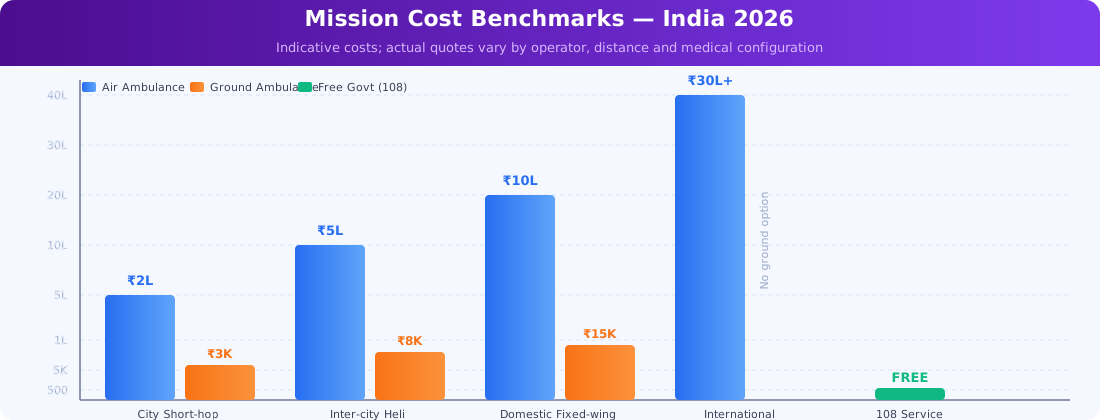
The single biggest barrier to air ambulance use in India is cost. Understanding the real numbers — and the insurance coverage that makes them manageable — is essential for hospital administrators, corporate HR teams, and individual policy buyers.
108 Government ambulance (BLS/ALS): ₹0 — free, government-funded, available 24×7 across most states. Right tool for the majority of urban emergencies.
Private road ALS (city to city, <150 km): ₹3,000–₹8,000. Adequate for stable post-discharge inter-hospital transfers.
Helicopter ambulance (100–300 km, within state): ₹1.5–₹4 lakh. The dominant air ambulance scenario for trauma, stroke, or neonatal emergencies in hilly or remote terrain.
International repatriation: ₹20–₹50 lakh+. Common for NRIs hospitalised abroad or Indian nationals requiring repatriation after accidents overseas.
Air ambulance costs can exceed ₹50 lakh. Is your insurance ready?
TropoGo's specialist air ambulance insurance covers helicopter and fixed-wing missions, international repatriation, and crew liability — so operators and policyholders aren't left exposed when it matters most.
Air ambulance operations in India sit at the intersection of two regulators:
DGCA (Directorate General of Civil Aviation): Governs all aircraft operations including aeromedical charter under CAR Section 8 Series S Part I. Operators require an Air Operator Certificate (AOC), pilot licensing, airworthiness certification, and approved medical equipment standards for each aircraft type.
MoHFW / State Health Departments: Set standards for the medical crew qualifications (typically a physician or paramedic with BLS/ACLS certification), drug inventories, and equipment calibration schedules aboard the aircraft.
IRDAI (Insurance Regulatory and Development Authority of India): Regulates the insurance products covering air ambulance operations — hull, third-party liability, crew personal accident, and passenger medical liability. Specialist aviation insurance policies must comply with IRDAI's general insurance licensing framework.
A fully compliant air ambulance operator needs an AOC, valid hull and TPL insurance, crew accident cover, and a documented emergency medical protocol approved by the state health authority. Hospitals offering helipad-based transfers must also comply with DGCA's helipad certification rules (CAR Section 9 Series C Part I).
Why Insurance Is the Invisible Infrastructure of Air Ambulance Operations
Ground ambulances carry relatively modest risk profiles — road accident liability and crew injury. Air ambulances operate in a fundamentally different risk environment: aviation liability, multi-million-rupee hull values, international airspace, critically ill passengers, and the reputational exposure of in-flight medical emergencies.
Hull All Risks: Covers the aircraft against accidental damage, fire, theft, and total loss — essential given that a medically configured helicopter can cost ₹15–₹50 crore.
Third-Party Liability (TPL): Covers bodily injury and property damage claims from third parties arising from aircraft operations — DGCA-mandated for all AOC holders.
Passenger Liability: Covers claims from patients and their attendants travelling aboard the air ambulance, including in-flight medical complications where the operator or crew may be implicated.
Crew Personal Accident: Covers pilots, flight nurses, and paramedics for death, permanent disability, and hospitalisation arising from aircraft accidents.
Medical Malpractice / Professional Indemnity: Protects the medical crew against liability arising from clinical decisions made during transport — a distinct exposure not covered by standard aircraft liability policies.
International Repatriation Cover: Covers operators conducting cross-border aeromedical evacuation, including compliance with bilateral aviation and insurance agreements.
For hospitals, corporate HR departments, and individual policyholders, air ambulance insurance also exists on the demand side: health and travel policies with explicit air ambulance evacuation riders ensure that a ₹30 lakh helicopter mission does not become a family's financial catastrophe.
The Outlook: Convergence and Integration
India's National Health Mission and Ayushman Bharat are gradually expanding emergency transport coverage, and several state governments have piloted helicopter ambulance services for remote districts — notably Himachal Pradesh (Project Sanjeevani), Uttarakhand, and Assam. As eVTOL technology matures (see our guide on air ambulances in India), short-range medical air transport will become faster to deploy and cheaper to operate, eventually bridging the cost gap with road ALS.
For the next five to seven years, the practical reality is a hybrid system: ground ambulances handling urban and short-range emergencies, helicopter ambulances serving mountain, flood, and time-critical cases, and fixed-wing aircraft managing long-range and international repatriations. Each mode needs properly structured insurance — and operators who understand the difference will be better positioned to grow.
Frequently Asked Questions
When is an air ambulance faster than a road ambulance in India?
For distances above 80–100 km, or when road traffic, terrain, or disaster conditions add more than 60 minutes to ground transport, an air ambulance is typically faster door-to-door. For strokes and cardiac events, where every 30 minutes of delay worsens outcomes, the air vs road speed advantage can be life-determining.
How much does a helicopter ambulance cost in India?
A typical helicopter air ambulance mission within 300 km costs ₹1.5–₹4 lakh, depending on the aircraft type, distance, crew composition, and whether night operations are involved. Fixed-wing domestic transfers range from ₹4–₹12 lakh, and international repatriation can exceed ₹50 lakh. These costs are significantly reduced or eliminated if the patient or operator holds a policy with an air ambulance evacuation benefit.
Is air ambulance covered under standard health insurance in India?
Most standard health insurance policies in India do not cover air ambulance costs by default. Some comprehensive health plans and travel insurance policies include air ambulance evacuation as a rider or sub-limit (typically ₹2–₹5 lakh). Standalone air ambulance insurance or specialist aviation insurance from providers like TropoGo offers broader coverage for both operators and passengers.
Which regulator governs air ambulance operations in India?
Air ambulance operators require an Air Operator Certificate (AOC) from DGCA under CAR Section 8. Medical crew standards are governed by state health departments and MoHFW guidelines. Insurance products for air ambulance operations fall under IRDAI's general insurance framework. Helipad infrastructure at hospitals must comply with DGCA CAR Section 9.
Can an air ambulance land at any hospital in India?
No. The receiving hospital must have a certified helipad or be within reasonable distance of an airstrip. Major tertiary hospitals in metros — AIIMS Delhi, Fortis, Apollo, Kokilaben, Narayana Health — have helipads. District hospitals in smaller cities frequently do not. Operators plan landing zones in advance and coordinate with the receiving facility before departure.
How does TropoGo's air ambulance insurance protect operators?
TropoGo specialises in aviation and aeromedical insurance tailored to the Indian regulatory environment. Our air ambulance insurance covers hull all risks, third-party liability, crew personal accident, passenger liability, medical professional indemnity, and international repatriation — the complete risk stack DGCA compliance and sustainable operations require. Speak to our team to structure a policy for your fleet.
Understanding when air transport is warranted — and ensuring both operators and patients are insured when it is — is increasingly a core competency in India's healthcare system. Get Air Ambulance Insurance