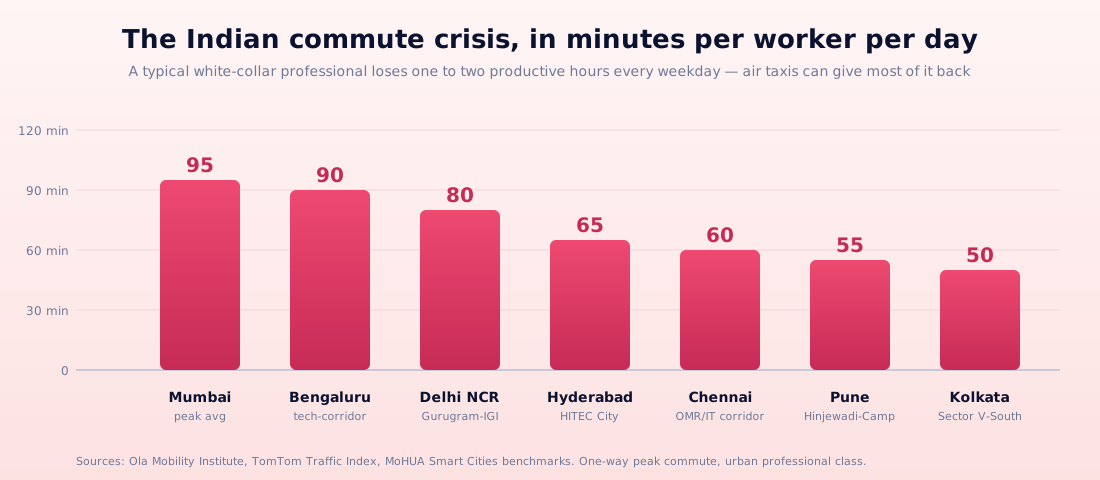
For most working professionals in Bengaluru, Mumbai or the Delhi NCR, the daily commute is a slow tax — 60 to 95 minutes a day, every day, lost to traffic that grows worse with every quarter. Multiply that across a metropolitan workforce and the country loses a productive hour per worker, every working day. By 2027, India's first commercial air taxi services will start chipping away at that tax, replacing the gridlocked drive with a 12-to-18-minute electric flight from one rooftop vertiport to the next. This isn't a luxury concept aimed at billionaires. It is a near-term, app-bookable, productivity-grade urban commute solution — and it will reshape how, where, and even why we live in Indian cities.
This guide walks through what the change actually looks like, who benefits first, how much it costs, and where insurance — for operators, not passengers — is the foundation that makes the entire shift possible.
The commute crisis we are solving
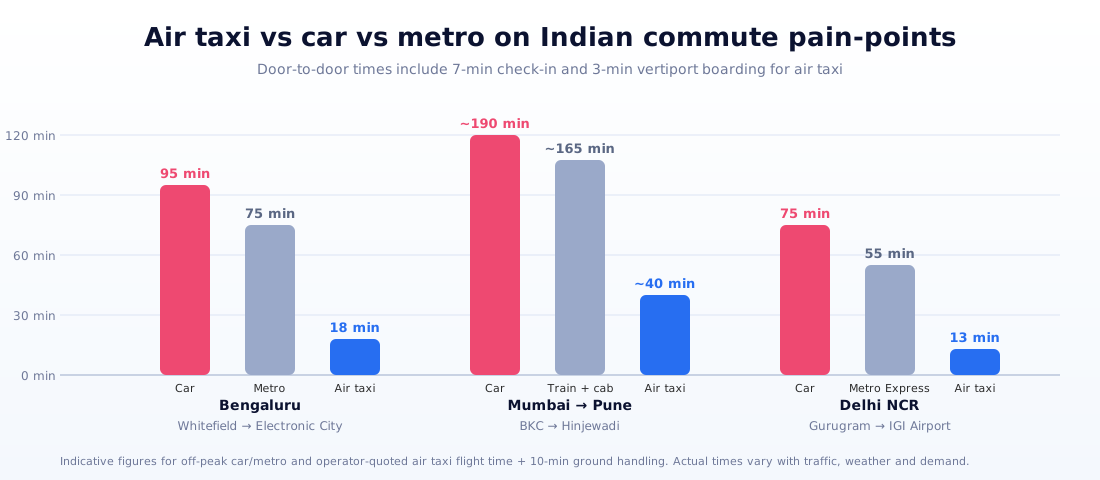
The Indian urban commute is genuinely broken. According to the Ola Mobility Institute and the TomTom Traffic Index, peak one-way commute times across India's largest metros sit between 50 and 95 minutes for tech, finance and consulting professionals. Bengaluru's Whitefield-to-Electronic-City corridor regularly tops 90 minutes each way. Mumbai's BKC-to-Pune commute swings from 165 minutes by train and cab to over 3 hours by car on a bad day. Delhi NCR's Gurugram-to-airport drive routinely takes 75 minutes for what is, by air, a 12-minute hop.
The cost is staggering — both personal and macroeconomic. The IIM Bengaluru Centre for Public Policy has estimated that Bengaluru alone loses around ₹38,000 crore in productivity to congestion every year. KPMG's 2024 mobility report puts the all-India figure for the seven largest metros at over ₹1.6 lakh crore annually, before accounting for fuel, mental-health costs, or the carbon impact of millions of idle engines. This is the gap that air-taxi services are designed to close — not for the entire commuter base in year one, but for the slice of the workforce whose hour is most expensive.
An average urban professional loses 240+ working hours every year to traffic.An air-taxi commute on a high-pain corridor like Whitefield to Electronic City reclaims about 75 of those minutes — every day, both ways.
What is an air taxi, briefly
An air taxi is a small, on-demand passenger aircraft that takes off and lands vertically from a dedicated mini-airport called a vertiport. Today's generation of air taxis are electric vertical take-off and landing (eVTOL) aircraft — battery-powered, distributed across multiple electric motors and rotors, dramatically quieter than helicopters, and with operating costs targeted to fall close to a premium ride-share fare in the next 5 to 7 years. (For a deeper explainer of the technology and the operators building it for India, see our companion piece "What is an Air Taxi? India's Emerging Urban Air Mobility Revolution".)
What matters for the commute story is the combination: vertical takeoff (no runway needed inside cities), electric propulsion (low noise, low cost, zero direct emissions), and 4-to-6-passenger cabins (right-sized for app-based booking). The result is a service that fits between Uber Premier and a domestic flight — and that solves problems neither one can.
The math of an air-taxi commute
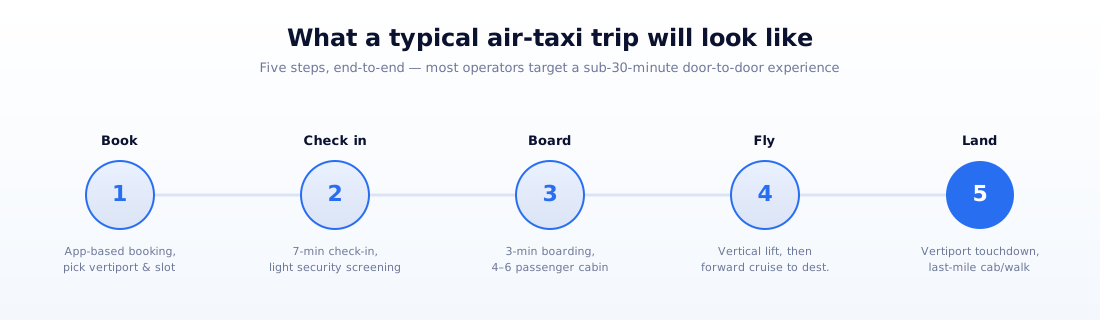
The single most powerful argument for air taxi transport in India is the time math. Operators are designing for a sub-30-minute door-to-door experience that includes 7 minutes of vertiport check-in, 3 minutes of boarding, the actual flight, and a short last-mile cab. Even with that overhead, the savings on India's worst commutes are not incremental — they are transformational.
Bengaluru, Whitefield to Electronic City. 45 km. By car at 6 pm: 95 minutes. By Namma Metro: 75 minutes. By air taxi: 18 minutes door-to-door.
Mumbai BKC to Pune Hinjewadi. 140 km. By car: 190 minutes. By train + last-mile cab: 165 minutes. By air taxi: ~40 minutes.
Delhi NCR, Gurugram to IGI Airport. 25 km. By car: 75 minutes. By Airport Express Metro: 55 minutes. By air taxi: 13 minutes.
Even the shortest of these saves a working professional more than an hour each way. Over a five-day week, that is more than ten hours back — for sleep, family, deep work, exercise. At the household level, that is a structural improvement in quality of life. At the macroeconomic level, it is a measurable productivity injection into India's services economy.
The shape of an air-taxi commute
The on-the-ground experience matters as much as the flight itself. Operators have converged on a roughly five-step model designed to feel as familiar as booking a Premier ride.
You open the operator's app, choose a departure vertiport (typically on a rooftop near a metro hub or a tech park), pick an arrival vertiport, and book a slot in the next available 5-minute window. You walk or take a short cab to the vertiport, complete a 7-minute check-in (lighter than airport security but with weight and luggage rules), board within 3 minutes, and lift off vertically. The flight itself is roughly 8 to 12 minutes for an intra-city corridor. You touch down at the destination vertiport and either walk to your office or take a 5-minute last-mile cab. Total elapsed time, door to door: 25 to 35 minutes for trips that would otherwise take 1 to 3 hours.
Five ways air-taxi commuting transforms Indian urban life
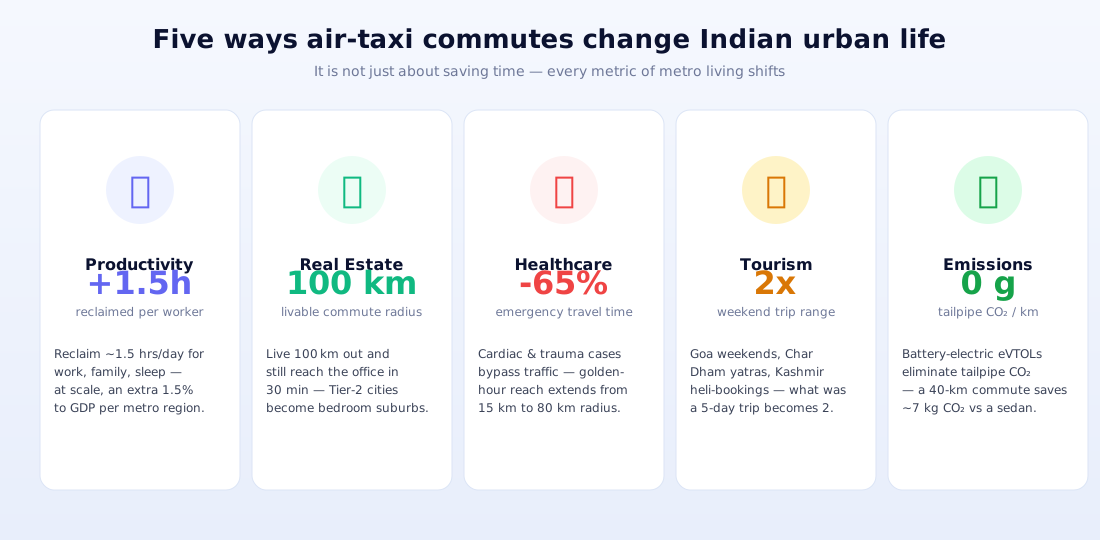
Time savings are the headline. The second-order effects are arguably more important — and they are the real air taxi benefits for the country.
Productivity. A working professional reclaiming 90 to 120 minutes a day, 240 days a year, gets back 360 to 480 hours annually — roughly two extra working months. Translated to India's white-collar workforce, this is a measurable lift to GDP from the same headcount.
Real-estate decentralisation. Once a 100-km commute fits in 30 minutes, Tier-2 cities like Mysuru, Nashik and Sonipat become realistic bedroom suburbs. Property markets, school choices and where Indians choose to raise families all shift.
Healthcare access. Air ambulances already exist; air taxis extend the principle. A cardiac event 80 km from a tertiary hospital becomes survivable in a way it isn't today, because the golden-hour reach radius from a vertiport-equipped hospital extends from roughly 15 km by road to 80 km by eVTOL.
Tourism and weekend trips. Goa weekends from Bengaluru, Char Dham yatras with vertiport-to-vertiport hops, Kashmir-valley tourism — what used to be a five-day commitment becomes a long weekend.
Emissions. A 40-km daily round-trip in a sedan emits roughly 7 kg of CO₂. The same trip on a battery-electric eVTOL emits zero tailpipe CO₂. At urban scale, this is a non-trivial decarbonisation lever.
Who benefits first?
Air-taxi commuting will not arrive uniformly. The first cohort of regular users will look something like this:
Tier-1 metro corporate professionals. Consultants, financial-services executives, senior tech-product staff — anyone whose hour is priced at ₹3,000+. The arithmetic of paying ₹2,500 to save 90 minutes makes immediate sense.
Airport-bound travellers. The Gurugram-to-IGI and BKC-to-CSMIA links are likely to be the first revenue routes, because the value proposition is clearest and the customer is already used to paying premium for time.
Medical and emergency response. Stroke and trauma cases, organ transport, and high-priority specialist consultations will pay top-tier rates in year one, and lock in volume.
Tier-2 city tourism and pilgrimage. Operators are explicitly looking at corridors like Bengaluru-Mysuru, Mumbai-Goa, Dehradun-Yamunotri and Delhi-Agra as second-tier launch markets.
High-value B2B logistics. Time-critical electronic spares, lab samples, jewellery and bonded courier traffic — small in volume, large in value-density, willing to pay a 5x road premium for one-quarter the transit time.
The cost trajectory
The pricing question is what most prospective commuters ask first. Here's the honest answer.
In year one (likely 2027), the introductory pricing on premium short routes will be roughly ₹2,500 to ₹4,000 per seat — comfortably below charter helicopter rates, comfortably above premium ride-share. By year three, as fleets scale from dozens to hundreds of aircraft and vertiports densify, the operating cost per seat-kilometre is projected to fall by 40 to 50 percent. By year five (around 2030), the premium-shift moment arrives: an air-taxi seat on a 30-km airport corridor is forecast to settle in the ₹800 to ₹1,500 band, comparable to or slightly above an Uber Premier or Ola Prime Plus, but with a dramatically faster door-to-door time.
Air Taxi & eVTOL Insurance, built for Indian operators
Hull, third-party liability, passenger and ground-risk cover from IRDAI-approved partners — all under one specialist aviation desk.
Why insurance is the foundation, not an afterthought
For everything described above to work, operators need a specialist insurance stack. Air taxis blur the line between aviation, ride-share and public transport — and so does their risk profile. A single eVTOL airframe might cost ₹30 to ₹60 crore, fly over densely populated areas, carry up to six paying passengers, and operate from rooftop vertiports built into commercial real estate. Each of these layers needs a different cover, and getting the structure wrong delays operations by months.
The cover stack typically includes:
Hull insurance for the aircraft itself, including battery packs, avionics and ground-handling damage.
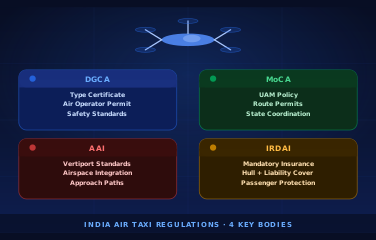
Third-party liability cover for damage or injury to people and property on the ground — almost certainly mandatory under DGCA's emerging eVTOL framework.
Passenger liability per seat, structured around ICAO / Montreal Convention principles.
Vertiport ground-risk cover for the rooftop infrastructure, charging equipment and ground-handling teams.
Pilot and crew personal accident for operators transitioning their workforce between rotary, fixed-wing and eVTOL platforms.
Business interruption for operators whose revenue depends on tight schedule integrity — a single cascading delay across a vertiport network is materially disruptive.
TropoGo's specialist desk works with IRDAI-approved partners to structure all six into a single, India-specific policy. If you're an operator, fleet financier, vertiport developer or charter buyer planning your first air-taxi commuter service, the Air Taxi & eVTOL Insurance India page is the right place to start.
The road ahead
The transformation is not theoretical and it is not far. By late 2027, expect three to five live commuter corridors in India — Whitefield to Electronic City, BKC to Hinjewadi or Pune, Gurugram to IGI Airport, and one or two airport-link routes in Hyderabad and Chennai. By 2030, projections from operators and the Ministry of Civil Aviation point to roughly 50 vertiports, a fleet of 200+ aircraft, and tens of thousands of daily commuters. By 2035, on a longer-term decarbonisation horizon, air taxis are projected to displace 10 to 15 percent of premium ride-share trips on the corridors they serve — at zero direct CO₂ cost.
The Indian commute, in other words, is about to get a third option for the first time in a generation. The traffic on the flyover below isn't going anywhere. But the workers who used to be stuck in it will have a route around it.
FAQs about air-taxi commuting in India
When can I actually use an air taxi for my daily commute?
Limited revenue commuter services on selected Bengaluru, Mumbai and Delhi NCR routes are targeted for late 2027 and 2028, subject to DGCA type certification and vertiport readiness. Helicopter-based pre-cursors (like FlyBlade's Mumbai-Pune service) are already running today as a stop-gap.
How much will an air-taxi commute cost?
Operators have signalled introductory pricing of roughly ₹2,500–4,000 per seat on premium short routes. By 2030, prices are expected to fall toward premium ride-share levels (₹800–1,500 per seat) as fleets scale, vertiports densify and battery costs drop.
Will air taxis really save time, accounting for vertiport access and check-in?
Yes. Even after factoring 7 minutes of vertiport check-in, 3 minutes of boarding, the flight, and a 5-minute last-mile cab, an air-taxi commute on the Whitefield–Electronic City corridor takes about 25 minutes door-to-door — versus 95 minutes by car at peak.
Are air taxis safe for daily commuting?
eVTOL aircraft are designed with multiple redundant rotors, batteries and flight computers; failure of any single rotor or motor still permits controlled flight. They must clear DGCA type certification, equivalent in rigour to commercial passenger aircraft. Insurance frameworks layer additional protection for passengers and third parties.
Will air taxis replace metros and ride-share?
No, they will complement them. Metro and ride-share remain the everyday transit backbone. Air taxis serve specific corridor and time-critical use cases — airport links, long inter-suburb commutes, premium tourism, and medical evacuation — where the time-savings justify the price premium.
What insurance do air-taxi operators need to run a commute service?
An operator typically needs hull cover for the aircraft, third-party liability (likely mandatory under DGCA rules), passenger liability per seat, ground-risk cover at the vertiport, crew personal accident, and business interruption. TropoGo's Air Taxi & eVTOL Insurance consolidates these into an India-specific stack.
If you operate, finance, lease or insure aircraft, get in touch with TropoGo's specialist aviation desk. We've placed insurance for India's earliest drone, BVLOS and special-mission operators — and we're building the same playbook for air taxis.