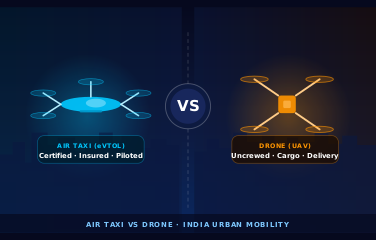
In April 2026, India's Ministry of Civil Aviation (MoCA) circulated its long-anticipated draft framework for urban air mobility — a detailed document that will determine whether India's first commercial air taxi routes take off in 2027 or wait until the end of the decade. For operators negotiating Letters of Intent with Archer, Joby and EHang, and for passengers who will eventually book seats on these aircraft, the regulatory picture matters enormously. This guide breaks down what India's air taxi regulations actually require, who enforces them, and what both operators and passengers need to know before the first commercial route opens. New to the space? Our guide What is an Air Taxi? India's Emerging Urban Air Mobility Revolution covers the technology, India's key operators and the market economics in full.
Who regulates air taxis in India?
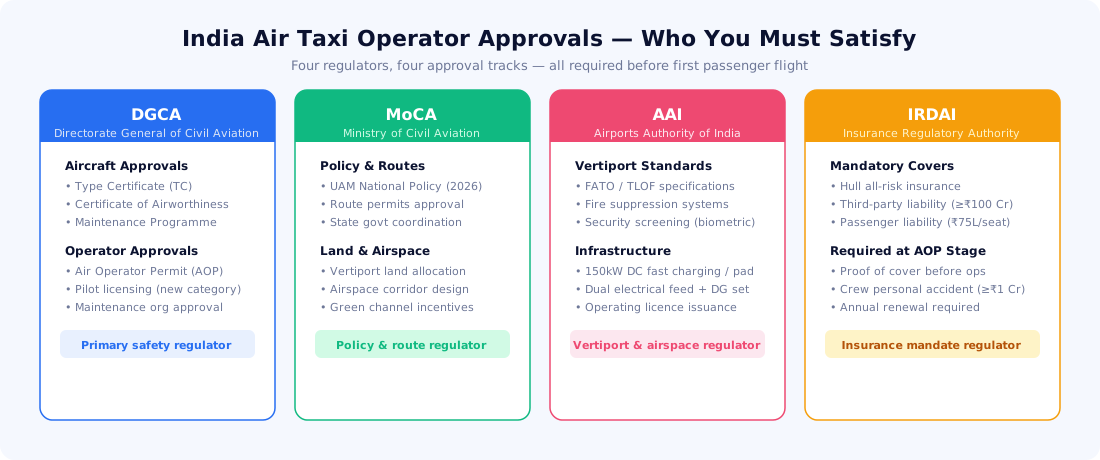
Air taxis sit at the intersection of four regulators, each with a distinct mandate. Understanding who does what is the first step for any operator planning an Indian operation.
DGCA (Directorate General of Civil Aviation): the primary safety regulator. Issues type certificates, Air Operator Permits (AOPs), pilot licences and airworthiness directives. Every eVTOL that carries a paying passenger in India must have a DGCA type certificate.
MoCA (Ministry of Civil Aviation): sets the UAM policy, approves routes and coordinates with state governments on land allocation for vertiports. The draft UAM National Policy (circulated April 2026) sits with MoCA for finalisation.
AAI (Airports Authority of India): responsible for vertiport design guidelines, airspace corridor integration, approach-path clearances and vertiport operating licences. AAI circulated its draft vertiport standards in December 2025.
IRDAI (Insurance Regulatory and Development Authority of India): mandates the minimum insurance covers that an operator must carry before DGCA will issue an AOP. No cover, no permit to fly passengers.
DGCA type certification — the first gate for operators
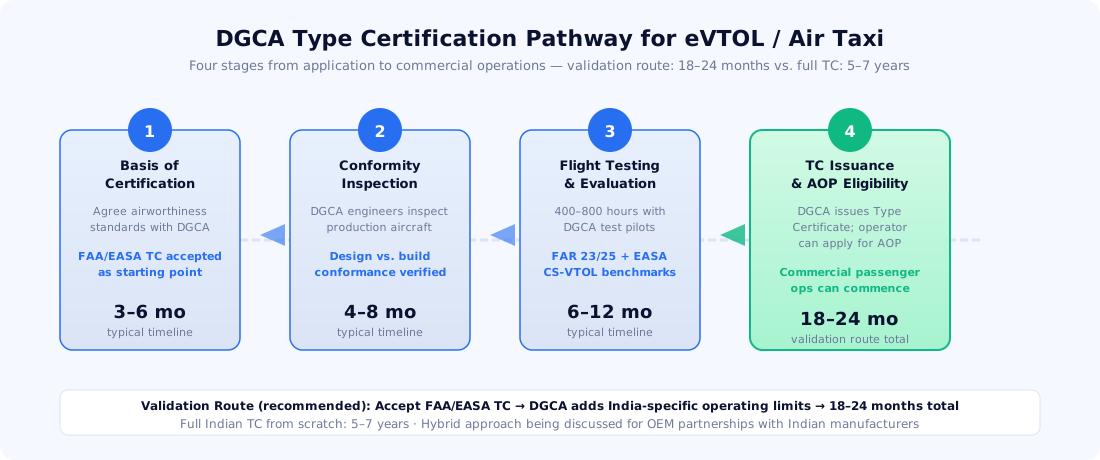
No eVTOL can carry Indian passengers without a DGCA-issued Type Certificate (TC). The process has four stages, and the choice of route — full Indian TC or validation of an FAA/EASA certificate — has enormous commercial implications.
The four certification stages
Stage 1 — Basis of Certification (BoC): The applicant defines which airworthiness standards will apply — typically FAR 23, FAR 25 or the new EASA CS-VTOL — and DGCA formally agrees them. This sets the entire subsequent test programme.
Stage 2 — Conformity inspection: DGCA engineers inspect production aircraft against the approved design. The goal is to confirm that what is being built matches what was certificated.
Stage 3 — Flight testing and evaluation: Typically 400–800 hours with DGCA test pilots, mirroring the FAA and EASA flight-test regimes. Performance, handling qualities, emergency procedures and failure modes are all tested against agreed limits.
Stage 4 — TC issuance: DGCA issues the Type Certificate. The operator can now apply for an AOP for commercial passenger operations using that aircraft type.
Validation route: 18–24 months. Full Indian TC from scratch: 5–7 years.Most Indian operators are pursuing the validation route — accepting an FAA or EASA TC as the starting point and having DGCA add India-specific operating limits. This compresses the timeline dramatically and is the path most likely to enable operations by 2027.
Operator licensing and route approvals
Once the aircraft is certified, the operator must navigate a four-body approval process before the first revenue passenger can board.
Air Operator Permit (AOP) from DGCA: requires proof of maintenance capability, trained and licensed crew, a Safety Management System (SMS), emergency response plan and, critically, a valid insurance certificate. The AOP must be renewed annually.
Route clearance from MoCA and ATS: each planned corridor (e.g., Bengaluru Airport to Whitefield) must be approved as a designated air taxi route, with separation standards from other air traffic agreed with Air Traffic Services.
Vertiport operating licence from AAI: the vertiport itself must pass AAI inspection against its December 2025 design standards before it can be opened to the public.
State government NOC: for each vertiport site, an NOC from the relevant state urban development authority is required — a requirement that is becoming a practical pinch-point given the complexity of urban land acquisition in India.
Safety standards — what eVTOLs must meet
India is aligning its technical requirements with global benchmarks, with additional India-specific limits for the subcontinent's climate and airspace density.
Structural airworthiness: equivalent to FAA AC 90-23G and EASA SC-VTOL — covering load factors, fatigue life of structural components and rotor blade integrity under Indian summer temperatures (up to 50°C ambient).
Powertrain safety: fail-safe design is mandatory. Failure of any single rotor, motor or battery module must allow a controlled landing at the nearest suitable point. Typically this means a minimum of six independently powered lift surfaces.
Software certification: DO-178C for airborne software and DO-254 for complex hardware — the global gold standard for aviation-grade software used in flight computers, battery management systems and redundancy managers.
Crashworthiness: seat and restraint systems must meet FAR 23.562 dynamic impact standards, protecting passengers in a 26g forward crash and a 7g vertical impact — the same benchmark applied to small helicopters.
Noise limits: ICAO Chapter 14 — approximately 65 dB at 100 m — is the expected standard. eVTOLs already meet or exceed this; legacy helicopters do not, which is why some city regulators are accelerating the transition.
Passenger rights and protections
Once commercial operations begin, passengers riding India's first air taxis will have enforceable rights under a layered framework.
Montreal Convention: India ratified it in 2009. It caps liability per passenger on international flights and sets the framework for domestic equivalents. Air taxi operators are widely expected to be required to meet equivalent limits for domestic routes — currently around ₹1.5 lakh per kg of checked baggage and ₹1.5 crore per passenger for death or injury.
DGCA CAR Section 3, Series M Part IV: India's existing passenger rights rules — covering delays, denied boarding, baggage loss and refunds — will extend to air taxi services once commercial ops begin. Operators must display these rights at every vertiport boarding point.
Mandatory passenger manifest: every air taxi departure must file a real-time passenger manifest with DGCA, similar to the process for commercial airlines. Identity verification (Aadhaar-linked or passport) will be required at check-in.
Minimum passenger liability cover: IRDAI has indicated a minimum of ₹75 lakh per seat per event — meaning that if an incident injures or kills a passenger, the operator's insurer must be able to pay at least that amount per affected seat, regardless of other claims.
AAI vertiport guidelines — what infrastructure must comply with
AAI's December 2025 draft standards set a clear technical floor for every vertiport in India. Operators negotiating rooftop or ground-level sites need to ensure their property partners can meet these requirements.
FATO and TLOF: the Final Approach and Take-Off area must maintain at least 1.5× rotor diameter clearance on all sides; the Touchdown and Lift-Off area must be fire-resistant and rated to bear 3× the maximum gross weight of the heaviest aircraft using that pad.
Fire suppression: an on-pad CO₂ or dry-powder system with automatic activation, plus a dedicated fire vehicle standby during all operations — a requirement that adds significantly to vertiport operating costs.
Security screening: biometric identification plus X-ray baggage scan, equivalent to domestic airport standards. This means vertiports cannot be casual rooftop pads — they must have credentialled, staffed security points.
Charging infrastructure: minimum 150 kW DC fast-charging per operational pad, with grid-level surge protection. Each vertiport must also have two independent electrical feeds and a diesel-generator backup capable of supporting a minimum of four charge cycles.
Air Taxi & eVTOL Insurance, built to satisfy DGCA's AOP requirements
Hull, third-party liability, passenger liability per seat and crew PA cover — from IRDAI-approved aviation insurers, structured as a single India-specific policy stack.
Insurance is not an optional add-on for Indian air taxi operators — it is a pre-condition for the DGCA AOP. IRDAI has signalled four mandatory minimum covers, and specialist operators typically add three further layers on top.
The four mandatory covers (pre-AOP requirement)
Hull all-risk insurance: covers physical damage to the aircraft — fuselage, rotors, avionics and battery packs — for the full purchase price during the first five years of operation. A single eVTOL costs ₹30–60 crore; uninsured hull loss would be a company-ending event for most Indian operators.
Third-party liability: covers injury or property damage to people and structures on the ground. A minimum of ₹100 crore per event is under active discussion for routes over Mumbai, Delhi NCR and Bengaluru — cities where a hull-loss event above a commercial district could result in very large third-party claims.
Passenger liability per seat: minimum ₹75 lakh per seat per event, aligned with the Montreal Convention limits converted to Indian rupees and updated for 2026 inflation. Operators must be able to demonstrate this cover before ticketing begins.
Crew personal accident: minimum ₹1 crore per pilot, covering death and permanent disability. As a new aircraft category, many pilot personal accident policies on the market today specifically exclude eVTOL operations — a gap operators must close before their first commercial flight.
Additional covers specialist operators typically carry
Ground-risk cover: for the vertiport itself, ground-handling equipment, charging infrastructure and ground staff — a significant asset exposure given AAI's requirement for 150 kW DC fast-chargers and on-pad fire systems.
Grounding cover: if DGCA suspends airworthiness directives for the aircraft type — as has happened for new aircraft globally — revenue loss during the grounding period can be covered under a specialist fleet-grounding policy.
War and political risk: for operators planning routes across sensitive Indian airspace corridors, standard aviation hull policies typically exclude war-risk events; a standalone war-risk endorsement fills that gap.
TropoGo's specialist aviation insurance desk works with IRDAI-approved partners to structure all seven layers into a single, India-specific policy stack. If you are working through your AOP application — or planning to — the Air Taxi & eVTOL Insurance India page is the right starting point.
What the 2026–2028 window means for operators
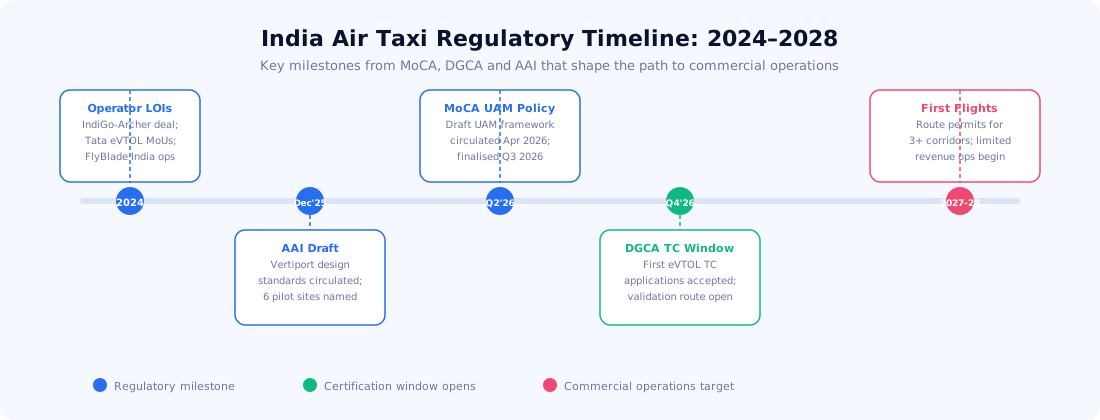
The MoCA draft UAM policy is expected to be finalised by Q3 2026. Once adopted, DGCA is prepared to accept the first eVTOL type certification applications under the validation route by end-2026 — the fastest path to an Indian TC. MoCA is targeting route permits for at least three corridors by mid-2027, and AAI has earmarked six sites across Bengaluru, Mumbai and Delhi NCR for priority vertiport construction.
The operators who will fly first are those who start the AOP process now: with type certification underway, insurance cover structured, vertiport partners engaged and safety management systems drafted. India's air taxi regulatory window is opening fast — and it will reward preparation over speed.
Frequently Asked Questions about India's Air Taxi Regulations
Does DGCA regulate air taxis the same way it regulates helicopters?
Not exactly. Air taxis are being given a dedicated regulatory framework distinct from helicopter rules under Civil Aviation Requirements. The key differences: eVTOLs will require a new pilot licence category (covering aircraft that hover but operate under fixed-wing performance standards), and the type certification basis will reference EASA CS-VTOL rather than the traditional FAR 27/29 rotorcraft standards that apply to helicopters.
What is type certification and how long does it take in India?
A Type Certificate (TC) is DGCA's formal approval that a specific aircraft design is safe to carry passengers. The full Indian TC process takes 5–7 years from application to issuance. However, most Indian operators are pursuing the validation route — starting from an existing FAA or EASA TC and having DGCA add India-specific operating limits — which compresses the timeline to 18–24 months.
Is air taxi insurance mandatory in India?
Yes. IRDAI and DGCA are aligning to make four covers mandatory before any operator can receive an Air Operator Permit: hull all-risk, third-party liability (minimum ₹100 crore per event is under discussion), passenger liability (₹75 lakh per seat) and crew personal accident (₹1 crore per pilot). No cover, no permit to carry passengers.
What vertiport standards apply in India?
AAI's December 2025 draft standards require: FATO clearance of 1.5× rotor diameter, TLOF rated at 3× max gross weight, on-pad fire suppression, biometric security screening, minimum 150 kW DC fast-charging per pad with dual grid feeds and a diesel-generator backup, and a full AAI operating licence before the first commercial flight. State government NOC is also required for each site.
What passenger rights will air taxi travellers have in India?
Passengers will be protected by the Montreal Convention framework (ratified by India in 2009), DGCA's Civil Aviation Requirements on passenger rights covering delays and denied boarding, mandatory real-time passenger manifests, and a minimum insurance cover of ₹75 lakh per seat. These protections apply from the first commercial flight — operators cannot waive them in terms and conditions.
How do I get air taxi insurance for my eVTOL operation in India?
Start with TropoGo's specialist aviation desk, which works with IRDAI-approved aviation insurers experienced in eVTOL and air taxi underwriting. We structure hull, third-party liability, passenger liability and crew PA into a single India-specific policy stack aligned with DGCA AOP requirements. Visit the Air Taxi & eVTOL Insurance India page to begin.
India's air taxi regulatory framework is being written right now — and the operators building their compliance infrastructure today will be first to receive AOPs when DGCA opens the gate. TropoGo's specialist aviation desk can help you get the insurance layer right from day one.