Air Taxi vs Drone: Understanding the Difference in Urban Mobility
7 May 2026 | 7 min read
Insure your air taxi, eVTOL or drone fleet with India's specialist aviation insurer
Whether you operate an eVTOL air taxi or a commercial drone fleet, TropoGo has IRDAI-approved insurance covers built for India's aerial mobility sector.
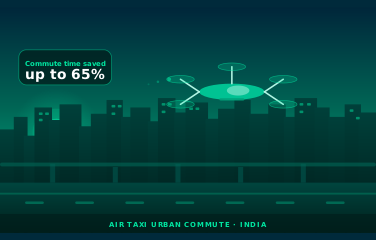
India's skies are entering a new era. On one side, commercial drones are already delivering medicines to remote Telangana villages and spraying Kharif crops across Andhra Pradesh. On the other, eVTOL air taxis from companies backed by IndiGo, Tata and Airbus are scheduled to start carrying paying passengers on Indian city corridors by 2027. Both technologies fly. Both are electric. Both are reshaping urban air transport in India. And yet they are fundamentally different machines — different purposes, different passengers, different regulations, and a completely different insurance logic.
If you're an operator, investor, regulator or simply a curious commuter trying to make sense of India's aerial mobility landscape, this guide cuts through the confusion and explains the real differences between an air taxi and a drone — and what each means for insurance.
What is a drone (UAV)?
A drone — formally an Unmanned Aircraft System (UAS) or Unmanned Aerial Vehicle (UAV) — is any aircraft that operates without a pilot on board. It can be controlled remotely by a human operator on the ground, or it can fly a pre-programmed route autonomously. In India, drones fall under the Drone Rules 2021 administered by the DGCA, and are classified by weight into five categories: Nano, Micro, Small, Medium and Large.
The payload of a drone is cargo, cameras or sensors — never paying passengers. This single fact separates a drone from every aircraft in the air-taxi category. Indian drone operators use UAVs for precision agriculture spraying across Punjab and Andhra Pradesh, last-mile medicine delivery on tribal routes in Telangana and Jharkhand, NHAI highway surveys, SVAMITVA land-mapping, power-line inspection, coastal surveillance and disaster-relief imaging. The DGCA's DigiSky portal and the No-Permission-No-Takeoff (NPNT) system govern where and when they fly.
What is an air taxi (eVTOL)?
An air taxi is a small, on-demand passenger aircraft designed to take off and land vertically — from a rooftop vertiport or a dedicated ground facility — and carry between one and six paying passengers over urban or peri-urban distances. Modern air taxis use electric vertical take-off and landing (eVTOL) technology: battery-powered, distributed across multiple electric motors and rotors, dramatically quieter than helicopters, and with a long-term target of bringing per-seat operating costs close to premium ride-share. For a deep-dive on eVTOL architectures, India's first operators and how the economics work, see our explainer What is an Air Taxi? India's Emerging Urban Air Mobility Revolution.
The key word is passenger. Air taxis are regulated not as drones but as piloted aircraft — they will require DGCA type certification, a new pilot licence category, mandatory passenger liability insurance, and vertiport infrastructure that meets AAI standards. In India, corridors between Bengaluru's BIAL airport and Whitefield, and between Mumbai's BKC and Pune Hinjewadi, are among the first routes being planned by IndiGo-backed Archer and Tata-affiliated operators.
India is projected to be a top-3 eVTOL market globally by 2035.Morgan Stanley forecasts global UAM at $1 trillion by 2040. Indian metro congestion, a young commuter base and government UAM policy are accelerating the timeline.
The core differences — side by side
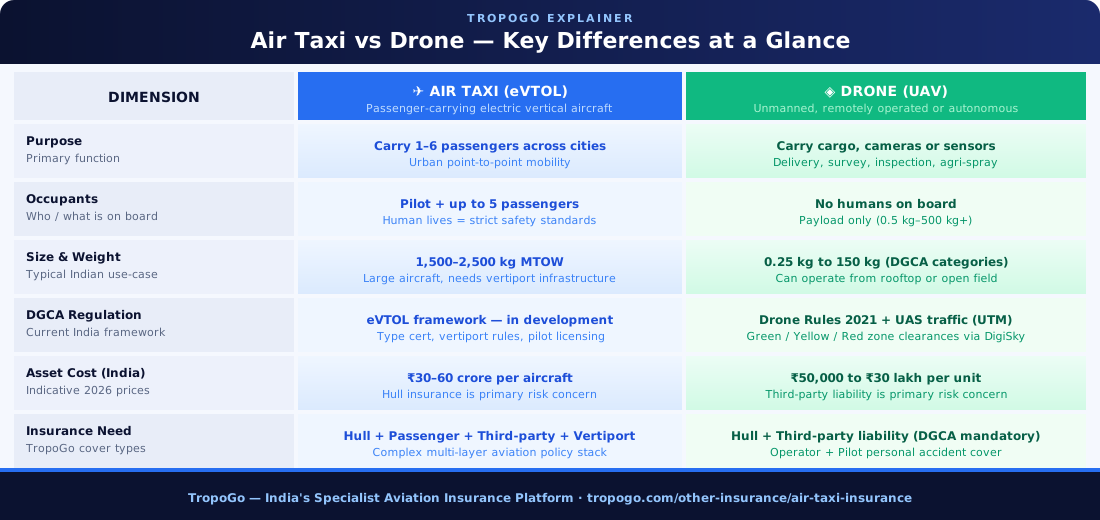
The table below maps seven dimensions where air taxis and drones diverge most sharply. These differences matter for regulators, insurers and investors equally.
Who uses what in India?
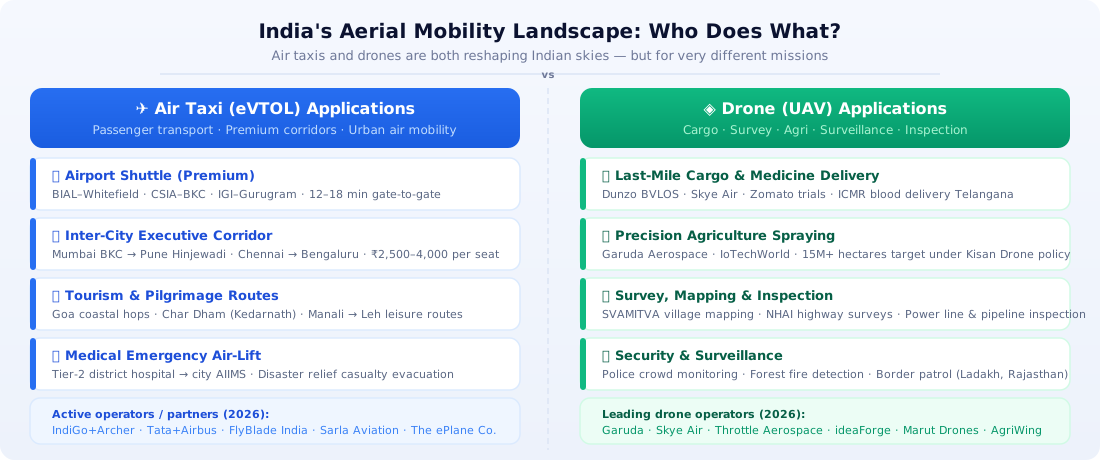
India has active, scaled drone operations today across agriculture, logistics and government surveying — and a pipeline of air-taxi operators building toward first revenue flights in 2027. The infographic below maps the leading Indian players and use cases for each technology.
Benefits: what each technology does well
Air taxi strengths
Time compression on congested corridors. An air taxi covers the Whitefield–Electronic City stretch in 12–18 minutes; the same route by car in evening traffic takes 75–90 minutes.
Zero direct emissions. Battery-electric propulsion eliminates tailpipe CO₂ — relevant as Indian cities face worsening AQI in metros.
Drastically lower noise than helicopters. Distributed electric rotors produce roughly 65 dB at 100 m, vs 85+ dB for turbine helicopters, enabling inner-city vertiports.
Medical and tourism access. Air-taxi economics open up Char Dham heli-taxi alternatives, coastal Goa routes, and emergency medical evacuation from tier-2 hospitals to city AIIMS centres.
Drone strengths
Scale and speed of deployment. A drone fleet can be operational within weeks on a new route — no vertiport, no pilot licence category needed.
Precision agriculture at national scale. India's Kisan Drone policy targets 15 million+ hectares of drone-sprayed farmland, a mission that only UAVs can serve.
Cost-effective data collection. ₹5–15 lakh UAVs capture survey data that would cost ten times as much by manned aircraft — SVAMITVA and NHAI have proved this at scale.
Humanitarian reach. Drones can carry blood, medicines and vaccines to villages cut off by floods or poor roads — a use case where there is no air-taxi equivalent.
Challenges for each technology
Air taxi — vertiport infrastructure. Each metro needs 10–15 well-located vertiports for a viable network. Land acquisition, rooftop engineering and last-mile design in dense Indian cities are significant hurdles.
Air taxi — type certification. DGCA eVTOL airworthiness rules are still being drafted; operators will likely bridge via FAA/EASA type certificates with India-specific overlays.
Drone — beyond visual line-of-sight (BVLOS) at scale. Urban BVLOS operations require UTM integration, detect-and-avoid capability and reliable 4G/5G coverage — all still maturing.
Drone — payload limits vs last-mile reality. Most commercially viable Indian drones carry 2–5 kg. Grocery and medicine delivery economics only work for specific high-urgency categories at this weight.
Both — battery life and Indian weather. Monsoon turbulence, summer heat and dust are harder on lithium batteries than the temperate conditions most aircraft were designed and tested in.
The regulatory picture: two very different paths
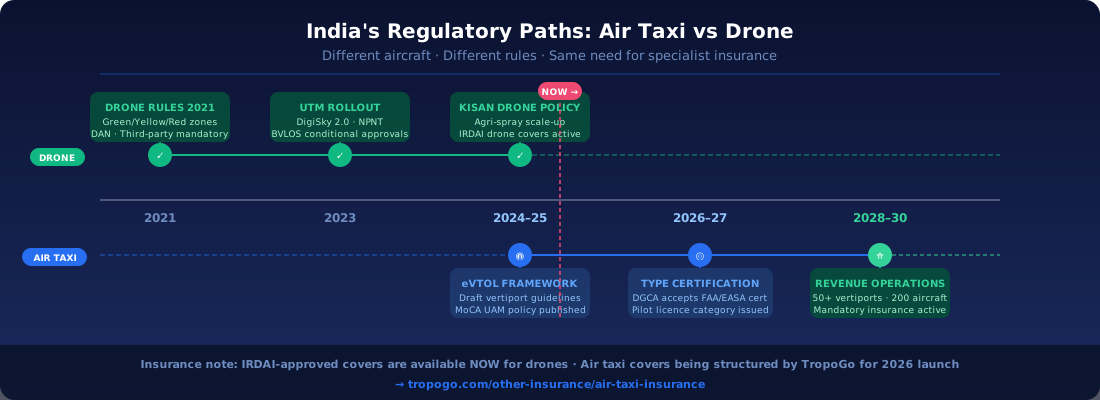
Drones and air taxis are regulated under completely separate frameworks in India — and the timelines are years apart. Understanding which rules apply is the starting point for any operator or insurer.
For drones, the DGCA's Drone Rules 2021 are live. The DigiSky 2.0 portal, NPNT (No-Permission-No-Takeoff), and the UAS Traffic Management (UTM) system are operational. Third-party liability insurance is already mandatory for commercial drone operations under these rules. IRDAI-approved drone insurance products — hull cover, third-party liability, operator personal accident — are actively available through TropoGo today.
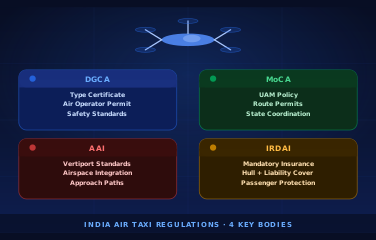
For air taxis, the Ministry of Civil Aviation (MoCA) has signalled a dedicated eVTOL operating framework distinct from both helicopter rules and drone rules. AAI draft vertiport design guidelines are in circulation. DGCA type certification for eVTOL aircraft is expected to follow FAA/EASA precedent. A new pilot licence category specific to eVTOL operations is being drafted. Mandatory third-party liability and passenger insurance — equivalent to what exists for commercial airlines — will almost certainly apply from day one of revenue operations. TropoGo is already structuring the insurance stack for Indian air-taxi operators ahead of this launch.
Air Taxi & eVTOL Insurance — built for Indian operators
Hull, passenger liability, third-party and vertiport cover from IRDAI-approved partners, structured by India's specialist aviation insurance desk.
Why insurance is non-negotiable — and different for each
The risk profiles of drones and air taxis differ almost as much as the aircraft themselves. Getting insurance right for each is not a bureaucratic box-tick — it is fundamental to operating legally and sustainably in India.
Insurance for drones (available now)
Third-party liability (mandatory under Drone Rules 2021). Covers damage to persons or property on the ground caused by drone operations — required for all commercial flights.
Hull / own-damage cover. Protects the drone itself and its payload against crash, theft or accidental damage — critical for expensive inspection and agri-spray drones worth ₹5–30 lakh.
Operator and pilot personal accident. Income-replacement and medical cover for the pilot or RPIC (Remote Pilot In Command) in case of injury during operations.
Cargo and payload liability. For delivery drones, covers loss or damage to goods carried — important for medical and perishable supply chains.
Insurance for air taxis (being structured now by TropoGo)
Hull insurance. A single eVTOL may cost ₹30–60 crore — hull cover for the airframe, battery packs and avionics is the largest line item in an air-taxi operator's insurance programme.
Passenger liability per seat. Aligned with ICAO / Montreal Convention principles and India's carriage-by-air framework — each passenger seat is individually insured for injury or death.
Third-party liability. For flights over dense urban areas, third-party cover for ground damage or casualty will be mandatory from day one of Indian commercial operations.
Vertiport and ground-risk cover. The vertiport itself — charging infrastructure, ground-handling equipment, facilities — represents a separate insurable asset class.
Pilot and crew personal accident. Especially important during the transition period as crews move between helicopter, fixed-wing and eVTOL type ratings.
Fleet and liability programme. Larger operators with 10+ aircraft will need fleet policies with single occurrence limits and reinsurance backing aligned to Indian aviation standards.
TropoGo's specialist aviation desk works with IRDAI-approved partners to structure both drone and air-taxi insurance stacks. Whether you're an agri-drone operator running 50 UAVs across Haryana or an eVTOL operator preparing your first Indian revenue flight, the Air Taxi & eVTOL Insurance India page is your starting point.
Where this is headed: convergence or divergence?
Over the next decade, the boundary between drones and air taxis will blur — not disappear. Some eVTOL designs will eventually operate autonomously, making them look more like large drones. Some cargo UAVs will scale up to payloads that challenge small manned aircraft. But the fundamental distinction — payload vs. passenger — will remain the regulatory and insurance divide for the foreseeable future in India.
By 2028, India should have its first eVTOL revenue flights operating alongside a mature commercial drone sector. Both will need specialist insurance, and both will be shaped by DGCA and IRDAI frameworks that are being written right now. Getting the coverage architecture right before the aircraft arrive is exactly what TropoGo is doing — for operators on both sides of the propeller.
FAQs: Air Taxi vs Drone
What is the main difference between an air taxi and a drone?
The core difference is purpose and occupants. An air taxi (eVTOL) carries human passengers — typically 1–6 people — on urban routes, piloted by a licensed aviator. A drone (UAV) carries cargo, cameras or sensors with no one on board, operated remotely or autonomously. This single distinction drives almost every regulatory and insurance difference between the two.
Are air taxis legal in India right now?
Commercial air-taxi operations are not yet active in India. The DGCA eVTOL framework, vertiport guidelines and new pilot licence categories are in development. Operators backed by IndiGo, Tata and others are targeting first revenue flights on select Indian corridors by 2027, subject to type certification and regulatory sign-off.
Do drones need insurance in India?
Yes. Third-party liability insurance is mandatory for all commercial drone operations under the DGCA Drone Rules 2021. IRDAI-approved drone insurance — covering hull, third-party liability and pilot personal accident — is available in India right now through TropoGo and other specialist brokers.
How much does an air taxi cost vs a drone in India?
A commercial eVTOL air taxi is expected to cost ₹30–60 crore per aircraft in India when first-generation models arrive. Commercial drones range from ₹50,000 for a basic mapping UAV to ₹20–30 lakh for a heavy-lift agri-spray or inspection drone. The cost gap explains why hull insurance is the primary concern for air-taxi operators, while third-party liability tends to dominate for drone operators.
Can a drone become an air taxi?
Not in the regulatory sense. Even if a UAV design could physically carry a human, carrying passengers requires a completely different certification pathway — DGCA type certification, airworthiness standards equivalent to commercial aviation, passenger liability covers, and a licensed pilot or crew. These are separate regulatory categories and that distinction will remain in India's aviation law for the foreseeable future.
What insurance do I need for an air taxi operation in India?
An Indian air-taxi operator will need hull cover for the aircraft (typically ₹30–60 crore per unit), third-party liability (likely mandatory by DGCA), passenger liability per seat, vertiport and ground-risk cover, and pilot personal accident insurance. TropoGo's Air Taxi & eVTOL Insurance India desk is already structuring these multi-layer programmes for India's first operators.
Whether you're launching India's first air-taxi corridor or scaling a commercial drone fleet, TropoGo's specialist aviation insurance desk has the products and IRDAI-approved partners to keep you covered from day one.