India has over 34 crore registered motor vehicles — the third-largest vehicle fleet in the world. Yet surveys consistently show that nearly 40% of them have lapsed or non-existent insurance. Every year, accidents involving uninsured vehicles generate over 5 lakh motor accident claims filed with IRDAI, with billions of rupees in disputes tied up in courts. The Motor Vehicles Act 1988 is explicit: driving on a public road without a valid third-party motor insurance policy is illegal. Period.
But the legal compulsion is actually the least important reason to buy car insurance. The more important one is financial: a single rear-end collision at a traffic light can cost ₹80,000–2,50,000 in repairs. A serious accident with third-party injury can expose you to unlimited liability under the Motor Vehicles Act — claims in India's motor accident claims tribunals have reached ₹1–3 crore in serious injury cases. The right car insurance policy is what stands between you and that exposure.
This guide explains how Indian car insurance actually works — the policy types, the add-ons that matter, how IDV and No-Claim Bonus affect your premium, and how claims are settled. By the end of it, you will be able to compare two quotes intelligently rather than just picking the cheapest number.
What is car insurance?
Car insurance (also called motor insurance or four-wheeler insurance) is a contract regulated by the IRDAI (Insurance Regulatory and Development Authority of India) under the Insurance Act 1938 and the Motor Vehicles Act 1988. In exchange for an annual premium, the insurer agrees to pay for specified financial losses arising from your vehicle — damage to your car, damage or injury caused to others, or theft of the vehicle.
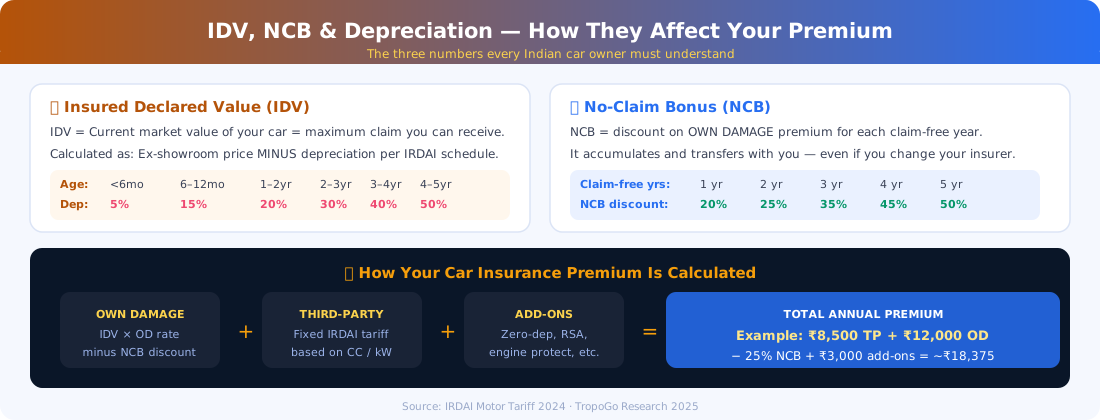
The policy works through an Insured Declared Value (IDV) — the agreed current market value of your car, which represents the maximum amount the insurer will pay for a total loss claim. Your own damage premium is a percentage of this IDV. The third-party liability component has a fixed premium set by IRDAI each year, independent of your car's value.
India's motor insurance market crossed ₹1.1 lakh crore in premium in FY2025 — the largest non-life segment by far.Source: IRDAI Annual Report 2024–25 · Motor Insurance Data
Types of car insurance policies in India
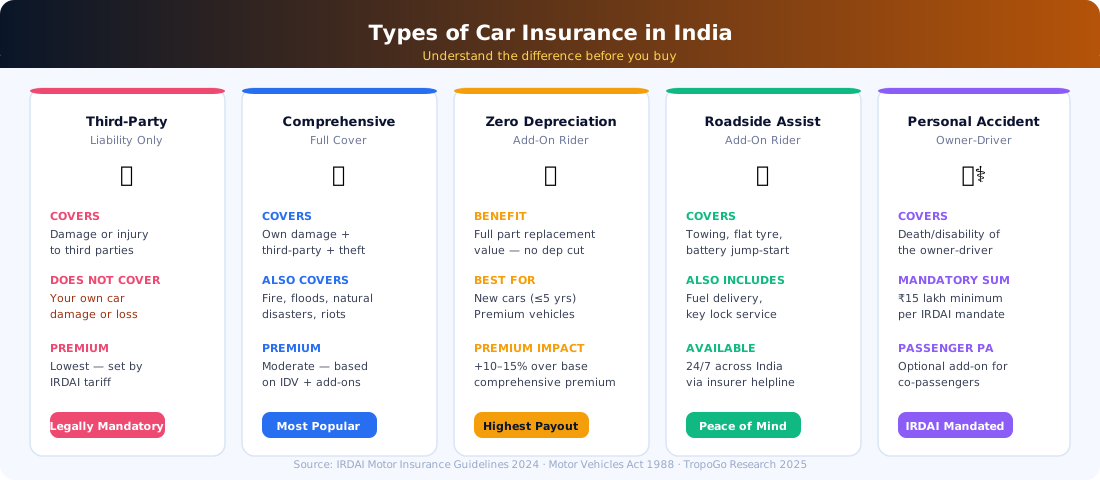
Not all car insurance is the same. Three core policy types exist — and a range of add-ons that sit on top. Understanding the structure is the prerequisite for choosing the right cover.
Third-party liability cover — the mandatory minimum
This covers bodily injury, death and property damage caused to other people by your car. It does not cover your own car's damage in any way. Under the Motor Vehicles Act, you cannot legally drive on a public road in India without this policy in force. The third-party premium is set annually by IRDAI based on engine cubic capacity (CC) for petrol/diesel cars and kilowatt (kW) rating for EVs. You cannot negotiate it — it's a tariff.
Third-party liability is technically unlimited for bodily injury and death claims under the Act. The insurer pays whatever the Motor Accident Claims Tribunal (MACT) awards, with no upper cap on their liability. For property damage, the current limit is ₹7.5 lakh per accident.
Own damage (OD) cover
This covers your own car for damage from accidents, fire, flood, hail, earthquake, landslide, riots, and theft. It does not cover third-party claims — it is purely for your vehicle. Own damage is optional in law (you're only legally required to have third-party), but financially, driving without it is imprudent for any car worth more than ₹3–4 lakh.
Comprehensive cover — TP + OD in one policy
The most complete option: combines third-party liability and own damage under a single policy. This is what most people mean when they say "full coverage." The base comprehensive policy can then be enhanced with add-ons — zero depreciation, engine protection, roadside assistance, key replacement, consumables cover, and so on.
IDV, depreciation and NCB — the three numbers you must understand
These three levers control your premium and your claim settlement amount more than any other factor. Getting them right is the difference between a policy that performs and one that disappoints.
Insured Declared Value (IDV)
Your IDV is the current market value of your car — set at the time of policy purchase using IRDAI's depreciation schedule on the original ex-showroom price. A higher IDV means a higher premium but better protection; a lower IDV means a cheaper policy but a smaller payout in case of total loss or theft. Never let your insurer push your IDV unreasonably low to offer you a headline cheap premium — check that the IDV matches the current market value of your make and model on used-car platforms.
No-Claim Bonus (NCB)
The NCB is a reward for not making claims. For each claim-free year, your own-damage premium is discounted by a fixed percentage — 20% after year 1, rising to 50% after five consecutive claim-free years. The NCB belongs to you, not to the car or the insurer — it transfers if you change insurers at renewal, and it transfers to a new car. One claim resets your NCB to zero, which is why small repairs under ₹10,000–15,000 are often better paid out of pocket than claimed.
Key add-on riders for Indian car owners
Zero depreciation (nil-dep). The most popular add-on in India. Without it, your claim settlement for replaced parts is reduced by the depreciation percentage on those parts. With zero-dep, you receive the full replacement cost. Essential for new cars (under 5 years) where parts are expensive.
Engine and gearbox protection. Covers damage from water ingression (common in India's monsoon season) and consequential mechanical failure — events typically excluded from the standard OD policy. Critical for cars in flood-prone cities like Chennai, Mumbai and Hyderabad.
Return to invoice. If your car is declared a total loss or is stolen, the standard settlement is the IDV (current market value). Return to invoice pays the original on-road price — bridging the gap between the depreciated IDV and what you actually paid for the car.
Key and lock replacement. Covers replacement of car keys and re-programming of the central locking system if keys are lost, stolen or accidentally broken.
Consumables cover. Standard OD policies don't cover the cost of replacing consumables — engine oil, nuts, bolts, filters, brake fluid — during a claim. This add-on fills that gap.
Roadside assistance (RSA). 24/7 breakdown cover: towing to the nearest authorised garage, battery jump-start, flat tyre, fuel delivery and key lockout service.
What car insurance does not cover
Drunk driving or driving without a valid licence. Any accident where the driver is proven to be under the influence of alcohol or drugs, or driving without a valid DL, will result in claim rejection.
Mechanical and electrical breakdown (unless engine protection add-on is in place).
Consumable costs (unless consumables add-on is purchased).
Depreciation on parts (unless zero-dep add-on is purchased).
Damage outside India — standard Indian motor policies do not extend to other countries.
Commercial use without commercial permit. Using a private car for commercial purposes (cab services, goods transport) without the appropriate permit voids the claim.
How car insurance claims work in India
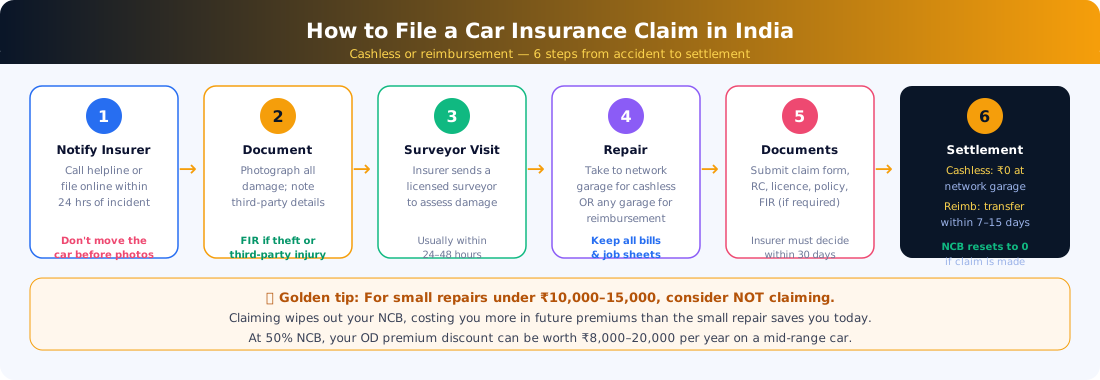
The claim process in India is straightforward when you know what to do in the first 24 hours after an incident.
The cashless network is the key advantage of a comprehensive policy from a major insurer. India's top motor insurers — HDFC ERGO, Bajaj Allianz, ICICI Lombard, Reliance General and New India Assurance — collectively have over 10,000 network garages across India. Taking your car to a network garage means the insurer pays the bill directly; you pay only your excess (deductible) and any non-covered costs. Reimbursement claims take longer (7–30 days) and require you to pay the garage upfront.
IRDAI regulatory framework for motor insurance
5-year TP + 1-year OD for new cars. IRDAI mandates that all new cars purchased from a dealership must have a 5-year third-party policy at the time of sale. Own damage can be renewed annually from year 2, giving you the flexibility to shop around.
Annual third-party tariff revision. IRDAI revises the third-party motor premium tariff annually, typically announced in June each year. The premium varies by engine CC (petrol/diesel) or kW (EV) — you cannot negotiate this rate.
Pay-as-you-drive (PAYD) policies. IRDAI approved pay-as-you-drive motor policies in 2020 — where your own-damage premium is calculated based on actual kilometres driven. Useful for urban residents who drive fewer than 5,000 km per year.
Cashless claim anywhere — IRDAI's Bima Sugam initiative is pushing for expanded cashless access, similar to the health insurance 'Cashless Everywhere' mandate.
Mandatory PA cover for owner-driver. A personal accident cover of ₹15 lakh for the owner-driver is mandatory under IRDAI motor rules — either as part of the motor policy or as a standalone PA policy.
Car insurance that actually pays — comprehensive, zero-dep, and NCB-protected
Compare IRDAI-approved motor policies from India's leading insurers, get cashless cover at 10,000+ garages, and protect your NCB across renewals.
Most aggregators show you a premium number. TropoGo shows you what that premium actually buys. Our motor desk works with IRDAI-approved partners to build policies that match your car's current value, your city's risk profile and your actual driving pattern. Here is what we structure for you:
Comprehensive own damage + third-party cover with accurate IDV — not a deflated IDV designed to manufacture a cheap headline number that undercovers your car at claim time.
Zero depreciation add-on for cars under 5 years old, ensuring you receive the full replacement cost for any part — not the depreciated value that's standard under a base OD policy.
Engine and gearbox protection — particularly important for Indian conditions: monsoon flooding, pothole damage, and water ingression that standard policies exclude.
NCB protection rider — preserves your No-Claim Bonus even after one claim in the policy year, protecting the discount you have accumulated over years of safe driving.
Return to invoice cover for total loss or theft — pays the original on-road price of your car, not the depreciated IDV, which can be ₹2–4 lakh lower for a 3-year-old vehicle.
Pay-as-you-drive policies for low-mileage urban drivers — if you drive under 7,500 km a year, a PAYD policy can reduce your OD premium by 20–40% against a standard annual policy.
Whether you drive a Maruti Swift, a Hyundai Creta, a Honda City or a Toyota Innova, the Car Insurance India page lets you compare, choose and buy from IRDAI-approved insurers — with transparent IDV, add-on options and the full claims network visible before you pay.
The outlook for motor insurance in India
India's vehicle fleet will cross 40 crore registered vehicles by 2028 at current growth rates. IRDAI's regulatory agenda — Bima Sugam, expanded cashless networks, PAYD standardisation and telematics-based pricing — will push motor insurance towards real-time, usage-based products over the next 3–5 years. For now, the fundamentals remain unchanged: legal compliance requires a valid third-party policy, and financial prudence requires comprehensive cover with the right add-ons for your car's age and value. Get those two right and the rest is detail.
FAQs about car insurance in India
Is car insurance mandatory in India?
Yes. Third-party motor insurance is mandatory under the Motor Vehicles Act 1988. Driving without a valid TP policy attracts a fine of ₹2,000 for the first offence and ₹4,000 for a repeat offence. New cars must be sold with a 5-year third-party policy under IRDAI's mandate.
What is the difference between third-party and comprehensive car insurance?
Third-party insurance covers damage or injury caused to other people by your car — it does not cover your own vehicle at all. Comprehensive insurance covers your own car (own damage) plus third-party liability. Comprehensive is optional in law but financially essential for any car worth more than ₹3–4 lakh.
What is IDV and how does it affect my claim?
IDV (Insured Declared Value) is the current market value of your car — the maximum amount the insurer will pay in case of total loss or theft. It is calculated as the original ex-showroom price minus depreciation on the IRDAI schedule. A higher IDV gives you better protection; an artificially low IDV (often used to offer cheaper premiums) means a smaller payout if your car is written off.
How does No-Claim Bonus work?
NCB is a discount on your own-damage premium for each claim-free year: 20% after year 1, rising to 50% after five consecutive claim-free years. NCB belongs to you — it transfers to a new insurer at renewal or to a new car. Making one claim resets your NCB to zero, which is why small repairs are often better paid out of pocket to protect the accumulated discount.
What should I do immediately after a car accident in India?
Do not move the car before photographing all damage. Call your insurer's helpline within 24 hours. File an FIR at the nearest police station if there is third-party injury or property damage. Take the other driver's name, vehicle number, DL and insurance details. Do not sign any settlement document without consulting your insurer first.
How do I buy car insurance through TropoGo?
Visit TropoGo's Car Insurance India page to compare policies from IRDAI-approved insurers with accurate IDV, add-on options and cashless garage network details. For fleet policies covering multiple vehicles, our motor desk structures group cover with volume pricing.
Your car takes you to work, to school, on holidays and to the hospital when it matters. The insurance policy behind it should be chosen with the same care — not picked by price alone, but by what it actually covers when you need it.