India’s commercial drone sector crossed 10,000 registered UAVs in 2025, and the pace is not slowing. Agriculture spray drones blanket fields in Punjab and Maharashtra. Inspection drones survey transmission towers in Rajasthan. Delivery drones carry medicines into tribal belts in Telangana. Each of these operations carries a distinct risk profile — and a distinct need for the right drone insurance policy.
Yet most Indian drone operators still carry either no cover at all, or a one-size-fits-all policy that leaves critical gaps. The DGCA’s Drone Rules 2021 (amended 2023) make third-party liability mandatory for most commercial operations, and IRDAI has issued UAV insurance guidelines. Getting the policy structure right matters — for compliance, for asset protection, and for client contracts that increasingly demand proof of coverage.
This guide breaks down every major type of drone insurance policy available in India today, explains which DGCA category each applies to, and helps you understand exactly what your operation needs.
How DGCA categorises drones — and why it matters for insurance
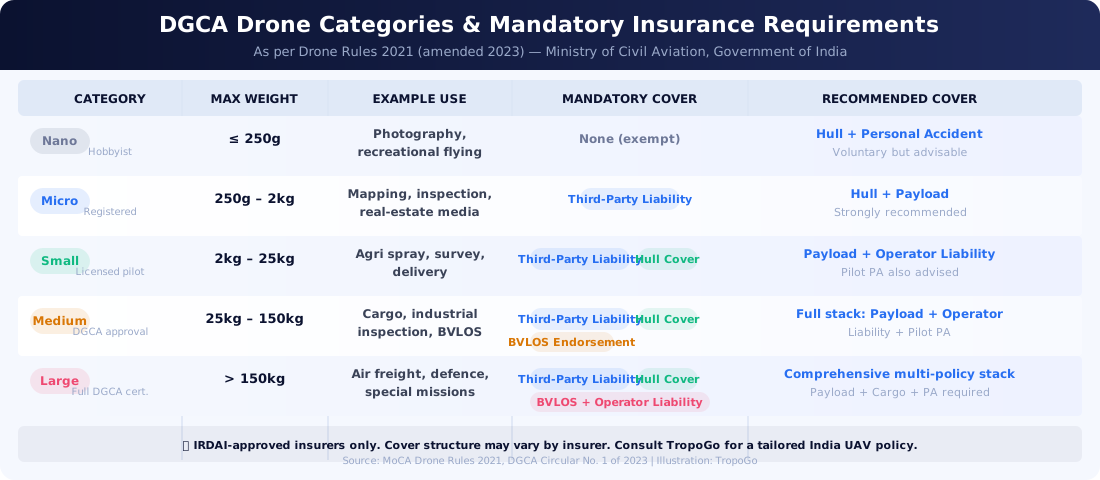
India’s Drone Rules 2021 classify UAVs into five weight categories. The category determines which registrations, licences and insurance requirements apply. Getting this right is the first step in structuring a compliant policy stack.
The key takeaways from the DGCA framework:
Nano drones (≤ 250g) are broadly exempt from mandatory insurance, but voluntary hull and personal accident cover still makes sense for operators flying expensive sensor payloads.
Micro drones (250g–2kg) require third-party liability (TPL) for all commercial operations. Mandatory — not optional.
Small drones (2–25kg) require both TPL and hull cover. Agricultural spray drones, which dominate this category, must carry comprehensive cover from IRDAI-approved insurers.
Medium (25–150kg) and Large (>150kg) drones require a full insurance stack including TPL, hull, and — for BVLOS-approved operations — a BVLOS endorsement. Full DGCA operator certification required.
The six types of drone insurance policies in India
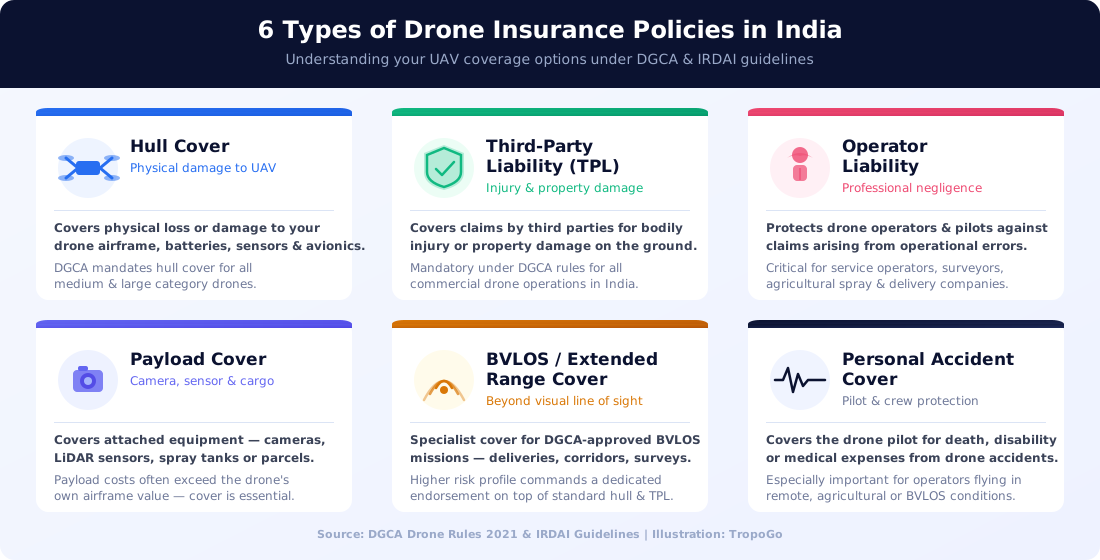
Commercial UAV insurance in India is structured around six distinct policy types, mirroring the approach taken in mature aviation markets like the UK and US, adapted for DGCA regulations and IRDAI-approved insurers.
1. Hull Cover (Physical Damage Insurance)
Hull cover is the most fundamental drone insurance policy: it pays for physical loss or damage to the drone airframe itself — crash damage, fly-away events, water ingress, fire and theft. For most commercial operators the drone is their primary capital asset: an agricultural spray drone costs ₹3.5–5 lakh, an industrial inspection drone can run to ₹15–20 lakh, and a large survey drone with integrated LiDAR can exceed ₹50 lakh.
Hull policies in India are structured on an agreed value basis (insured value fixed at inception, paid in full on total loss) or market value basis (subject to depreciation). For new commercial drones, agreed value is strongly preferred. Batteries — which degrade faster than airframes — are sometimes sub-limited or excluded; check the policy wording carefully.
2. Third-Party Liability (TPL)
Third-party liability is the policy type most explicitly required by DGCA. It covers claims by third parties for bodily injury or property damage caused by the drone. If your spray drone drifts off course and damages a neighbour’s greenhouse, or your inspection drone falls and injures a construction site worker below, TPL is what pays.
Under Drone Rules 2021, all commercial operations above Nano category must carry TPL from an IRDAI-approved insurer. Minimum indemnity limits vary by operator type and client contract, but ₹10 lakh to ₹1 crore per occurrence is the typical commercial range in India today. Government tenders and infrastructure contracts increasingly demand TPL certificates as a bid condition.
3. Operator Liability
Operator liability — sometimes called professional indemnity for drone operators — covers claims from errors, omissions or negligence in the professional service provided. While TPL covers physical injury or property damage to third parties, operator liability covers financial loss flowing from a failed or flawed service.
Concrete examples: a surveying company delivers an inaccurate topographic dataset because the drone’s GNSS malfunctioned; a real-estate photographer’s footage causes a legal dispute; an agricultural drone fails to spray the correct area, leading to crop loss claims. Any commercial operator delivering a data or inspection service should carry this cover. For broader professional indemnity concepts, see our guide on professional indemnity insurance in India.
4. Payload Cover
Payload cover insures equipment attached to the drone but not part of the airframe: cameras, LiDAR sensors, multispectral imaging units, spray tanks, delivery parcels. It is critical because payload costs routinely exceed the drone’s own value. A photogrammetry operator may fly a ₹5 lakh drone carrying a ₹12 lakh LiDAR pod. Hull cover replaces the drone; payload cover replaces the sensor.
Most Indian drone hull policies exclude payload by default or sub-limit it to 10–15% of hull value. Operators must negotiate explicit payload extensions and provide serial numbers, purchase receipts, and — for high-value sensors — recent calibration certificates.
5. BVLOS / Extended-Range Cover
Beyond Visual Line of Sight (BVLOS) operations — where the pilot cannot see the drone unaided — require a separate DGCA approval and a BVLOS endorsement on the base policy. Standard drone policies exclude BVLOS entirely. Operating BVLOS without this endorsement voids the policy completely.
BVLOS is the frontier of Indian commercial drone use: medicine delivery corridors in the Northeast, NITI Aayog pilot programmes, and infrastructure inspection across long pipeline or transmission routes. Expect premiums 1.5–2× the base hull + TPL rate. Specialist covers for extended BVLOS and defence operations are explored in our guide on defence and testing drone insurance.
6. Personal Accident Cover for Pilots
Personal accident (PA) cover for the drone pilot or Remote Pilot in Command (RPIC) pays a lump sum for death, permanent disability or medical expenses from a drone-related accident. Distinct from TPL (protects third parties) and hull (protects the aircraft), PA is the pilot’s own safety net.
PA is especially important for agricultural spray pilots flying low near moving machinery, BVLOS operators in remote terrain, and special-mission operators. DGCA’s Remote Pilot Licence framework requires operator PA in certain categories. ₹25–50 lakh sum-assured PA policies are available from IRDAI-approved insurers at modest premiums relative to the risk.
How to choose the right policy mix
The right drone insurance stack depends on three variables: what you fly, where you fly, and what service you provide.
Agricultural spray operators (Small/Medium): Hull + TPL + Payload (spray tank) + Pilot PA. Add BVLOS endorsement if operating under an approved corridor programme.
Survey & mapping operators: Hull + Payload (camera/LiDAR) + TPL + Operator Liability. Payload cover is non-negotiable given sensor values.
Hobbyist / recreational pilots: Hull and PA voluntary but advisable. TPL not mandated for Nano but recommended for flights near people or property.
What DGCA compliance actually requires from your insurer
Under Drone Rules 2021, the insurer must be IRDAI-approved and must issue a policy naming the drone’s Unique Identification Number (UIN) from the Digital Sky Platform and the operator’s DGCA Remote Pilot Licence or Operator Certificate number. Generic motor or property policies do not satisfy this requirement. The insurance document must be available digitally via Digital Sky for enforcement checks during flight missions.
TropoGo is India’s only drone-specialist platform that links IRDAI-approved insurers directly to the Digital Sky registration system. Policies issued via TropoGo carry the correct UIN references, cover the mandated TPL limits, and can be produced instantly for DGCA inspections or client contract audits.
Common mistakes Indian drone operators make with insurance
Buying hull cover but no TPL. Without TPL, a single third-party injury claim can exceed the total aircraft value several times over.
Forgetting payload. The LiDAR sensor is worth more than the drone. Hull-only policies leave the most expensive item uninsured.
Not disclosing BVLOS operations. An undisclosed BVLOS flight at the time of loss voids the entire policy.
Insuring at purchase price without depreciation review. A drone bought for ₹8 lakh two years ago may only replace at ₹6 lakh today. Over-insuring wastes premium; under-insuring creates a gap at claim time.
No operator liability for service businesses. Data errors from a survey or inspection job can generate claims far exceeding hardware value.
Get DGCA-compliant Drone Insurance from IRDAI-approved partners
Hull, third-party liability, payload and BVLOS cover — tailored to your UAV category, linked to your Digital Sky UIN.
Broad indicative ranges as of 2026 from IRDAI-approved insurers:
Hull cover: 1.5–2.5% of insured value per year for standard commercial drones. Higher for large, BVLOS or special-mission operations.
TPL (₹10 lakh limit): ₹4,000–7,000 per year for a small commercial operation. Scales with indemnity limit and fleet size.
Payload cover: 1.5–2% of payload value per year, with deductibles proportional to payload value.
BVLOS endorsement: Adds 50–100% to the base hull + TPL premium depending on corridor and operation type.
Pilot PA: ₹2,500–5,000 per year for a ₹25 lakh sum-assured policy for a commercial RPIC.
For a multi-drone fleet, volume discounts of 10–25% are standard. TropoGo’s platform lets you compare quotes across IRDAI-approved insurers and structure the right combination in under 10 minutes.
What’s changing: the road ahead for drone insurance in India
Mandatory cargo insurance for drone deliveries. As delivery corridors are formalised under the National Drone Policy 2021 roadmap, DGCA is expected to mandate cargo or consignment cover for commercial delivery operations.
Standardised IRDAI policy wordings. IRDAI is working with the General Insurance Council to create standard drone insurance product guidelines, reducing exclusion clause ambiguity.
Parametric triggers for agri-spray drones. Weather-linked parametric payouts — triggered automatically when operational wind thresholds are breached — are being piloted by two IRDAI-approved insurers in 2026.
Frequently Asked Questions
Is drone insurance mandatory in India?
Third-party liability (TPL) is mandatory under DGCA Drone Rules 2021 for all commercial operations above Nano category. Hull cover is additionally mandated for Small (2–25kg) and above. Nano drones and recreational flyers are currently exempt, though voluntary cover is advisable.
What is the difference between hull cover and third-party liability?
Hull cover insures the drone itself against physical damage or loss. TPL insures you against claims from third parties for injury or property damage caused by the drone. They are separate policies and both are typically needed for commercial operations.
Does a standard drone policy cover BVLOS flights?
No. BVLOS operations are excluded from all standard drone insurance policies. You need a separate BVLOS endorsement from an insurer with DGCA-aligned policy wordings. Operating BVLOS without this endorsement voids your entire cover.
Is payload (camera, LiDAR) automatically covered under hull insurance?
Usually not. Most Indian hull policies either exclude payload entirely or sub-limit it to 10–15% of hull value. Request an explicit payload extension and list all equipment with serial numbers and purchase values.
Do I need operator liability if I already have TPL?
Yes, if you provide a data or inspection service. TPL covers physical injury and property damage. Operator liability covers financial loss from errors in your service — for example, a flawed survey dataset or incorrect spray calibration. They are complementary, not interchangeable.
How do I get DGCA-compliant drone insurance in India?
You need a policy from an IRDAI-approved insurer naming your drone’s Unique Identification Number (UIN) from the Digital Sky Platform and your Remote Pilot Licence number. TropoGo’s drone insurance platform links directly to IRDAI-approved insurers and structures DGCA-compliant policies for every UAV category.
The right drone insurance policy is not just about compliance — it is the foundation that lets your operation scale, win client contracts, and absorb the inevitable hardware incident without shutting down.