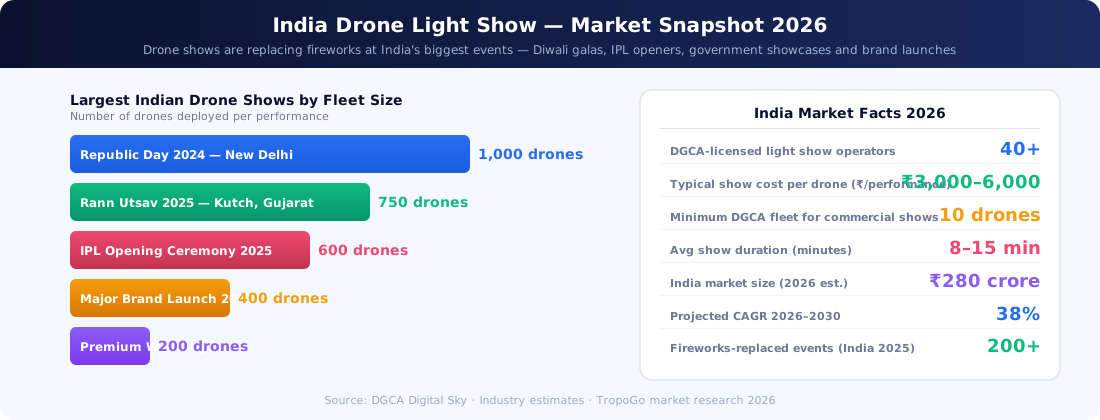
India's event landscape is being redrawn — one drone at a time. Where Roman candles and Diwali rockets once ruled the sky, a new form of spectacle is taking their place: drone light shows, where hundreds or thousands of precisely choreographed drones paint dynamic, programmable art across the night sky. The 2024 Republic Day celebrations in New Delhi featured 1,000 drones forming the national emblem and the Indian tricolour at 120 metres altitude. The IPL 2025 opening ceremony opened with a 600-drone display synced to a live AR Rehman score. A luxury Rajasthan wedding recently commissioned 200 drones to trace the initials of the couple in fire-coloured pixels above their guests.
This is no longer a novelty. India's drone light show industry is projected to reach ₹280 crore by 2026 and grow at 38% CAGR through 2030 — and with that growth comes a new category of commercial and liability risk that operators, event organisers and their insurers are only beginning to fully price. This guide explains how drone light shows work, what the DGCA requires, what can go wrong, and why specialist insurance is not optional for any professional show operator in India.
What exactly is a drone light show?
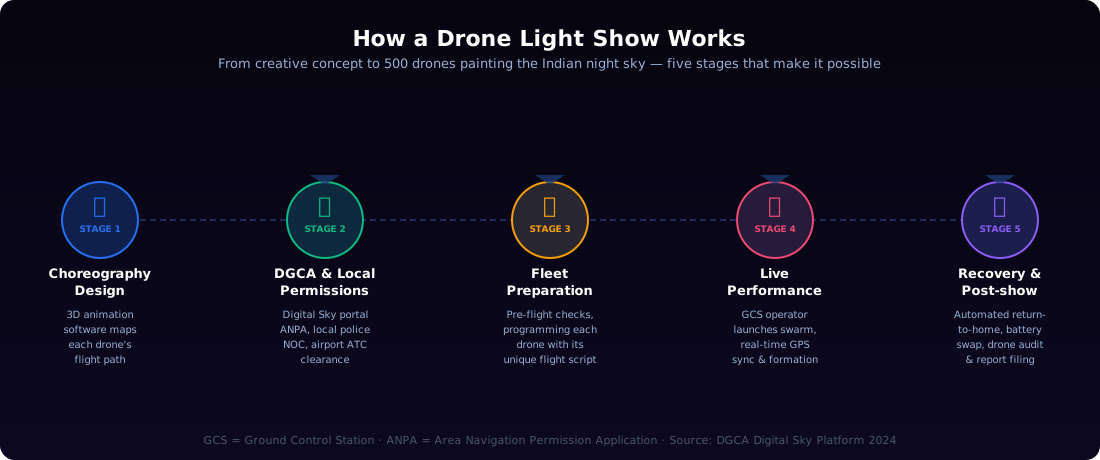
A drone light show is a coordinated aerial display using a fleet of multi-rotor drones — each equipped with programmable RGB LED arrays — that fly pre-scripted three-dimensional flight paths to create animated visual patterns visible to audiences on the ground. Unlike fireworks, which are single-use, uncontrollable once ignited, and generate particulate pollution, drones are reusable, fully programmable, silent relative to fireworks, and produce zero pyrotechnic residue. Each drone in the fleet is given a unique choreography script by a Ground Control Station (GCS) operator, and the show is executed semi-autonomously once the launch sequence is triggered.
Modern light show drones typically weigh 250–500 grams, carry 4–8 rotors, have a flight time of 20–30 minutes on a battery charge, and can hold their GPS position to within 10–30 centimetres. The LED payloads can render 16.7 million colours, enabling intricate animated shapes, scrolling text, brand logos, national symbols and even real-time countdowns.
India's Republic Day 2024 drone show used 1,000 drones — making it one of the largest coordinated drone displays in Asia.DGCA clearances, ATC coordination and local police NOCs had to be secured across five separate jurisdictions for a single 12-minute performance above Kartavya Path.
India's drone light show market — who's doing what
The market has expanded rapidly from government showcase events to commercial, corporate and social occasions. Indian drone show operators including Botlab Dynamics, Indigrid, Skylark Drones and a growing number of regional players are now competing for contracts across weddings, sports openers, brand activations, festival celebrations and political rallies. International operators have also entered the Indian market on specific large-scale government commissions.
The economics are compelling for event organisers: a 200-drone show replacing a ground fireworks display typically costs 20–40% less on a total event cost basis once venue cleanup, fire safety officer fees and pollution mitigation costs are factored in. For venues with proximity to residential areas — a common challenge in Mumbai, Delhi NCR and Bengaluru — drone shows eliminate the noise and spark risk that makes fireworks NOCs increasingly difficult to obtain from local fire departments.
What the DGCA requires for commercial drone shows in India
Drone light shows in India are not unregulated spectacles. The DGCA Drone Rules 2021, the Digital Sky platform and subsequent circulars lay out a structured framework that every professional show operator must navigate. Key requirements include:
Remote Pilot Certificate (RPC) — each drone in the show fleet must be operated by or under the supervision of an RPTO-certified Remote Pilot. Shows with large fleets typically have one lead RPC holder who is legally responsible for the entire swarm.
Unique Identification Number (UIN) — every drone in the fleet must carry a valid UIN registration on the Digital Sky platform. A 500-drone show means 500 UIN registrations.
Permission for Aerial Work (UAS Traffic Management) — operators must file an Area Navigation Permission Application (ANPA) for each show, specifying the coordinates, altitude envelope, duration and safety buffer zone.
Local administration NOC — district collector or sub-divisional magistrate clearance is required for shows within controlled areas. Police NOC is additionally required for events with public gatherings exceeding specified crowd sizes.
ATC coordination — shows within 5 km of an airport require explicit ATC approval and a formal NOTAM (Notice to Airmen) to be filed, ensuring no commercial aircraft conflict with the drone operating altitude.
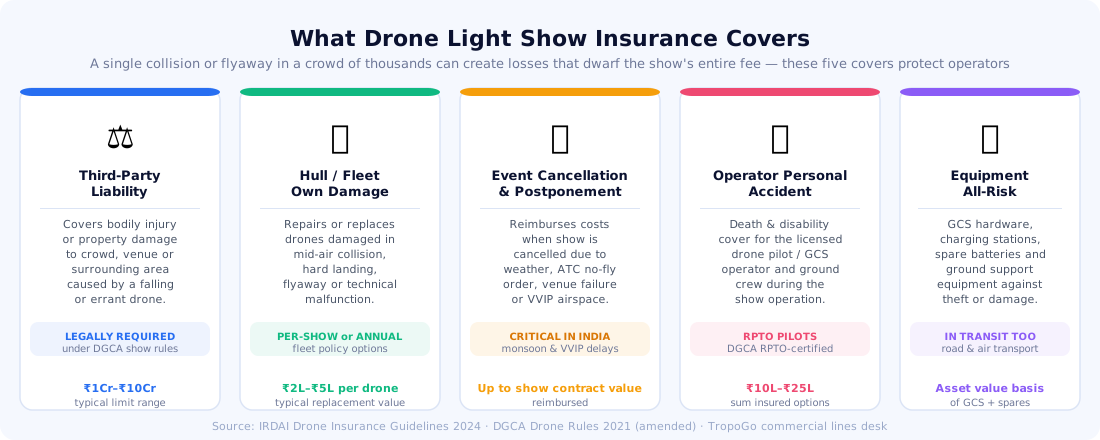
Third-party liability insurance — DGCA circulars strongly recommend, and many municipal authorities now contractually require, third-party liability cover for any commercial drone show operating over or near public gatherings.
What can go wrong — and why insurance is critical
Drone light shows operate at the intersection of high-value equipment, complex airspace, large crowds and unpredictable environmental conditions. The risks are not hypothetical. Indian operators have experienced GPS interference causing formation errors, battery failures during flight, unexpected wind shear at the show altitude disrupting choreography, and — in at least two documented cases — individual drones entering uncontrolled descent toward crowds before automated return-to-home protocols activated.
A single drone weighing 300 grams falling from 80 metres can strike the ground at speeds exceeding 60 km/h. In a crowd of 5,000 guests at a private venue, the liability exposure from a single such incident — medical costs, legal costs, reputational damage, contract penalties — can exceed ₹1 crore. A show using 500 drones creates 500 independent probability events simultaneously.
Insure Your Drone Show — From the First Launch to the Last Landing
TropoGo structures specialist liability, hull, cancellation and operator PA covers for India's drone light show operators — per show or annual fleet policies.
Why specialist drone show insurance is a business imperative
Standard commercial drone insurance — the hull and liability products available for photography, survey or agricultural drone operations — does not adequately address the specific risk profile of a drone light show. Show-specific insurance must account for:
Simultaneous multi-drone exposure — a standard drone policy may cover one drone; a show needs 100–1,000 covered simultaneously under a single limit that aggregates the per-drone risk correctly.
Crowd density multiplier — the liability exposure at a public show with 10,000 attendees is categorically different from a survey operation over an empty field. Underwriters price this separately.
Event cancellation / non-appearance — monsoon weather, VVIP airspace restrictions, ATC ground stops and venue failures can cancel a show hours before launch. Event cancellation cover protects the operator's contract fee and mobilisation costs.
GCS and ground equipment — the Ground Control Station, charging infrastructure and spare battery inventory supporting a large show can cost ₹10–50 lakh. These need separate all-risk equipment cover, especially during road or air transport between venues.
Regulatory non-compliance exclusion — policies must be reviewed carefully for exclusions related to operating without valid DGCA permissions. A show that flies without a filed ANPA or during a NOTAM-prohibited window may find its entire claim excluded.
TropoGo's aerial mobility insurance desk has structured policies for drone show operators ranging from boutique 50-drone wedding show operators to large-scale government event contractors operating 800+ drone fleets across simultaneous multi-city shows.
Drone shows vs fireworks — the insurance perspective
Event organisers choosing between drone shows and fireworks should understand that the insurance risk profiles are meaningfully different. Fireworks carry explosion and fire liability — typically covered under specialised pyrotechnics insurance with strict safety buffer requirements, and increasingly hard to obtain in urban jurisdictions. Drone shows carry aerial liability and equipment risk — insurable under aviation/drone specialist markets, but requiring careful policy construction around crowd proximity, altitude and fleet size. Neither is inherently cheaper to insure than the other at equivalent spectacle scale, but drone shows are becoming easier to insure as actuarial data accumulates and IRDAI-approved drone insurance products mature.
What's next for India's drone show industry
The trajectory is steep. DGCA's ongoing regulatory evolution is expected to streamline the ANPA process for operators with clean compliance records, making it easier to book and execute shows at shorter notice. State governments — particularly Gujarat, Rajasthan, Maharashtra and Tamil Nadu — are actively promoting drone shows as centrepieces of tourism and cultural events, creating a growing public-sector demand stream alongside the private event market. Drone swarm technology is advancing rapidly: inter-drone communication protocols (V2V) are reducing dependence on GPS alone, improving resilience to urban GPS interference — one of the most common show disruption risks in Indian cities.
As the industry scales, the insurance ecosystem will deepen. TropoGo is working with IRDAI-licensed insurers to build dedicated drone show underwriting capacity, with risk-scored products that reward operators who maintain compliance records, invest in fail-safe technology and demonstrate structured pre-show safety protocols.
Frequently Asked Questions — Drone Light Show Insurance
Is drone light show insurance mandatory in India?
Third-party liability insurance is not explicitly mandated by DGCA rules for all shows, but it is increasingly required by event venues, municipal authorities and corporate clients as a contractual condition. Several state governments now require it for shows at public gatherings. Regardless of contractual requirement, operating a 100–1,000 drone show over a public crowd without third-party liability cover is an extreme commercial risk that no professional operator should take.
Does a standard drone insurance policy cover a light show?
Typically, no. Standard commercial drone policies are underwritten for single-drone or small multi-drone operations in low-crowd environments. A light show requires specific underwriting for simultaneous multi-drone fleet exposure, crowd density multipliers, event cancellation cover and large-scale third-party liability limits. Always disclose the show nature, fleet size and expected crowd size when requesting a quote — misrepresentation voids cover.
What happens if DGCA cancels permission at the last minute?
Last-minute DGCA or ATC cancellations — due to VVIP movements, security alerts or airspace conflicts — are an increasingly common risk for Indian drone show operators, especially in Delhi NCR and near major airports. Event cancellation insurance covers the operator's mobilisation costs, contract penalties and lost fee when the show cannot proceed due to such regulatory/airspace events. This cover should be purchased as early as possible, ideally at contract signature, not at show day.
How is the premium for a drone show policy calculated?
Key factors are: number of drones in the fleet, individual drone value (replacement cost), show duration and altitude, expected crowd size and proximity, location (urban vs rural, proximity to airport), operator's DGCA compliance history, and whether the show runs over one or multiple days. Operators with clean regulatory records and documented safety protocols typically access better rates. TropoGo can provide quotes on a per-show or annual basis depending on operator volume.
Can I get insurance for a one-off drone show rather than an annual policy?
Yes. Per-show policies are available and are often the right structure for event organisers or venues that commission occasional drone shows rather than operating their own fleet regularly. For operators running shows monthly or more frequently, an annual open policy with per-show endorsements is typically more cost-effective. TropoGo structures both options based on your expected show cadence for the year.
How do I get drone light show insurance from TropoGo?
Visit tropogo.com/other-insurance/drone-light-show-insurance and provide details about your fleet (number and type of drones, individual values), your upcoming show (date, location, crowd size, altitude, DGCA permissions status) and your operator credentials (RPTO certification, UIN registrations). TropoGo's aerial mobility desk will structure a policy from IRDAI-licensed insurers within 48–72 hours for standard shows, and within 24 hours for urgent pre-show requests.
A drone light show is a complex, multi-system aerial operation conducted over some of India's largest crowd gatherings. The technology is spectacular — and the liability exposure is equally dramatic. Every professional operator needs specialist cover before their first drone leaves the ground.