What is an Underwater Drone? Exploring Marine Technology and Its Applications
19 May 2026 | 7 min read
Protect your underwater drone operations with India's specialist marine insurer
Hull, third-party liability, wreck removal and operator PA covers for ROV/AUV operators, port inspectors, oil & gas contractors and marine researchers.
India's coastline stretches for 7,517 km. Its Exclusive Economic Zone covers 2.37 million square kilometres of the Indian Ocean. Within that vast marine expanse sits oil and gas infrastructure worth lakhs of crores, undersea cables that carry 95% of international internet traffic, the world's third-largest fishing sector, and one of the fastest-growing naval forces in Asia. For decades, monitoring, inspecting and securing all of this depended on human divers — limited by depth, time and risk. Underwater drones are changing that calculus entirely.
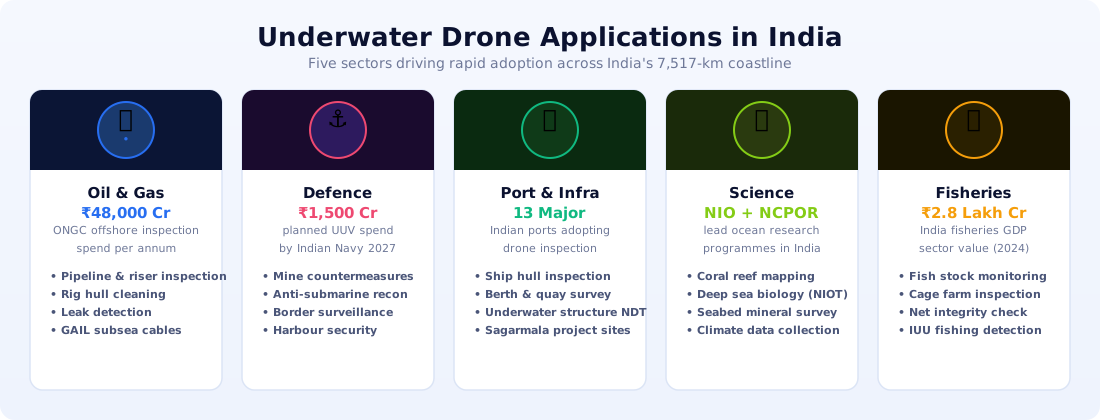
In 2026, underwater drones — also called UUVs (Unmanned Underwater Vehicles), subsea drones or aquatic drones — are at work in Indian waters across five sectors: oil and gas inspection, naval defence, port and infrastructure survey, scientific research and fisheries. The market is growing rapidly, the technology is maturing, and the regulatory framework is catching up. This guide explains what underwater drones are, how they work, who is deploying them in India, and what insurance an operator genuinely needs before deploying one.
What exactly is an underwater drone?
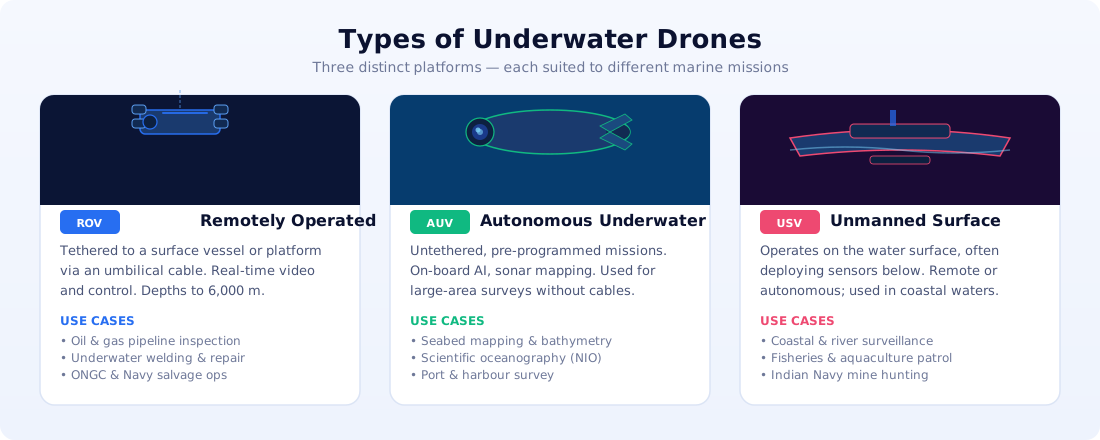
An underwater drone is an unmanned vehicle that operates below the water surface, controlled remotely or autonomously, carrying sensors, cameras and sometimes robotic arms to perform work that would otherwise require a manned submersible or a trained diver. There are three main platform types, each with a distinct engineering philosophy and mission profile.
ROV — Remotely Operated Vehicle
An ROV is tethered to a surface ship or platform by an umbilical cable that carries power and a real-time data link. The operator watches live video, steers thrusters and controls robotic manipulator arms from a control station on the vessel above. ROVs range from compact inspection units the size of a shoebox to work-class vehicles weighing several tonnes, capable of operating at depths of 6,000 metres and beyond. In India, ONGC's offshore platforms — off the Mumbai High, in the Krishna–Godavari basin and along the Cauvery coast — use work-class ROVs for pipeline inspection, riser maintenance and underwater welding.
AUV — Autonomous Underwater Vehicle
An AUV carries no tether. It executes pre-programmed missions — a survey grid, a transect, a mapping pass — using on-board batteries, navigation sensors (DVL, USBL, INS) and acoustic communication. Once a mission is complete the vehicle surfaces, is recovered and its data is downloaded. AUVs are the tool of choice for large-area seabed mapping, oceanographic research and bathymetric surveys. India's National Institute of Ocean Technology (NIOT) operates multiple AUVs in the Bay of Bengal, Arabian Sea and under the Deep Ocean Mission to survey polymetallic nodule fields at depths exceeding 5,500 metres.
USV — Unmanned Surface Vehicle
A USV operates on the surface, typically deploying sonar arrays, multibeam echosounders or towed sensors below the waterline. India's Coast Guard and Navy are both evaluating USVs for patrol, mine-hunting and intelligence-gathering missions. The Indian Coast Guard's 2025 Request for Proposal for autonomous surface vessels specifically references counter-IED (improvised explosive device) and mine-countermeasure use cases around Indian port approaches.
Key application sectors in India
India's 7,500-km coastline, its offshore hydrocarbon fields, its 13 major and 200+ minor ports, its expanding naval footprint and its Blue Economy ambition collectively make it one of the highest-potential underwater drone markets in Asia.
Oil and gas — the largest commercial market
ONGC operates India's largest offshore infrastructure — 280+ wells, hundreds of kilometres of subsea pipelines and dozens of platforms in the Mumbai High alone. Every weld, every pipeline flange and every jacket leg below the waterline must be inspected on a scheduled cycle under the Petroleum and Natural Gas (Safety in Offshore Operations) Rules. Until recently, that meant contracting expensive diver inspection teams whose depth and bottom-time are strictly limited. ROVs now do the same work faster, with higher-resolution video, in any weather and at depths no diver can reach. GAIL's subsea cable crossings and Reliance's KG-D6 deepwater fields are other major deployments. The total ROV inspection market within India's offshore oil sector is estimated at over ₹1,200 crore annually and growing as deepwater discoveries increase.
Indian Navy and Coast Guard
The Indian Navy's Technology Perspective and Capability Roadmap (TPCR) explicitly lists unmanned underwater vehicles as a priority acquisition. India's naval UUV programme covers three mission families: anti-mine (searching for and neutralising bottom mines in harbours and approaches), intelligence-surveillance-reconnaissance (ISR) in contested maritime zones, and anti-submarine support. The Navy signed contracts for its first domestically designed AUVs through DRDO's Naval Science and Technological Laboratory (NSTL) in Visakhapatnam, which has been developing underwater vehicles since 2018. The planned spend on UUV systems through 2027 exceeds ₹1,500 crore.
India has 7,517 km of coastline and a 2.37 million sq km Exclusive Economic Zone — the world's 6th largest.Monitoring this maritime territory with human assets alone is impossible. Underwater drones are the only scalable answer.
Port and harbour inspection
India's Sagarmala programme aims to invest ₹6 lakh crore in port modernisation and coastal connectivity by 2035. Every new berth, every jetty extension and every breakwater addition requires underwater structural surveys before commissioning and at regular intervals thereafter. Traditional diver surveys are slow, weather-dependent and expensive at major ports like JNPA (Mumbai), Mundra, Visakhapatnam and Chennai. Inspection-class ROVs — compact, man-portable units costing ₹25–80 lakh — are now standard equipment for port authorities in Tier-I Indian ports. Ship hull inspections (required for class certificates) are another fast-growing segment; an ROV survey is faster and cheaper than a dry-dock for routine condition assessment.
Scientific research and Blue Economy
India's Deep Ocean Mission, launched in 2021 with a ₹4,077 crore budget, aims to put a manned submersible (Matsya 6000) to 6,000 metres. Supporting it is a fleet of AUVs from NIOT, NIO (National Institute of Oceanography, Goa) and NCPOR (National Centre for Polar and Ocean Research). These vehicles survey polymetallic nodule fields in the Central Indian Ocean Basin, map hydrothermal vents, collect sediment samples and monitor coral bleaching events across the Lakshadweep and Andaman reef systems. Simultaneously, university-level oceanography departments at IIT-Madras, IISc and Cochin University of Science and Technology (CUSAT) are developing and operating their own low-cost AUVs for near-shore research.
Fisheries and aquaculture
India is the world's second-largest fish producer. Its marine fisheries sector alone employs over 16 lakh fishermen. Aquaculture cage farms — particularly shrimp and sea bass cages off the Andhra and Odisha coasts — require regular inspection of net integrity, feed dispersal and fouling levels. Shrimp farming in India is a multi-thousand crore industry, and a single net breach can wipe out a season's production. Compact inspection ROVs (₹8–20 lakh) are now commercially available through Indian distributors from manufacturers like VideoRay (USA), Chasing Innovation (China) and indigenous players such as Deep Blue Robotics (Kochi).
Benefits of underwater drones vs traditional methods
Depth and endurance. ROVs reach 6,000 m; AUVs can survey continuously for 24+ hours. No diver can work below 300 m saturation depth, and bottom time even at 60 m is tightly limited by decompression schedules.
Safety. Eliminating divers from confined, high-pressure or entanglement-risk environments is the single largest occupational safety gain in the offshore industry since North Sea saturation diving protocols were introduced.
Data quality. Modern inspection ROVs carry 4K cameras, multibeam sonar, thickness gauges (UTDR) and CP (cathodic protection) probes simultaneously. No diver can carry or operate all of these at once.
Cost. A work-class ROV mobilisation to do a full platform inspection may cost 40–60% less than an equivalent diver survey team over a 10-day scope of work, even accounting for vessel time.
Night and weather ops. ROVs and AUVs are insensitive to sea state at depth and operate around the clock — a major advantage in the Arabian Sea's cyclone-prone monsoon season.
Challenges and risks
Tether management. ROV umbilical cables are the most common cause of mission failure — snagging on structures, kinking, or being cut by vessel propellers. A lost ROV at depth means a wreck-recovery operation that may cost more than the vehicle itself.
Acoustic communications. AUVs operating untethered rely on underwater acoustic modems (UDAMs) for position updates and commands. In India's busy ship-traffic corridors (Arabian Sea, Bay of Bengal), acoustic interference is a real operational challenge.
Corrosion and biofouling. India's warm coastal waters accelerate hull corrosion, O-ring degradation and marine growth on sensors. Maintenance cycles are shorter than in temperate-water deployments.
Regulatory ambiguity. The DGCA's Drone Rules 2021 cover airborne UAS only — they explicitly exclude "underwater vehicles." A comprehensive regulatory framework for commercial underwater drone operations in Indian waters does not yet exist at the national level.
Skill shortage. Certified ROV pilots with offshore experience remain scarce in India. Most operators currently depend on expatriate pilots or personnel trained abroad, raising costs.
Regulatory framework: where things stand in India
Unlike airborne drones — which are tightly governed by the DGCA's Drone Rules 2021 and the Digital Sky platform — underwater drones in India operate in a regulatory patchwork. Understanding which authority applies to which operation is essential for compliance and insurance.
DGCA (Civil Aviation): Does NOT apply to underwater vehicles. The Drone Rules 2021 specifically govern aircraft operating in airspace. An underwater drone is not an aircraft.
Ministry of Ports, Shipping and Waterways (MoPSW): Governs commercial operations in Indian ports and waterways. Any ROV or USV operating within a major port's fairway or anchorage requires prior permission from the Port Authority. The National Waterways Act 2016 extends similar requirements to inland waterway operations.
Indian Navy / Coast Guard: Naval waters, defence exclusion zones and areas around naval bases (Vishakhapatnam, Karwar, Mumbai) require explicit Navy/Coast Guard clearance for any underwater vehicle operation. Unauthorised operation in restricted naval waters can invoke the Official Secrets Act 1923.
OIDB / DGH: The Directorate General of Hydrocarbons and the Oil Industry Development Board govern offshore oil operations. ROV deployments on ONGC infrastructure must comply with their Safety Management System requirements and the PNSO Rules 2008.
IRDAI (Insurance): Marine hull insurance for underwater drones falls under the Marine Insurance Act 1963. Third-party liability is governed by IRDAI's marine and miscellaneous categories. There is currently no standalone "underwater drone" policy product; coverage is structured under existing marine, engineering and liability classes by specialist brokers.
IMO Conventions: Indian-flagged vessels deploying ROVs in international waters are bound by SOLAS, MARPOL and relevant IMO circulars on unmanned maritime systems — particularly MSC-MEPC.2/Circ.23 on interim guidelines for UMS.
Underwater Drone Insurance, built for Indian operators
Hull, third-party liability, wreck removal and operator PA cover — structured under IRDAI-approved marine classes by TropoGo's specialist marine desk.
Why insurance is the foundation, not an afterthought
An inspection-class ROV costs ₹25–80 lakh. A work-class deep-water ROV costs ₹5–25 crore. An AUV optimised for seabed mapping starts at ₹1.5 crore. Any of these can be lost in minutes — to a snagged tether, a propeller strike from a passing vessel, a flooded electronics housing, or simply a navigation error in a complex offshore environment. And the vehicle loss is often the least costly part: a lost ROV near a live pipeline can trigger a mobilisation for recovery that costs multiples of the vehicle's value. A collision with another vessel's hull or a subsea cable can trigger third-party claims running to crores.
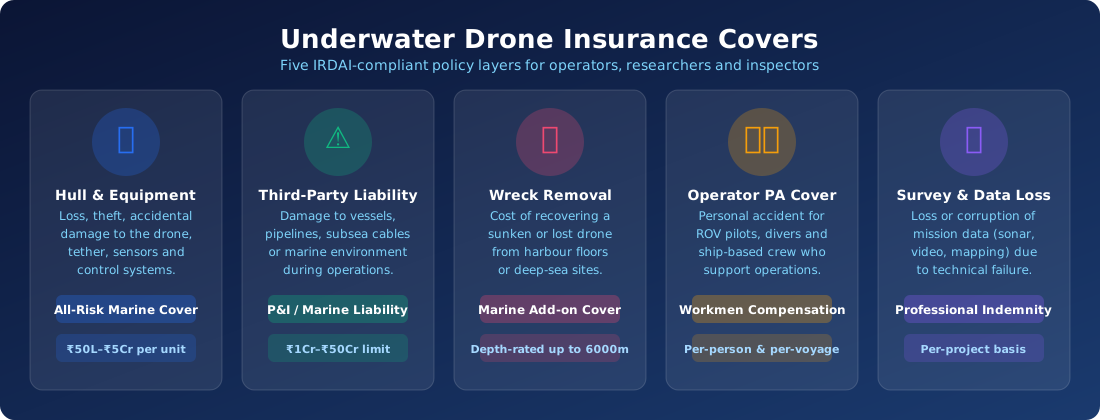
Five distinct insurance covers are relevant to almost every professional underwater drone operation in India:
Hull and equipment (all-risk marine cover): Covers the vehicle itself against physical loss or damage — flooding, collision, fire, theft and mechanical failure — along with the tether, control console, sensors and tooling. Typical sum insured ranges from ₹50 lakh for an inspection ROV to ₹25 crore for a deep-water work-class unit.
Third-party liability (P&I / marine liability): If your ROV collides with another vessel's hull, entangles with a pipeline or damages a subsea power cable, the operator faces potentially unlimited third-party claims. A separate liability cover — ₹1 crore to ₹50 crore depending on the operating environment — is essential. Standard marine cargo or vessel policies rarely extend to third parties' subsea infrastructure.
Wreck removal cover: Recovery of a lost ROV from a harbour floor, a platform jacket or a deep-sea site involves specialist vessels, surface-supplied diving or secondary ROV mobilisation. Costs are unpredictable and can far exceed the vehicle value. Wreck removal cover (an add-on to hull cover, or a separate policy) addresses this directly.
Operator and crew personal accident: ROV pilots working on offshore platforms or small vessels face the same occupational hazards as any offshore worker. A workmen's compensation and personal accident policy for the human crew managing the vehicle is as important as insuring the vehicle itself.
Survey and professional indemnity: If the primary deliverable of your underwater drone mission is a survey report — a structural inspection, a bathymetric chart, a pipeline condition assessment — and that data turns out to be corrupted, incomplete or incorrect due to equipment failure, the client may sue for consequential loss. Professional indemnity cover protects the operator against these claims.
TropoGo's specialist marine insurance desk structures all five of these covers under IRDAI-approved products, calibrated to the specific platform (ROV, AUV, USV), operating depth, geography and use case. Whether you are an offshore contractor, a port authority, a research institution or a start-up operating inspection ROVs in Indian coastal waters, the Underwater Drone Insurance India page is where your cover begins.
India's underwater drone sector: the outlook to 2030
Three macro-level forces will drive the Indian underwater drone market over the next four years. First, the Deep Ocean Mission will catalyse domestic AUV development — NIOT and DRDO's NSTL are both incubating indigenous vehicles, and the first deep-rated Indian-built AUV is expected to complete sea trials by 2027. Second, the Sagarmala port modernisation programme will create recurring demand for inspection ROVs at every greenfield port built over the next decade. Third, the Indian Navy's expanding UUV programme will create a captive defence market that inevitably seeds commercial spin-offs — as it did in the USA and UK.
India also has a growing start-up ecosystem in this space. Deep Blue Robotics (Kochi), Robosys Automation (Navi Mumbai, focused on USVs) and IIT-Madras's technology transfer programmes are among the early-stage players building indigenous capability. As domestic manufacturing scales under the PLI (Production Linked Incentive) framework, the cost of ownership will fall and adoption will broaden from large operators to mid-size port contractors, aquaculture companies and environmental monitoring firms.
The water below India's surface is vast, strategically important and largely unexplored by automated systems. The decade ahead belongs to operators who combine capable vehicles, a skilled team — and the right insurance stack — to work in it safely.
FAQs about underwater drones in India
Are underwater drones covered by India's Drone Rules 2021?
No. The DGCA's Drone Rules 2021 govern aircraft operating in airspace and explicitly exclude underwater vehicles. Commercial underwater drone operations in Indian waters are regulated by a patchwork of authorities: MoPSW for port and waterway operations, the Indian Navy and Coast Guard for restricted maritime zones, DGH for offshore oil operations, and IRDAI for insurance. There is currently no single national regulatory framework for commercial UUV operations.
What is the difference between an ROV and an AUV?
An ROV (Remotely Operated Vehicle) is tethered to a surface vessel by an umbilical cable, giving operators real-time control and unlimited endurance. An AUV (Autonomous Underwater Vehicle) is untethered, runs pre-programmed missions on battery power, and returns data after surfacing. ROVs are preferred for intervention and inspection tasks; AUVs are preferred for large-area survey missions where real-time control is not needed.
Who uses underwater drones in India today?
The main deployers today are ONGC and private offshore contractors (oil and gas inspection), the Indian Navy and Coast Guard (defence), major port authorities under the Sagarmala programme (infrastructure inspection), NIOT and NIO (oceanographic research) and commercial fish cage operators in Andhra Pradesh and Tamil Nadu. A growing ecosystem of start-ups — Deep Blue Robotics, Robosys Automation, IIT-Madras spin-offs — are developing and selling indigenous platforms.
What depth can underwater drones reach?
Depth ratings vary widely by platform. Compact inspection ROVs (e.g. Blue Robotics BlueROV2) are rated to 100 m; mid-class units to 300–1,000 m; work-class ROVs (Schilling, Oceaneering) to 4,000–6,000 m. NIOT's deep-rated AUVs are designed for 5,500 m. The Matsya 6000 manned submersible under India's Deep Ocean Mission targets 6,000 m.
How much does an underwater drone cost in India?
Entry-level inspection ROVs start at ₹8–20 lakh. Mid-range inspection class units cost ₹25–80 lakh. Work-class ROVs for offshore oil operations cost ₹5–25 crore. Research-grade AUVs range from ₹1.5 to ₹15 crore depending on depth rating and sensor suite. Annual operating costs (maintenance, tether replacement, sensor calibration) typically add 15–25% of capital cost per year.
What insurance does an underwater drone operator need in India?
A comprehensive cover stack for Indian operators should include: hull and equipment all-risk cover for the vehicle and sensors, third-party liability (marine P&I class) for damage to vessels or subsea infrastructure, wreck removal cover for recovery of a lost vehicle, operator and crew personal accident, and professional indemnity if survey data is a primary deliverable. TropoGo's Underwater Drone Insurance structures all five under IRDAI-approved marine products.
Whether you operate an inspection ROV for ONGC, deploy AUVs for deep-sea research, or run a port survey business under the Sagarmala programme, underwater drone operations carry real financial risk. TropoGo's specialist marine desk provides cover designed specifically for Indian operators — not generic cargo policies bolted onto a new use case.