India's air ambulance sector is at an inflection point. For two decades, helicopter ambulances were the preserve of defence-funded rescue missions and a handful of private hospitals serving ultra-high-net-worth patients. By 2026, that picture has changed sharply: government schemes are funding aeromedical transport for ordinary citizens, digital dispatch platforms are cutting response times from hours to minutes, and the first eVTOL medevac aircraft are on order from operators in Bengaluru and Mumbai. The question is no longer whether India will have a mature air ambulance industry — it is how quickly it will get there, and who will shape it.
This guide maps the five biggest trends reshaping India's emergency air-transport sector, identifies the companies and regulators driving the change, and explains why specialist insurance is the one non-negotiable foundation every operator needs before the first rotor turns.
Where India's air ambulance industry stands today
India currently has roughly 150–180 medically configured helicopters and fixed-wing aircraft in aeromedical service, operated by a mix of state aviation corporations (UDAN-funded), private operators, and hospital-owned fleets. Demand is concentrated on five corridors: the Kashmir and Himachal hill districts, the Odisha–Jharkhand mining belt, Gujarat coastal clusters, the North-East, and inter-metro organ-transport runs.
Yet the sector is growing at an estimated 18–22% CAGR, driven by rising health insurance penetration, AB-PMJAY scheme expansion, and a sharp increase in road-accident mortality awareness prompting state governments to fund aeromedical capacity. The gap between demand and supply has never been wider — which is exactly what makes the next five years so consequential.
Five trends reshaping India's aeromedical future
Trend 1 — eVTOL medevac aircraft
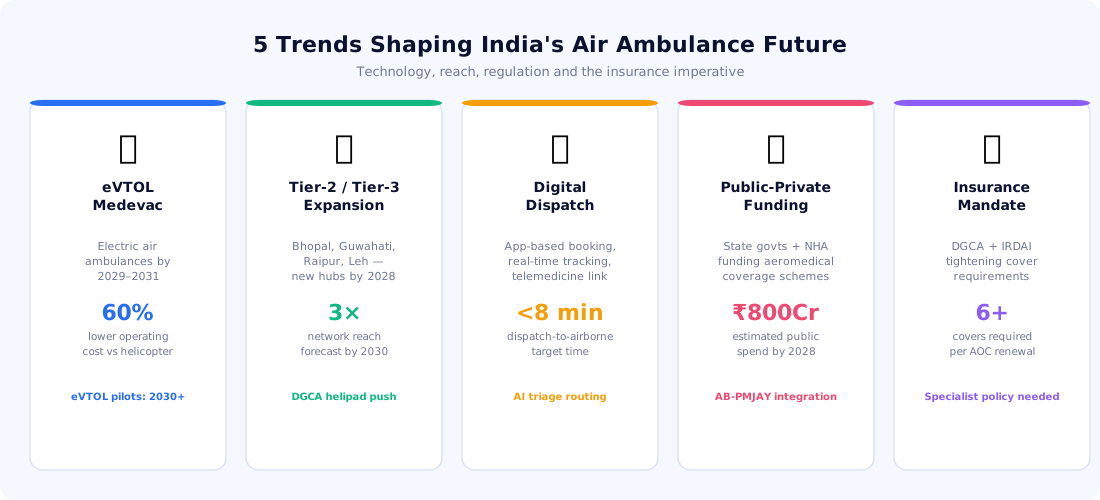
The same electric vertical take-off and landing (eVTOL) platforms being developed for air-taxi services are being adapted for medical missions. Aircraft like the Joby S4, Wisk Aero and India-developed designs from The ePlane Company (IIT-M spin-off) can carry a patient, a paramedic and medical equipment on a 60–100 km mission. Critically, eVTOL medevac aircraft are projected to cut per-hour operating costs by up to 60% compared with turbine helicopters — the single biggest barrier to aeromedical scale in India. Operators in Bengaluru and Mumbai have confirmed LOIs with overseas manufacturers, with trial routes expected by 2028.
Trend 2 — Tier-2 and Tier-3 expansion
For decades, India's air ambulance coverage map had a predictable shape: heavy in metros and hill districts, essentially absent across the vast Tier-2 arc from Bhopal to Coimbatore. AB-PMJAY scheme expansions and state government capitation contracts are now funding aeromedical bases in cities like Nagpur, Patna, Indore, Raipur and Visakhapatnam. These bases are small — typically one or two aircraft — but the coverage geometry change is transformative: a patient in rural Chhattisgarh who previously needed a 6-hour road journey to a cardiac centre can now reach one in under an hour. Operators with Tier-2 footprints are reporting 3x volume growth year-on-year on state-contract routes.
Trend 3 — Digital dispatch and AI triage
Response time is the single variable most correlated with survival in aeromedical missions. India's first purpose-built HEMS dispatch platforms — modelled on London HEMS and Swiss Rega — are entering service. These systems integrate weather data, aircraft availability, nearest landing zone mapping and hospital capacity into a single decision engine. Leading operators like Air Asia Medical, Medi Air Rescue and Thumbay Group's aviation arm are deploying dispatch AI that is cutting average response-to-wheels-up time from 28 minutes to under 8 minutes on pre-cleared urban corridors. For rural missions where the landing zone still needs reconnaissance, the reduction is from over 3 hours to under 70 minutes.
Trend 4 — Public-private funding convergence
India's central government has allocated approximately ₹800 crore to aeromedical infrastructure across the 15th Finance Commission cycle, covering helipad construction at district hospitals, pilot training stipends and equipment grants. Simultaneously, private equity is entering the sector: two dedicated aeromedical operators received Series-B funding of over ₹250 crore between 2024 and early 2026. The PPP template that proved successful in the UDAN fixed-wing scheme is now being extended to helicopter ambulance routes — government subsidises the base cost, operators add private premium capacity on the same aircraft.
Trend 5 — Mandatory insurance and regulatory formalisation
DGCA CAR Section 8 already mandates minimum third-party liability for non-scheduled operators. As of 2025, the IRDAI issued sector-specific guidance requiring operators receiving AB-PMJAY or state-government contracts to carry comprehensive aviation liability cover of at least ₹50 crore per occurrence. This shift from voluntary to mandatory insurance is the single most important structural change in the sector: it forces operators to price insurance into their unit economics and it unlocks institutional investor confidence. Six specialised aeromedical insurance products are now available in India from IRDAI-approved partners.
Who is shaping India's aeromedical future?
The landscape spans government bodies, established operators and an emerging crop of tech-first aeromedical start-ups:
DGCA and MoCA: Drafting an updated CAR Section 8 (2026 edition) that brings eVTOL medevac aircraft under a dedicated sub-category with faster AOC processing for HEMS operators.
Air Asia Medical: India's largest dedicated air ambulance operator, now running 38 aircraft from 11 bases, with a confirmed eVTOL medevac pilot at Kempegowda International Airport.
Medi Air Rescue (MAR): Pioneer of India's first 24×7 HEMS dispatch centre in Mumbai, integrating AI triage with live hospital-bed capacity from 140+ partner hospitals.
Government Medical Services Corporation (GMSC), Odisha & Chhattisgarh: Running the largest publicly-funded aeromedical programmes, each operating 8–12 state-contracted helicopters on trauma and maternal-health missions.
Narayana Health & Apollo Hospitals: Hospital-owned fixed-wing air ambulances for inter-facility organ transport, with Apollo's network covering 22 cities.
The ePlane Company (IIT Madras): Developing the e200, a 200 kg payload electric fixed-wing with a 200 km range, targeted explicitly at HEMS missions in India's Tier-2 geographies.
Benefits driving the growth
Survival impact: For STEMI cardiac events, every 10-minute reduction in door-to-cath-lab time reduces mortality by roughly 7%. Aeromedical transport routinely eliminates 60–180 minutes of road time on critical corridors.
Organ viability: Fixed-wing transport extends the cold-ischaemia window for heart, liver and lung transplants — each of which has strict time ceilings before the organ is unusable.
Reach: India has over 640 districts. Road ambulances simply cannot cover the mountain, forest and flood-affected geographies that hold roughly 80 million people in persistent underservice.
Economic returns: State governments that have run cost-benefit analyses on their HEMS programmes consistently find that the per-life-saved cost falls within acceptable public-health thresholds when compared with ICU costs of delayed treatment.
Medical tourism: Inbound medical tourists increasingly arrive with air ambulance repatriation insurance; Indian hospitals that offer seamless aeromedical discharge are winning multi-crore contracts with GCC and African health systems.
Challenges the sector must still clear
Helipad certification backlog: DGCA's helipad approval queue is estimated at 400+ sites. A fast-track certification track for hospitals with NABH accreditation is under discussion but not yet gazetted.
Pilot shortage: India has fewer than 600 instrument-rated helicopter pilots. HEMS operations require additional night-rated and mountain endorsements, narrowing the pool further. Operator associations estimate a deficit of 200 mission-ready HEMS pilots by 2028.
Cost recovery: Even with AB-PMJAY reimbursement, the average state-government tariff of ₹45,000–65,000 per mission does not cover the ₹90,000–120,000 true operating cost of a turbine helicopter mission. The viability gap is a structural problem until eVTOL platforms bring costs down.
Weather and terrain: The North-East, Ladakh and Western Ghats corridors are the highest-demand regions and also the hardest operationally — high-altitude density altitude limits, rapidly deteriorating weather and limited instrument approach procedures.
Insurance awareness: Despite IRDAI guidance, an estimated 40% of smaller aeromedical operators still carry only minimum third-party cover. Comprehensive hull and passenger liability remains under-penetrated.
The regulatory framework — what operators need to know
India's aeromedical regulatory architecture is maturing rapidly. Key milestones:
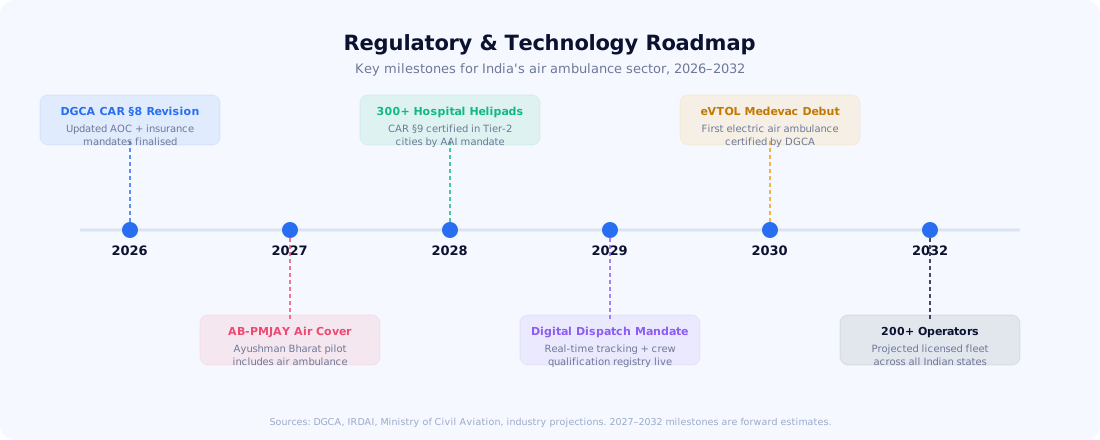
DGCA CAR Section 8, Series O, Part I — the primary rule-set for non-scheduled operators running HEMS, last revised with interim guidance in 2024. A full revision incorporating eVTOL medevac sub-categories is expected by late 2026.
Air Operator Certificate (AOC): All commercial aeromedical operators must hold or operate under an AOC. HEMS-specific endorsements cover equipment fitouts (stretcher, oxygen, cardiac monitor standards) and crew medical qualifications.
IRDAI Circular (2025): Mandates ₹50 crore minimum liability cover for operators on public-funded routes — a threshold most specialist policies now meet as standard.
MoCA's Helipad Policy: The 2022 national helipad policy streamlined environmental approvals for hospital helipads but left the DGCA certification queue intact — the bottleneck remains approval rather than permission.
eVTOL sub-framework: DGCA and MoCA have released a joint discussion paper on eVTOL certification (2025). Medical-use eVTOLs are likely to be treated as non-scheduled operators under an amended CAR Section 8, with a manufacturer-type-certificate fast-track for aircraft already holding FAA or EASA approval.
Air Ambulance Insurance — built for India's aeromedical operators
Hull, third-party liability, crew personal accident and passenger cover from IRDAI-approved partners. One specialist desk. One policy stack.
An air ambulance operation carries risk layers that no generic vehicle insurance can address. A single turbine helicopter represents a ₹15–40 crore asset; it operates in instrument conditions, carries critically ill passengers and lands at improvised sites. Each layer of risk needs its own policy response:
Hull & machinery insurance covering the airframe, rotors, avionics and medical equipment fitout — including loss caused by hard landings at unimproved sites, which is excluded from most standard aviation policies.
Third-party liability of at least ₹50 crore per occurrence, now mandated under the 2025 IRDAI circular for all publicly-funded aeromedical operators.
Passenger liability per seat, structured on Montreal Convention principles — essential when carrying fee-paying patients or family members who are not crew.
Crew personal accident for pilots and paramedics, covering death, permanent disability and temporary disability — standard ESIC cover is inadequate for aviation crews.
Medical equipment all-risk cover for portable ventilators, intra-aortic balloon pumps, ECMO units and other high-value devices that are loaded and unloaded on each mission.
Repatriation and ground-liability cover for hospital helipad operations, covering third-party injury from rotor downwash, blown debris or emergency vehicle interactions at uncontrolled landing zones.
TropoGo's specialist aviation insurance desk works with IRDAI-approved underwriters to structure all six covers into a single, India-specific policy — eliminating the coverage gaps that typically emerge when operators piece together generic aviation and health policies. For operators on IRDAI-mandated routes, TropoGo's Air Ambulance Insurance product meets the ₹50 crore liability threshold as standard.
Read our related guide on India's Air Ambulance Regulations for the complete CAR Section 8 compliance checklist every operator needs.
The outlook: India's aeromedical future by 2032
If current trajectories hold, India's air ambulance sector will look substantially different by 2032. The most probable milestones:
A fleet of 400+ medically configured aircraft, up from roughly 175 today, driven by eVTOL medevac unit economics making Tier-2 routes viable for the first time.
300+ certified hospital helipads, with fast-track approval clearing the current backlog, enabling ambulance helicopter access at every NABH-accredited tertiary care centre.
A national aeromedical dispatch network modelled on European HEMS systems, enabling a single call to dispatch the nearest available aircraft anywhere in India within a defined response window.
AB-PMJAY coverage extension to include air ambulance for defined emergencies — a policy ask that gained serious traction in the 2025–26 Union Budget discussions.
India becoming a net exporter of aeromedical services to neighbouring South Asian markets — Bangladesh, Nepal, Myanmar and Sri Lanka — as Indian operators develop the fleet and operational experience that exceeds regional alternatives.
The decade ahead will be defined not by the arrival of new aircraft types — those are already confirmed — but by the regulatory, insurance and funding scaffolding that determines which operators can afford to scale and which routes become commercially viable. Operators who get their insurance architecture right now will be best placed to capture the growth.
FAQs about the future of air ambulance services in India
When will eVTOL medevac aircraft enter service in India?
Leading operators have signed LOIs with eVTOL manufacturers for aircraft expected to receive DGCA approval between 2027 and 2029, subject to the parent aircraft completing FAA or EASA type certification. Trial HEMS corridors in Bengaluru and Mumbai are the most likely launch routes.
How is AB-PMJAY funding changing air ambulance access?
AB-PMJAY scheme expansions are progressively including inter-facility air transport for defined critical-care categories. State-level capitation contracts already fund aeromedical bases in Odisha, Chhattisgarh and Himachal Pradesh, with five more states in advanced discussions as of early 2026.
What is the DGCA CAR Section 8 requirement for air ambulance operators?
DGCA CAR Section 8 requires all commercial HEMS operators to hold an Air Operator Certificate (AOC) with a HEMS endorsement, maintain medically configured aircraft to specified standards, and carry minimum third-party liability insurance. The 2026 revision is expected to add an eVTOL medevac sub-category. See our full regulations guide for details.
What insurance is mandatory for an air ambulance operator in India?
Under the 2025 IRDAI circular, operators on publicly-funded or AB-PMJAY routes must hold a minimum ₹50 crore third-party liability policy. Hull insurance is not yet legally mandated but is required by most lenders and state-government contract frameworks. Crew PA and passenger liability are standard in comprehensive operator policies.
How does digital dispatch reduce response times?
Modern HEMS dispatch platforms integrate aircraft GPS, hospital bed availability, weather data and landing zone suitability into a single decision engine. The fastest systems in India are now dispatching aircraft in under 8 minutes from call receipt on pre-cleared urban corridors — down from industry averages of 25–35 minutes just three years ago.
How can TropoGo help an air ambulance operator get insured?
TropoGo's specialist aviation desk structures hull, third-party liability (meeting the ₹50 crore IRDAI threshold), crew PA, passenger liability and medical equipment cover into a single India-specific policy through IRDAI-approved underwriters. Explore the Air Ambulance Insurance India page or contact our team for a quote.
Whether you're launching a new HEMS operation, expanding an existing fleet or seeking compliance with the latest IRDAI mandate, TropoGo's specialist aviation insurance desk has the expertise and IRDAI-approved partner network to structure the right cover for your mission profile.