For decades, the dream of hailing a flying taxi has been the stuff of science fiction. In 2026, it is starting to look like an Indian commute. With investment from the Tata group, Mahindra, IndiGo and a wave of global eVTOL manufacturers, India is emerging as one of the largest potential markets for urban air mobility (UAM) in the world. The first air taxi services in Bengaluru, Mumbai and the Delhi NCR are no longer hypothetical — they are timelines.
This guide explains what an air taxi is, how the technology actually works, who is building India's first networks, what the DGCA framework looks like, and where insurance fits in. If your business will operate, lease, finance or insure an air taxi, this is the starting point.
So, what exactly is an air taxi?
An air taxi is a small, on-demand passenger aircraft that takes off and lands vertically from a dedicated mini-airport called a vertiport. Unlike a traditional helicopter, today's air taxis are electric vertical take-off and landing (eVTOL) aircraft — battery powered, distributed across multiple electric motors and rotors, dramatically quieter, and with operating costs targeted to fall close to a premium ride-share trip over the next decade.
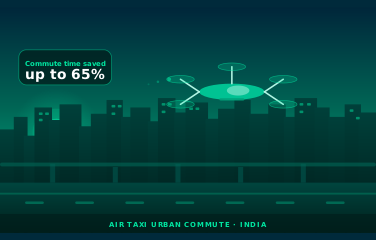
The combination matters. Quieter aircraft can fly closer to people; lower operating costs make routes economically viable; vertical landing removes the need for runways. Stitch those three together and you can move passengers across a 40 km traffic-clogged city in 12 to 18 minutes, gate-to-gate. For a city-by-city breakdown of the actual time savings on Bengaluru, Mumbai-Pune and Delhi NCR corridors, see our companion piece How Air Taxis Will Transform Urban Commutes in India.
Morgan Stanley estimates the global UAM market at $1 trillion by 2040 and ~$9 trillion by 2050.India is forecast to be among the top three markets by passenger volume, driven by metropolitan congestion and a young, app-first commuter base.
The eVTOL technology behind air taxis
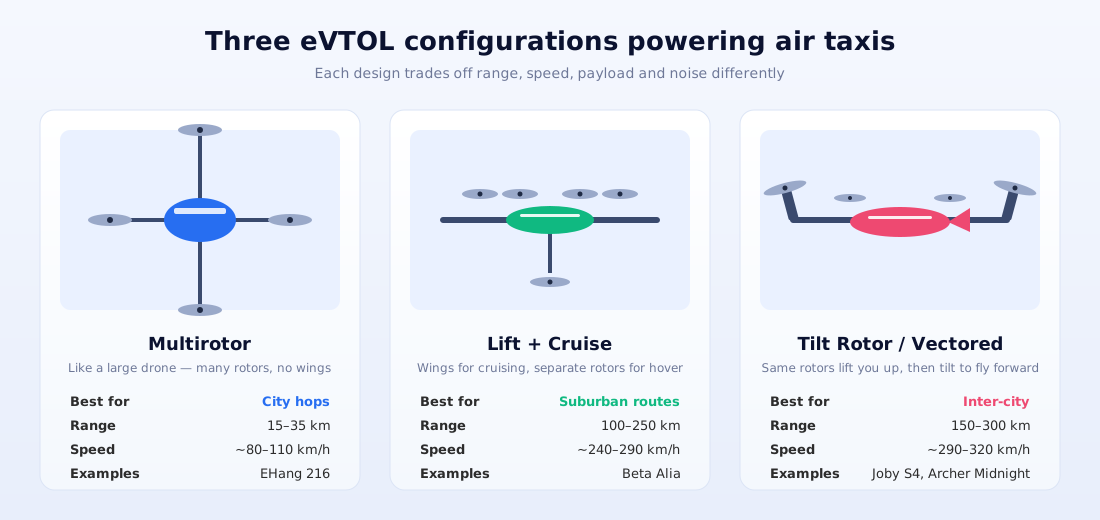
Not all eVTOLs are built the same. Three distinct architectures dominate the market — each with a different sweet spot in range, speed and noise. Understanding them helps make sense of which operator can serve which type of route in India.
Multirotor
The most familiar shape — a giant passenger drone. Simple, mature and forgiving in city centres, but limited to short hops because it spends all its energy lifting against gravity. Ideal for the 15–35 km intra-city ride that 70% of Indian air-taxi pilot routes are designed around.
Lift + Cruise
A fixed wing for cruising plus dedicated rotors for hover. The wing makes long-distance flight efficient, which is why this configuration suits routes like Mumbai BKC to Pune Hinjewadi or Chennai to Bengaluru. Slightly more complex to certify because lift and cruise systems are independent.
Tilt rotor / vectored thrust
The same rotors that lift the aircraft tilt forward to push it through the air — combining the speed of a fixed-wing aircraft with the vertical capability of a helicopter. Joby's S4, Archer's Midnight and Airbus's CityAirbus NextGen all sit in this family. The most demanding to certify, but the most flexible operationally, with cruise speeds of 290–320 km/h.
Who is building India's air-taxi network?
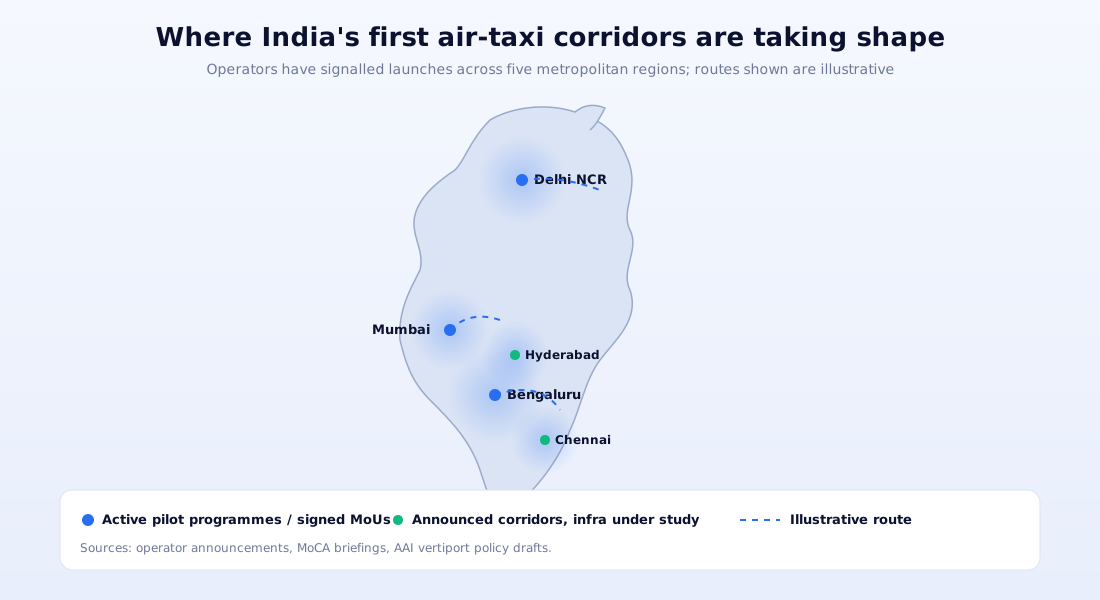
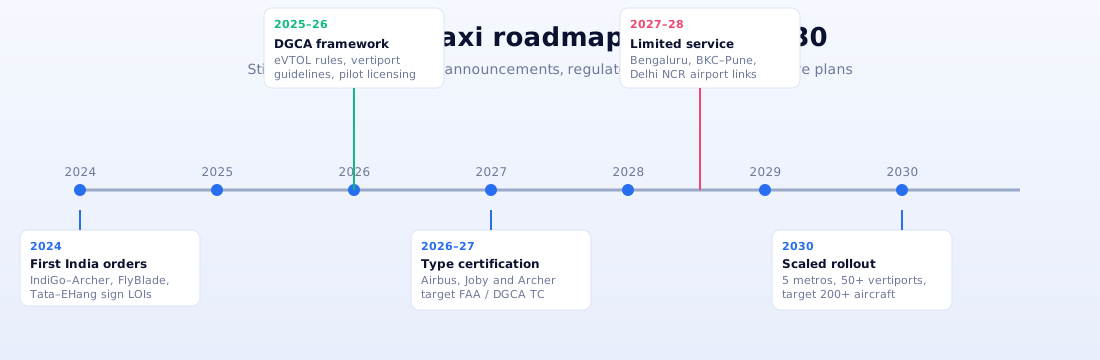
India's UAM landscape took shape rapidly between 2024 and the start of 2026. Operators have signed Letters of Intent or firm orders, vertiport developers have begun site surveys, and the DGCA has published draft rules. The map below shows where the first corridors are taking shape.
IndiGo & Archer Aviation: InterGlobe Enterprises (parent of IndiGo) signed an LOI in 2024 to launch all-electric air taxi services with Archer's Midnight aircraft, targeting Bengaluru, Mumbai and Delhi by 2027.
Tata group & EHang / Airbus: Tata Sons has partnerships across Airbus (Helicopters / CityAirbus NextGen) and Indian operators, with announcements around routes connecting Bengaluru airport with Whitefield and Electronic City.
FlyBlade India (Hunch Mobility): Already running helicopter shuttles between Mumbai's BKC and Pune, FlyBlade has indicated transition plans to eVTOL fleets.
Mahindra Aerospace partnerships and several start-ups (e.g. ePlane, Sarla Aviation, The ePlane Company at IIT-M, Bengaluru-based Bonbon Aerospace) are working on India-built eVTOL airframes for the longer term.
Vertiport developers: AAI's draft vertiport guidelines, plus partnerships with airport operators (BIAL, GMR, GVK) and real-estate platforms, will determine where these aircraft can actually pick passengers up.
What will an air-taxi journey actually look like?
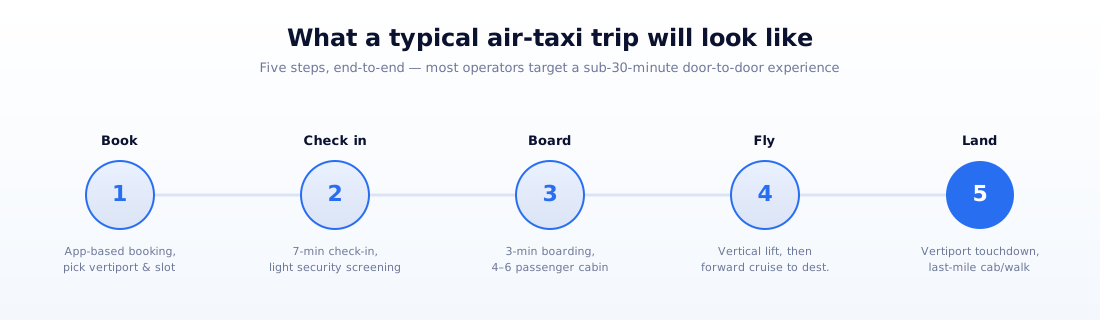
Operators are designing for a sub-30 minute door-to-door experience. The aircraft itself is just one part — the booking, vertiport check-in, and last-mile cab matter equally.
How does it compare with car and metro on real Indian routes?
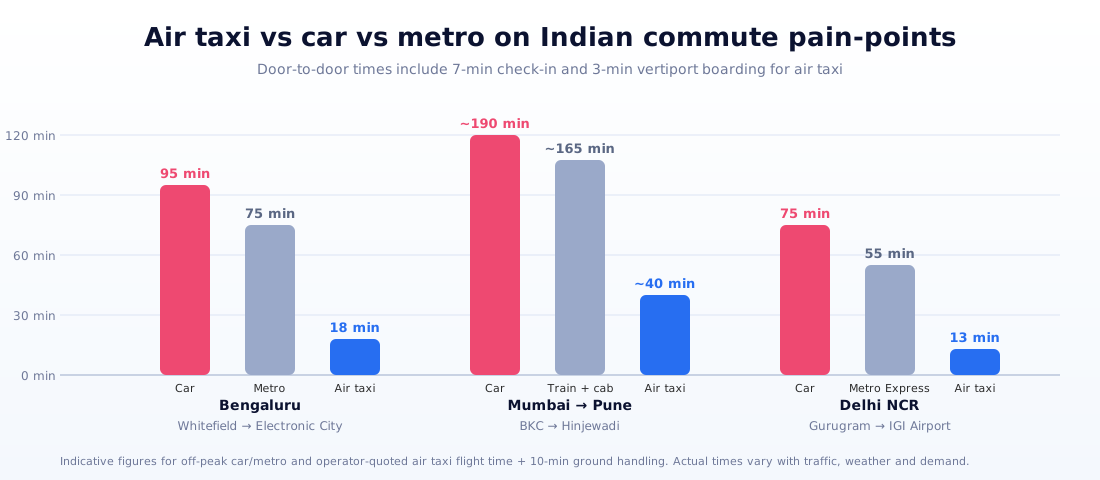
The headline benefit of UAM is time saved. On the most painful Indian commutes, the time-savings are not incremental — they're transformational. The chart below benchmarks an air taxi against the same trip by car and by metro, including all ground handling at the vertiport.
Even after factoring a 7-minute check-in and a 3-minute boarding step, an air taxi covers the Whitefield to Electronic City stretch in roughly 18 minutes — a fifth of the typical evening drive. On the BKC to Pune Hinjewadi corridor, the savings rise to over 2.5 hours each way for the right kind of high-value commuter.
Benefits of air taxis for India
Time recovery on congested routes. Indian metros lose an estimated 1.5 hours per worker per day to traffic. UAM could reclaim a meaningful chunk of that on key corridors.
Zero direct emissions. Battery-electric eVTOLs eliminate tailpipe CO₂ and particulate output — a sharp contrast with diesel feeder buses or older taxi fleets.
Drastically reduced noise vs helicopters. Distributed electric propulsion delivers ~65 dB at 100 m for new eVTOLs, compared with 85+ dB for legacy helicopters — quiet enough to fly closer to residential blocks.
Airport & tier-2 connectivity. Vertiports at airport perimeters open up door-to-airport options, which are a leading use case for UAM in India.
Tourism & medical evacuation. Tier-2 routes — Goa coastal hops, Char Dham heli-taxi alternatives, Kashmir tourism — and emergency medical evacuation become economically viable.
The challenges India still has to clear
None of this is automatic. Five hard problems still sit on the road from announcement to revenue.
Vertiport infrastructure. Each metro needs 8–15 well-located vertiports for a usable network. Land cost, rooftop engineering and last-mile design are open questions in dense Indian cities.
Type certification. The DGCA is still finalising eVTOL airworthiness rules. Operators will likely accept a foreign type certificate (FAA / EASA) as a starting point and add India-specific operating limits.
Pilot supply. A new licensing category — covering aircraft that can hover but operate under fixed-wing rules — is being drafted.
Battery and weather. Indian summers, monsoon turbulence and dust are tougher on batteries and rotors than the European environments most aircraft are tested in.
Public acceptance. Noise above residential areas, perceived safety and ticket pricing will all shape adoption. Early routes are likely to be airport-shuttle pricing of ₹2,500–4,000 per seat, falling as fleets scale.
The DGCA framework — where regulation stands
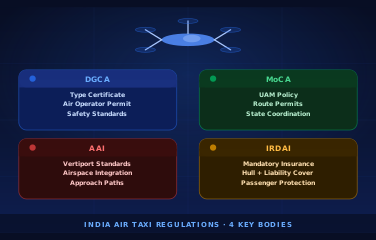
India's regulatory architecture for air taxis is being assembled in parallel with the aircraft. For the full operator-ready breakdown — from DGCA Type Certificate to IRDAI insurance mandates — see India's Air Taxi Regulations: What Operators and Passengers Need to Know. Current direction:
The Ministry of Civil Aviation has signalled a dedicated eVTOL operating framework distinct from helicopter rules.
Draft vertiport design guidelines are circulating with AAI, covering approach paths, charging infrastructure, fire-fighting, and security screening.
A new remote-pilot category is anticipated for aircraft that operate with reduced crew or, eventually, autonomous modes — building on the lessons of the Drone Rules 2021 and Drone Acknowledgement Number (DAN) system.
Mandatory third-party liability insurance already exists for drones; the same principle is widely expected to apply to air taxis from day one of commercial operations.
Air Taxi & eVTOL Insurance, built for Indian operators
Hull, third-party liability, passenger and ground-risk cover from IRDAI-approved partners — all under one specialist aviation desk.
Why insurance is the foundation, not an afterthought
Air taxis blur the line between aviation, ride-share and public transport — and so does their risk profile. A single eVTOL might cost ₹30–60 crore, fly over densely populated areas, carry up to six paying passengers, and operate from rooftop vertiports built into commercial real estate. Each of these layers needs a different policy:
Hull insurance covering the aircraft itself, including battery packs and avionics — the highest-value component on day one.
Third-party liability cover for damage or injury to people and property on the ground, which Indian regulators are widely expected to mandate.
Passenger liability per seat, aligned with the ICAO / Montreal Convention principles.
Ground-risk cover for the vertiport itself, ground handling teams and charging infrastructure.
Pilot & crew personal accident cover, especially as a transition workforce moves between rotary, fixed-wing and eVTOL operations.
TropoGo's specialist insurance desk works with IRDAI-approved partners to structure all five into a single, India-specific policy stack. If you're an operator, fleet financier, vertiport developer or charter buyer planning your first eVTOL fleet, the Air Taxi & eVTOL Insurance India page is the right place to start.
Where this is headed by 2030
If certification timelines hold, India should see limited revenue air-taxi operations on three to five corridors by late 2027, scaling to roughly 50 vertiports and a 200+ aircraft fleet by 2030. The bigger story isn't the aircraft itself — it's the network it enables. Hospitals connected to airports. Tier-2 cities connected to metros without four-hour drives. Workers reclaiming an hour a day. That is what a working urban air mobility system looks like, and India is now actively building one.
FAQs about air taxis in India
When will air taxi services actually start in India?
Operators are targeting limited revenue services on selected Bengaluru, Mumbai and Delhi NCR routes between late 2027 and 2028, subject to DGCA type certification and vertiport readiness. Some helicopter-based pre-cursors (like FlyBlade's Mumbai-Pune service) are already running today.
Is an air taxi the same as a helicopter?
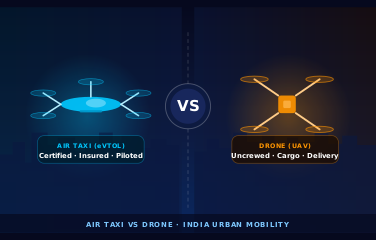
No. Air taxis are typically eVTOL aircraft — battery-powered, with multiple distributed electric motors and rotors. They are quieter, cheaper to operate, and emit nothing locally. Helicopters use turbine engines and a single main rotor.
How much will an air taxi ride cost in India?
Operators have signalled introductory pricing of roughly ₹2,500–4,000 per seat on premium short routes (e.g. airport shuttles), falling toward premium ride-share levels as fleets scale, vertiports densify and battery costs drop.
Are air taxis safe?
eVTOLs are designed with multiple redundant rotors, batteries and flight computers; failure of any single rotor or motor still allows controlled flight. They must clear DGCA type certification, equivalent in rigour to commercial aircraft. Insurance frameworks layer additional protection for passengers and third parties.
Will air taxis be autonomous?
Initial Indian operations will use a piloted model — one or two qualified pilots in the cockpit. Some long-term roadmaps envisage remotely-supervised or fully autonomous operations, but those will require new licensing categories and significant regulatory groundwork.
What insurance does an air taxi operator need in India?
An operator typically needs hull cover for the aircraft, third-party liability (likely mandatory), passenger liability per seat, ground-risk cover at the vertiport and crew personal accident. TropoGo's Air Taxi & eVTOL Insurance consolidates these into an India-specific stack.
If you operate, finance, lease or insure aircraft, get in touch with TropoGo's specialist aviation desk. We've placed insurance for India's earliest drone, BVLOS and special-mission operators — and we're building the same playbook for air taxis.